| Record Information |
|---|
| Version | 5.0 |
|---|
| Status | Detected and Quantified |
|---|
| Creation Date | 2007-04-12 19:07:12 UTC |
|---|
| Update Date | 2023-02-21 17:17:11 UTC |
|---|
| HMDB ID | HMDB0005973 |
|---|
| Secondary Accession Numbers | |
|---|
| Metabolite Identification |
|---|
| Common Name | Dimethyltryptamine |
|---|
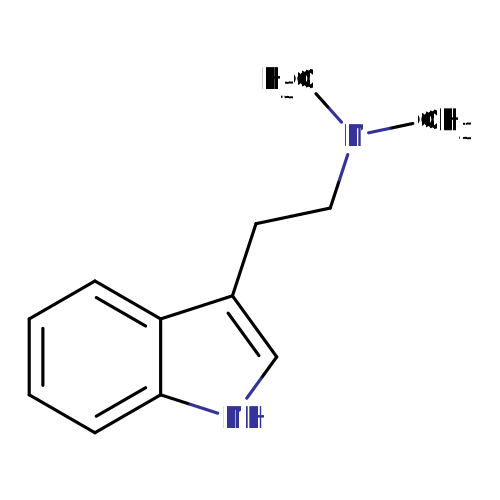
| Description | Dimethyltryptamine is an N-methylated indoleamine derivative, a serotonergic hallucinogen found in several plants, especially Prestonia amazonica (Apocynaceae) and in mammalian brain, blood, and urine. It apparently acts as an agonist at some types of serotonin receptors and an antagonist at others. DMT is a derivative of tryptamine with two additional methyl groups at the amine nitrogen atom. DMT is often synthesized by the Speeter-Anthony synthesis from indole using oxalyl chloride, dimethylamine, and lithium aluminium hydride as reagents. DMT is usually used in its base form, but it is more stable as a salt, e.g. as a fumarate. In contrast to DMT's base, its salts are water-soluble. DMT in solution degrades relatively fast and should be stored protected from air and light in a freezer. Highly pure DMT crystals, when evaporated out of a solvent and depositing upon glass, often produce small but highly defined white crystalline needles which when viewed under intense light will sparkle, and appear colorless under high magnification. In labs, it has been known to be explosive under a certain degree of heat. DMT is a powerful psychoactive substance. If DMT is smoked, injected, or orally ingested with an MAOI, it can produce powerful entheogenic experiences including intense visual hallucinations, euphoria, even true hallucinations (perceived extensions of reality). A trip sitter is recommended to assist the drug user in staying physically and mentally healthy, and, in the case of smoked DMT, to catch the pipe if the user loses awareness of it. DMT is classified in the United States as a Schedule I drug. There are no drug tests that would show DMT usage. None of the basic NIDA 5 drug tests or any extended drug test will show a result for DMT. Dimethyltryptamine (DMT), also known as N,N-dimethyltryptamine, is a psychedelic tryptamine. It is not to be confused with 5-MeO-DMT and is similar in chemical structure to the neurotransmitter serotonin. DMT is created in small amounts by the human body during normal metabolism by the enzyme tryptamine-N-methyltransferase. Pure DMT at room temperature is a clear or white crystalline solid. DMT was first chemically synthesized in 1931. It also occurs naturally in many species of plants. DMT-containing plants are used in several South American shamanic practices. It is one of the main active constituents of snuffs like yopo and of the drink ayahuasca. Oral ingestion: DMT, which is broken down by the digestive enzyme monoamine oxidase, is practically inactive if taken orally, unless combined with a monoamine oxidase inhibitor (MAOI). The traditional South American ayahuasca, or yage, is a tea mixture containing DMT and a MAOI. There are a number of admixtures to this brew, but most commonly it is simply the leaves of Psychotria viridis (containing DMT), and the vine Banisteriopsis caapi (the source of MAOI). Other DMT containing plants, including Diplopterys cabrerana, are sometimes used in ayahuasca in different areas of South America. Two common sources in the western US are Reed canary grass (Phalaris arundinacea) and Harding grass (Phalaris aquatica). These invasive grasses contain low levels of DMT and other alkaloids. Taken orally with an appropriate MAOI, DMT produces a long lasting (over 3 hour), slow, but deep spiritual experience. MAOIs should be used with extreme caution as they can have lethal complications with some prescription drugs, such as SSRI antidepressants, and some over-the-counter drugs. Smoked: If DMT is smoked, the maximal effects last for a short period of time (5-30 minutes dose dependent). The onset after inhalation is very fast (less than 45 seconds) and maximal effects are reached within about a minute. The Business Man's lunch trip is a common name due to the relatively short duration of vaporized, insufflated, or injected DMT. |
|---|
| Structure | InChI=1S/C12H16N2/c1-14(2)8-7-10-9-13-12-6-4-3-5-11(10)12/h3-6,9,13H,7-8H2,1-2H3 |
|---|
| Synonyms | | Value | Source |
|---|
| 2-(3-Indolyl)ethyldimethylamine | ChEBI | | 3-(2-Dimethylaminoethyl)indole | ChEBI | | 3-[2-(Dimethylamino)ethyl]indole | ChEBI | | DMT | ChEBI | | N,N-Dimethyl-1H-indole-3-ethylamine | ChEBI | | N,N Dimethyltryptamine | MeSH | | (2-indol-3-Ylethyl)dimethylamine | HMDB | | (Psychogenic) | HMDB | | 2-(1H-indol-3-yl)-N,N-Dimethylethanamine | HMDB | | 2-(1H-indol-3-yl)-N,N-Dimethylethanamine (acd/name 4.0) | HMDB | | 3-(2-(dimethylamino)Ethyl)-indole | HMDB | | 3-[2- (dimethylamino)Ethyl]-indole | HMDB | | Dimethyltryptamine(DMT) | HMDB | | Indolalkylamine der | HMDB | | N,N-Dimethyl-1H-indole-3-ethanamine | HMDB | | N,N-Dimethyl-1H-indole-3-ethanamine (9ci) | HMDB | | N,N-Dimethyltryptamine | HMDB | | N-(2-(1H-indol-3-yl)Ethyl)-N,N-dimethylamine (acd/name 4.0) | HMDB | | Dimethyltryptamine | MeSH |
|
|---|
| Chemical Formula | C12H16N2 |
|---|
| Average Molecular Weight | 188.2688 |
|---|
| Monoisotopic Molecular Weight | 188.131348522 |
|---|
| IUPAC Name | [2-(1H-indol-3-yl)ethyl]dimethylamine |
|---|
| Traditional Name | (psychogenic) |
|---|
| CAS Registry Number | 61-50-7 |
|---|
| SMILES | CN(C)CCC1=CNC2=CC=CC=C12 |
|---|
| InChI Identifier | InChI=1S/C12H16N2/c1-14(2)8-7-10-9-13-12-6-4-3-5-11(10)12/h3-6,9,13H,7-8H2,1-2H3 |
|---|
| InChI Key | DMULVCHRPCFFGV-UHFFFAOYSA-N |
|---|
| Chemical Taxonomy |
|---|
| Description | Belongs to the class of organic compounds known as tryptamines and derivatives. Tryptamines and derivatives are compounds containing the tryptamine backbone, which is structurally characterized by an indole ring substituted at the 3-position by an ethanamine. |
|---|
| Kingdom | Organic compounds |
|---|
| Super Class | Organoheterocyclic compounds |
|---|
| Class | Indoles and derivatives |
|---|
| Sub Class | Tryptamines and derivatives |
|---|
| Direct Parent | Tryptamines and derivatives |
|---|
| Alternative Parents | |
|---|
| Substituents | - Tryptamine
- 3-alkylindole
- Indole
- Aralkylamine
- Substituted pyrrole
- Benzenoid
- Pyrrole
- Heteroaromatic compound
- Tertiary aliphatic amine
- Tertiary amine
- Azacycle
- Hydrocarbon derivative
- Organopnictogen compound
- Amine
- Organonitrogen compound
- Organic nitrogen compound
- Aromatic heteropolycyclic compound
|
|---|
| Molecular Framework | Aromatic heteropolycyclic compounds |
|---|
| External Descriptors | |
|---|
| Ontology |
|---|
| Not Available | Not Available |
|---|
| Physical Properties |
|---|
| State | Solid |
|---|
| Experimental Molecular Properties | | Property | Value | Reference |
|---|
| Melting Point | 46 °C | Not Available | | Boiling Point | Not Available | Not Available | | Water Solubility | Not Available | Not Available | | LogP | Not Available | Not Available |
|
|---|
| Experimental Chromatographic Properties | Not Available |
|---|
| Predicted Molecular Properties | |
|---|
| Predicted Chromatographic Properties | Predicted Collision Cross SectionsPredicted Retention Times Underivatized| Chromatographic Method | Retention Time | Reference |
|---|
| Measured using a Waters Acquity ultraperformance liquid chromatography (UPLC) ethylene-bridged hybrid (BEH) C18 column (100 mm × 2.1 mm; 1.7 μmparticle diameter). Predicted by Afia on May 17, 2022. Predicted by Afia on May 17, 2022. | 3.73 minutes | 32390414 | | Predicted by Siyang on May 30, 2022 | 9.8269 minutes | 33406817 | | Predicted by Siyang using ReTip algorithm on June 8, 2022 | 3.15 minutes | 32390414 | | AjsUoB = Accucore 150 Amide HILIC with 10mM Ammonium Formate, 0.1% Formic Acid | 76.4 seconds | 40023050 | | Fem_Long = Waters ACQUITY UPLC HSS T3 C18 with Water:MeOH and 0.1% Formic Acid | 708.9 seconds | 40023050 | | Fem_Lipids = Ascentis Express C18 with (60:40 water:ACN):(90:10 IPA:ACN) and 10mM NH4COOH + 0.1% Formic Acid | 291.0 seconds | 40023050 | | Life_Old = Waters ACQUITY UPLC BEH C18 with Water:(20:80 acetone:ACN) and 0.1% Formic Acid | 120.7 seconds | 40023050 | | Life_New = RP Waters ACQUITY UPLC HSS T3 C18 with Water:(30:70 MeOH:ACN) and 0.1% Formic Acid | 175.1 seconds | 40023050 | | RIKEN = Waters ACQUITY UPLC BEH C18 with Water:ACN and 0.1% Formic Acid | 105.8 seconds | 40023050 | | Eawag_XBridgeC18 = XBridge C18 3.5u 2.1x50 mm with Water:MeOH and 0.1% Formic Acid | 291.9 seconds | 40023050 | | BfG_NTS_RP1 =Agilent Zorbax Eclipse Plus C18 (2.1 mm x 150 mm, 3.5 um) with Water:ACN and 0.1% Formic Acid | 295.2 seconds | 40023050 | | HILIC_BDD_2 = Merck SeQuant ZIC-HILIC with ACN(0.1% formic acid):water(16 mM ammonium formate) | 733.9 seconds | 40023050 | | UniToyama_Atlantis = RP Waters Atlantis T3 (2.1 x 150 mm, 5 um) with ACN:Water and 0.1% Formic Acid | 695.3 seconds | 40023050 | | BDD_C18 = Hypersil Gold 1.9µm C18 with Water:ACN and 0.1% Formic Acid | 166.7 seconds | 40023050 | | UFZ_Phenomenex = Kinetex Core-Shell C18 2.6 um, 3.0 x 100 mm, Phenomenex with Water:MeOH and 0.1% Formic Acid | 1010.0 seconds | 40023050 | | SNU_RIKEN_POS = Waters ACQUITY UPLC BEH C18 with Water:ACN and 0.1% Formic Acid | 204.1 seconds | 40023050 | | RPMMFDA = Waters ACQUITY UPLC BEH C18 with Water:ACN and 0.1% Formic Acid | 260.1 seconds | 40023050 | | MTBLS87 = Merck SeQuant ZIC-pHILIC column with ACN:Water and :ammonium carbonate | 635.0 seconds | 40023050 | | KI_GIAR_zic_HILIC_pH2_7 = Merck SeQuant ZIC-HILIC with ACN:Water and 0.1% FA | 419.1 seconds | 40023050 | | Meister zic-pHILIC pH9.3 = Merck SeQuant ZIC-pHILIC column with ACN:Water 5mM NH4Ac pH9.3 and 5mM ammonium acetate in water | 46.0 seconds | 40023050 |
Predicted Kovats Retention IndicesUnderivatizedDerivatized| Derivative Name / Structure | SMILES | Kovats RI Value | Column Type | Reference |
|---|
| Dimethyltryptamine,1TMS,isomer #1 | CN(C)CCC1=CN([Si](C)(C)C)C2=CC=CC=C12 | 1838.1 | Semi standard non polar | 33892256 | | Dimethyltryptamine,1TMS,isomer #1 | CN(C)CCC1=CN([Si](C)(C)C)C2=CC=CC=C12 | 1840.7 | Standard non polar | 33892256 | | Dimethyltryptamine,1TMS,isomer #1 | CN(C)CCC1=CN([Si](C)(C)C)C2=CC=CC=C12 | 2057.9 | Standard polar | 33892256 | | Dimethyltryptamine,1TBDMS,isomer #1 | CN(C)CCC1=CN([Si](C)(C)C(C)(C)C)C2=CC=CC=C12 | 2057.7 | Semi standard non polar | 33892256 | | Dimethyltryptamine,1TBDMS,isomer #1 | CN(C)CCC1=CN([Si](C)(C)C(C)(C)C)C2=CC=CC=C12 | 2052.4 | Standard non polar | 33892256 | | Dimethyltryptamine,1TBDMS,isomer #1 | CN(C)CCC1=CN([Si](C)(C)C(C)(C)C)C2=CC=CC=C12 | 2193.0 | Standard polar | 33892256 |
|
|---|