| Record Information |
|---|
| Version | 5.0 |
|---|
| Status | Detected and Quantified |
|---|
| Creation Date | 2008-10-29 15:23:07 UTC |
|---|
| Update Date | 2023-02-21 17:17:28 UTC |
|---|
| HMDB ID | HMDB0011178 |
|---|
| Secondary Accession Numbers | |
|---|
| Metabolite Identification |
|---|
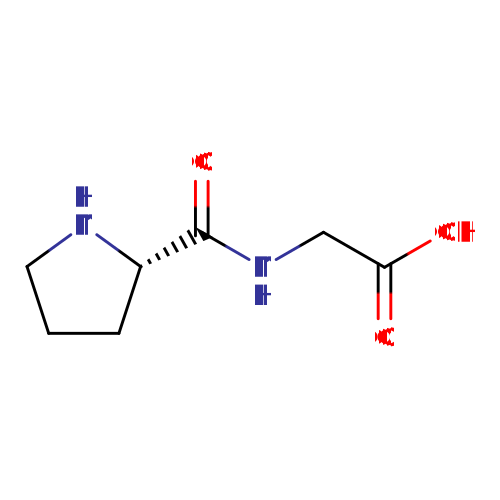
| Common Name | Prolylglycine |
|---|
| Description | Prolylglycine is a dipeptide composed of proline and glycine. It is an incomplete breakdown product of protein digestion or protein catabolism. Some dipeptides are known to have physiological or cell-signaling effects although most are simply short-lived intermediates on their way to specific amino acid degradation pathways following further proteolysis. It is found in urine (PMID: 3782411 ). |
|---|
| Structure | OC(=O)CNC(=O)[C@@H]1CCCN1 InChI=1S/C7H12N2O3/c10-6(11)4-9-7(12)5-2-1-3-8-5/h5,8H,1-4H2,(H,9,12)(H,10,11)/t5-/m0/s1 |
|---|
| Synonyms | | Value | Source |
|---|
| L-Pro-gly | ChEBI | | L-Prolinylglycine | ChEBI | | P-G | ChEBI | | PG | ChEBI | | Pro-gly | ChEBI | | L-Prolylglycine | HMDB | | N-L-Prolylglycine | HMDB | | N-Prolylglycine | HMDB | | NSC 89175 | HMDB | | p-g Dipeptide | HMDB | | PG Dipeptide | HMDB | | Proline glycine dipeptide | HMDB | | Proline-glycine dipeptide | HMDB | | Prolyl-glycine | HMDB | | Prolylglycine | ChEBI |
|
|---|
| Chemical Formula | C7H12N2O3 |
|---|
| Average Molecular Weight | 172.1818 |
|---|
| Monoisotopic Molecular Weight | 172.08479226 |
|---|
| IUPAC Name | 2-{[(2S)-pyrrolidin-2-yl]formamido}acetic acid |
|---|
| Traditional Name | Pro-Gly |
|---|
| CAS Registry Number | 2578-57-6 |
|---|
| SMILES | OC(=O)CNC(=O)[C@@H]1CCCN1 |
|---|
| InChI Identifier | InChI=1S/C7H12N2O3/c10-6(11)4-9-7(12)5-2-1-3-8-5/h5,8H,1-4H2,(H,9,12)(H,10,11)/t5-/m0/s1 |
|---|
| InChI Key | RNKSNIBMTUYWSH-YFKPBYRVSA-N |
|---|
| Chemical Taxonomy |
|---|
| Description | Belongs to the class of organic compounds known as dipeptides. These are organic compounds containing a sequence of exactly two alpha-amino acids joined by a peptide bond. |
|---|
| Kingdom | Organic compounds |
|---|
| Super Class | Organic acids and derivatives |
|---|
| Class | Carboxylic acids and derivatives |
|---|
| Sub Class | Amino acids, peptides, and analogues |
|---|
| Direct Parent | Dipeptides |
|---|
| Alternative Parents | |
|---|
| Substituents | - Alpha-dipeptide
- Proline or derivatives
- N-acyl-alpha-amino acid
- N-acyl-alpha amino acid or derivatives
- Alpha-amino acid amide
- Alpha-amino acid or derivatives
- Pyrrolidine carboxylic acid or derivatives
- Pyrrolidine-2-carboxamide
- Pyrrolidine
- Amino acid or derivatives
- Carboxamide group
- Amino acid
- Secondary carboxylic acid amide
- Carboxylic acid
- Secondary aliphatic amine
- Monocarboxylic acid or derivatives
- Azacycle
- Organoheterocyclic compound
- Secondary amine
- Organic oxygen compound
- Organic nitrogen compound
- Organic oxide
- Hydrocarbon derivative
- Amine
- Organonitrogen compound
- Organooxygen compound
- Organopnictogen compound
- Carbonyl group
- Aliphatic heteromonocyclic compound
|
|---|
| Molecular Framework | Aliphatic heteromonocyclic compounds |
|---|
| External Descriptors | |
|---|
| Ontology |
|---|
| Physiological effect | Not Available |
|---|
| Disposition | |
|---|
| Process | Not Available |
|---|
| Role | Not Available |
|---|
| Physical Properties |
|---|
| State | Solid |
|---|
| Experimental Molecular Properties | | Property | Value | Reference |
|---|
| Melting Point | Not Available | Not Available | | Boiling Point | Not Available | Not Available | | Water Solubility | Not Available | Not Available | | LogP | Not Available | Not Available |
|
|---|
| Experimental Chromatographic Properties | Not Available |
|---|
| Predicted Molecular Properties | |
|---|
| Predicted Chromatographic Properties | Predicted Collision Cross Sections| Predictor | Adduct Type | CCS Value (Å2) | Reference |
|---|
| DeepCCS | [M+H]+ | 130.883 | 30932474 | | DeepCCS | [M-H]- | 128.445 | 30932474 | | DeepCCS | [M-2H]- | 164.086 | 30932474 | | DeepCCS | [M+Na]+ | 139.338 | 30932474 |
Predicted Retention Times Underivatized| Chromatographic Method | Retention Time | Reference |
|---|
| Measured using a Waters Acquity ultraperformance liquid chromatography (UPLC) ethylene-bridged hybrid (BEH) C18 column (100 mm × 2.1 mm; 1.7 μmparticle diameter). Predicted by Afia on May 17, 2022. Predicted by Afia on May 17, 2022. | 1.15 minutes | 32390414 | | Predicted by Siyang on May 30, 2022 | 8.4931 minutes | 33406817 | | Predicted by Siyang using ReTip algorithm on June 8, 2022 | 7.98 minutes | 32390414 | | AjsUoB = Accucore 150 Amide HILIC with 10mM Ammonium Formate, 0.1% Formic Acid | 303.5 seconds | 40023050 | | Fem_Long = Waters ACQUITY UPLC HSS T3 C18 with Water:MeOH and 0.1% Formic Acid | 514.3 seconds | 40023050 | | Fem_Lipids = Ascentis Express C18 with (60:40 water:ACN):(90:10 IPA:ACN) and 10mM NH4COOH + 0.1% Formic Acid | 258.2 seconds | 40023050 | | Life_Old = Waters ACQUITY UPLC BEH C18 with Water:(20:80 acetone:ACN) and 0.1% Formic Acid | 66.4 seconds | 40023050 | | Life_New = RP Waters ACQUITY UPLC HSS T3 C18 with Water:(30:70 MeOH:ACN) and 0.1% Formic Acid | 164.5 seconds | 40023050 | | RIKEN = Waters ACQUITY UPLC BEH C18 with Water:ACN and 0.1% Formic Acid | 50.0 seconds | 40023050 | | Eawag_XBridgeC18 = XBridge C18 3.5u 2.1x50 mm with Water:MeOH and 0.1% Formic Acid | 257.9 seconds | 40023050 | | BfG_NTS_RP1 =Agilent Zorbax Eclipse Plus C18 (2.1 mm x 150 mm, 3.5 um) with Water:ACN and 0.1% Formic Acid | 238.0 seconds | 40023050 | | HILIC_BDD_2 = Merck SeQuant ZIC-HILIC with ACN(0.1% formic acid):water(16 mM ammonium formate) | 734.1 seconds | 40023050 | | UniToyama_Atlantis = RP Waters Atlantis T3 (2.1 x 150 mm, 5 um) with ACN:Water and 0.1% Formic Acid | 550.3 seconds | 40023050 | | BDD_C18 = Hypersil Gold 1.9µm C18 with Water:ACN and 0.1% Formic Acid | 59.1 seconds | 40023050 | | UFZ_Phenomenex = Kinetex Core-Shell C18 2.6 um, 3.0 x 100 mm, Phenomenex with Water:MeOH and 0.1% Formic Acid | 726.4 seconds | 40023050 | | SNU_RIKEN_POS = Waters ACQUITY UPLC BEH C18 with Water:ACN and 0.1% Formic Acid | 177.8 seconds | 40023050 | | RPMMFDA = Waters ACQUITY UPLC BEH C18 with Water:ACN and 0.1% Formic Acid | 189.7 seconds | 40023050 | | MTBLS87 = Merck SeQuant ZIC-pHILIC column with ACN:Water and :ammonium carbonate | 691.1 seconds | 40023050 | | KI_GIAR_zic_HILIC_pH2_7 = Merck SeQuant ZIC-HILIC with ACN:Water and 0.1% FA | 439.0 seconds | 40023050 | | Meister zic-pHILIC pH9.3 = Merck SeQuant ZIC-pHILIC column with ACN:Water 5mM NH4Ac pH9.3 and 5mM ammonium acetate in water | 265.9 seconds | 40023050 |
Predicted Kovats Retention IndicesUnderivatizedDerivatized| Derivative Name / Structure | SMILES | Kovats RI Value | Column Type | Reference |
|---|
| Prolylglycine,1TMS,isomer #1 | C[Si](C)(C)OC(=O)CNC(=O)[C@@H]1CCCN1 | 1797.3 | Semi standard non polar | 33892256 | | Prolylglycine,1TMS,isomer #2 | C[Si](C)(C)N(CC(=O)O)C(=O)[C@@H]1CCCN1 | 1774.7 | Semi standard non polar | 33892256 | | Prolylglycine,1TMS,isomer #3 | C[Si](C)(C)N1CCC[C@H]1C(=O)NCC(=O)O | 1826.0 | Semi standard non polar | 33892256 | | Prolylglycine,2TMS,isomer #1 | C[Si](C)(C)OC(=O)CN(C(=O)[C@@H]1CCCN1)[Si](C)(C)C | 1752.7 | Semi standard non polar | 33892256 | | Prolylglycine,2TMS,isomer #1 | C[Si](C)(C)OC(=O)CN(C(=O)[C@@H]1CCCN1)[Si](C)(C)C | 1785.9 | Standard non polar | 33892256 | | Prolylglycine,2TMS,isomer #1 | C[Si](C)(C)OC(=O)CN(C(=O)[C@@H]1CCCN1)[Si](C)(C)C | 2574.8 | Standard polar | 33892256 | | Prolylglycine,2TMS,isomer #2 | C[Si](C)(C)OC(=O)CNC(=O)[C@@H]1CCCN1[Si](C)(C)C | 1795.5 | Semi standard non polar | 33892256 | | Prolylglycine,2TMS,isomer #2 | C[Si](C)(C)OC(=O)CNC(=O)[C@@H]1CCCN1[Si](C)(C)C | 1817.0 | Standard non polar | 33892256 | | Prolylglycine,2TMS,isomer #2 | C[Si](C)(C)OC(=O)CNC(=O)[C@@H]1CCCN1[Si](C)(C)C | 2468.9 | Standard polar | 33892256 | | Prolylglycine,2TMS,isomer #3 | C[Si](C)(C)N(CC(=O)O)C(=O)[C@@H]1CCCN1[Si](C)(C)C | 1737.5 | Semi standard non polar | 33892256 | | Prolylglycine,2TMS,isomer #3 | C[Si](C)(C)N(CC(=O)O)C(=O)[C@@H]1CCCN1[Si](C)(C)C | 1825.8 | Standard non polar | 33892256 | | Prolylglycine,2TMS,isomer #3 | C[Si](C)(C)N(CC(=O)O)C(=O)[C@@H]1CCCN1[Si](C)(C)C | 2315.9 | Standard polar | 33892256 | | Prolylglycine,3TMS,isomer #1 | C[Si](C)(C)OC(=O)CN(C(=O)[C@@H]1CCCN1[Si](C)(C)C)[Si](C)(C)C | 1792.6 | Semi standard non polar | 33892256 | | Prolylglycine,3TMS,isomer #1 | C[Si](C)(C)OC(=O)CN(C(=O)[C@@H]1CCCN1[Si](C)(C)C)[Si](C)(C)C | 1889.2 | Standard non polar | 33892256 | | Prolylglycine,3TMS,isomer #1 | C[Si](C)(C)OC(=O)CN(C(=O)[C@@H]1CCCN1[Si](C)(C)C)[Si](C)(C)C | 2145.6 | Standard polar | 33892256 | | Prolylglycine,1TBDMS,isomer #1 | CC(C)(C)[Si](C)(C)OC(=O)CNC(=O)[C@@H]1CCCN1 | 2045.6 | Semi standard non polar | 33892256 | | Prolylglycine,1TBDMS,isomer #2 | CC(C)(C)[Si](C)(C)N(CC(=O)O)C(=O)[C@@H]1CCCN1 | 2018.2 | Semi standard non polar | 33892256 | | Prolylglycine,1TBDMS,isomer #3 | CC(C)(C)[Si](C)(C)N1CCC[C@H]1C(=O)NCC(=O)O | 2078.1 | Semi standard non polar | 33892256 | | Prolylglycine,2TBDMS,isomer #1 | CC(C)(C)[Si](C)(C)OC(=O)CN(C(=O)[C@@H]1CCCN1)[Si](C)(C)C(C)(C)C | 2227.7 | Semi standard non polar | 33892256 | | Prolylglycine,2TBDMS,isomer #1 | CC(C)(C)[Si](C)(C)OC(=O)CN(C(=O)[C@@H]1CCCN1)[Si](C)(C)C(C)(C)C | 2205.9 | Standard non polar | 33892256 | | Prolylglycine,2TBDMS,isomer #1 | CC(C)(C)[Si](C)(C)OC(=O)CN(C(=O)[C@@H]1CCCN1)[Si](C)(C)C(C)(C)C | 2609.8 | Standard polar | 33892256 | | Prolylglycine,2TBDMS,isomer #2 | CC(C)(C)[Si](C)(C)OC(=O)CNC(=O)[C@@H]1CCCN1[Si](C)(C)C(C)(C)C | 2292.2 | Semi standard non polar | 33892256 | | Prolylglycine,2TBDMS,isomer #2 | CC(C)(C)[Si](C)(C)OC(=O)CNC(=O)[C@@H]1CCCN1[Si](C)(C)C(C)(C)C | 2225.0 | Standard non polar | 33892256 | | Prolylglycine,2TBDMS,isomer #2 | CC(C)(C)[Si](C)(C)OC(=O)CNC(=O)[C@@H]1CCCN1[Si](C)(C)C(C)(C)C | 2575.8 | Standard polar | 33892256 | | Prolylglycine,2TBDMS,isomer #3 | CC(C)(C)[Si](C)(C)N(CC(=O)O)C(=O)[C@@H]1CCCN1[Si](C)(C)C(C)(C)C | 2247.9 | Semi standard non polar | 33892256 | | Prolylglycine,2TBDMS,isomer #3 | CC(C)(C)[Si](C)(C)N(CC(=O)O)C(=O)[C@@H]1CCCN1[Si](C)(C)C(C)(C)C | 2233.0 | Standard non polar | 33892256 | | Prolylglycine,2TBDMS,isomer #3 | CC(C)(C)[Si](C)(C)N(CC(=O)O)C(=O)[C@@H]1CCCN1[Si](C)(C)C(C)(C)C | 2509.8 | Standard polar | 33892256 | | Prolylglycine,3TBDMS,isomer #1 | CC(C)(C)[Si](C)(C)OC(=O)CN(C(=O)[C@@H]1CCCN1[Si](C)(C)C(C)(C)C)[Si](C)(C)C(C)(C)C | 2481.7 | Semi standard non polar | 33892256 | | Prolylglycine,3TBDMS,isomer #1 | CC(C)(C)[Si](C)(C)OC(=O)CN(C(=O)[C@@H]1CCCN1[Si](C)(C)C(C)(C)C)[Si](C)(C)C(C)(C)C | 2476.8 | Standard non polar | 33892256 | | Prolylglycine,3TBDMS,isomer #1 | CC(C)(C)[Si](C)(C)OC(=O)CN(C(=O)[C@@H]1CCCN1[Si](C)(C)C(C)(C)C)[Si](C)(C)C(C)(C)C | 2492.9 | Standard polar | 33892256 |
|
|---|
| Disease References | | Colorectal cancer |
|---|
- Goedert JJ, Sampson JN, Moore SC, Xiao Q, Xiong X, Hayes RB, Ahn J, Shi J, Sinha R: Fecal metabolomics: assay performance and association with colorectal cancer. Carcinogenesis. 2014 Sep;35(9):2089-96. doi: 10.1093/carcin/bgu131. Epub 2014 Jul 18. [PubMed:25037050 ]
| | Attachment loss |
|---|
- Liebsch C, Pitchika V, Pink C, Samietz S, Kastenmuller G, Artati A, Suhre K, Adamski J, Nauck M, Volzke H, Friedrich N, Kocher T, Holtfreter B, Pietzner M: The Saliva Metabolome in Association to Oral Health Status. J Dent Res. 2019 Jun;98(6):642-651. doi: 10.1177/0022034519842853. Epub 2019 Apr 26. [PubMed:31026179 ]
| | Missing teeth |
|---|
- Liebsch C, Pitchika V, Pink C, Samietz S, Kastenmuller G, Artati A, Suhre K, Adamski J, Nauck M, Volzke H, Friedrich N, Kocher T, Holtfreter B, Pietzner M: The Saliva Metabolome in Association to Oral Health Status. J Dent Res. 2019 Jun;98(6):642-651. doi: 10.1177/0022034519842853. Epub 2019 Apr 26. [PubMed:31026179 ]
| | Periodontal Probing Depth |
|---|
- Liebsch C, Pitchika V, Pink C, Samietz S, Kastenmuller G, Artati A, Suhre K, Adamski J, Nauck M, Volzke H, Friedrich N, Kocher T, Holtfreter B, Pietzner M: The Saliva Metabolome in Association to Oral Health Status. J Dent Res. 2019 Jun;98(6):642-651. doi: 10.1177/0022034519842853. Epub 2019 Apr 26. [PubMed:31026179 ]
|
|
|---|