| Record Information |
|---|
| Version | 5.0 |
|---|
| Status | Expected but not Quantified |
|---|
| Creation Date | 2009-07-25 00:02:55 UTC |
|---|
| Update Date | 2022-03-07 02:51:26 UTC |
|---|
| HMDB ID | HMDB0012559 |
|---|
| Secondary Accession Numbers | |
|---|
| Metabolite Identification |
|---|
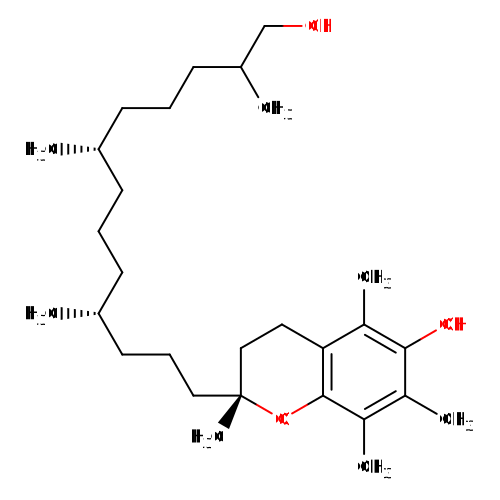
| Common Name | 13'-Hydroxy-alpha-tocopherol |
|---|
| Description | 13'-hydroxy-alpha-tocopherol is the precursor in dehydrogenation to 13'-carboxy-alpha-tocopherol by an unidentified microsomal enzyme(s) probably via an aldehyde intermediate. The tocopherols ( a-tocopherol , b-tocopherol ,r-tocopherol and d-tocopherol ) and their corresponding tocotrienols are synthesized by plants and have vitamin E antixoidant activity (see pathway vitamin E biosynthesis ). They differ in the number and location of methyl groups on the chromanol ring. The naturally occurring form of a-tocopherol is (2R,4'R,8'R)-a-tocopherol (synonym (R,R,R)-a-tocopherol). Synthetic a-tocopherols are a racemic mixture of eight different R and S stereoisomers. Only the 2R forms are recognized as meeting human requirements. The in vivo function of vitamin E is to scavenge peroxyl radicals via its phenolic (chromanol) hydroxyl group, thus protecting lipids against free radical-catalyzed peroxidation. The tocopheryl radical formed can then be reduced by reductants such as L-ascorbate. Other major products of a-tocopherol oxidation include α-tocopherylquinone and epoxy-a-tocopherols. The metabolites a-tocopheronic acid and its lactone, known as the Simon metabolites, are generally believed to be artefacts. In addition to these oxidation products, the other major class of tocopherol metabolites is the carboxyethyl-hydroxychromans.These metabolites are produced in significant amounts in response to excess vitamin E ingestion. Vitamin E is fat-soluble and its utilization requires intestinal fat absorption mechanisms. It is secreted from the intestine into the lymphatic system in chylomicrons which subsequently enter the plasma. Lipolysis of these chylomicrons can result in delivery of vitamin E to tissues, transfer to high-density lipoproteins (and subsequently to other lipoproteins via the phospholipid exchange protein), or retention in chylomicron remnants. These remnants are taken up by the liver. Natural (R,R,R)-α-tocopherol and synthetic 2R-α-tocopherols are then preferentially secreted from the liver into plasma as a result of the specificity of the α-tocopherol transfer protein. This protein, along with the metabolism of excess vitamin E in the liver and excretion into urine and bile, mediate the supply of a-tocopherol in plasma and tissues. |
|---|
| Structure | CC(CO)CCC[C@@H](C)CCC[C@@H](C)CCC[C@]1(C)CCC2=C(O1)C(C)=C(C)C(O)=C2C InChI=1S/C29H50O3/c1-20(13-9-14-22(3)19-30)11-8-12-21(2)15-10-17-29(7)18-16-26-25(6)27(31)23(4)24(5)28(26)32-29/h20-22,30-31H,8-19H2,1-7H3/t20-,21+,22?,29+/m0/s1 |
|---|
| Synonyms | | Value | Source |
|---|
| 13-OH-alpha-Tocopherol | ChEBI | | 13-OH-a-Tocopherol | Generator | | 13-OH-Α-tocopherol | Generator | | 13'-Hydroxy-a-tocopherol | Generator | | 13'-Hydroxy-α-tocopherol | Generator | | 13-Hydroxy-a-tocopherol | HMDB | | 13-Hydroxy-α-tocopherol | HMDB | | 13'-Hydroxy-alpha-tocopherol | ChEBI |
|
|---|
| Chemical Formula | C29H50O3 |
|---|
| Average Molecular Weight | 446.7055 |
|---|
| Monoisotopic Molecular Weight | 446.375995466 |
|---|
| IUPAC Name | (2R)-2-[(4R,8S)-13-hydroxy-4,8,12-trimethyltridecyl]-2,5,7,8-tetramethyl-3,4-dihydro-2H-1-benzopyran-6-ol |
|---|
| Traditional Name | (2R)-2-[(4R,8S)-13-hydroxy-4,8,12-trimethyltridecyl]-2,5,7,8-tetramethyl-3,4-dihydro-1-benzopyran-6-ol |
|---|
| CAS Registry Number | Not Available |
|---|
| SMILES | CC(CO)CCC[C@@H](C)CCC[C@@H](C)CCC[C@]1(C)CCC2=C(O1)C(C)=C(C)C(O)=C2C |
|---|
| InChI Identifier | InChI=1S/C29H50O3/c1-20(13-9-14-22(3)19-30)11-8-12-21(2)15-10-17-29(7)18-16-26-25(6)27(31)23(4)24(5)28(26)32-29/h20-22,30-31H,8-19H2,1-7H3/t20-,21+,22?,29+/m0/s1 |
|---|
| InChI Key | URYLCCKXLNXSRS-XIRVVSDESA-N |
|---|
| Chemical Taxonomy |
|---|
| Description | Belongs to the class of organic compounds known as tocopherols. These are vitamin E derivatives containing a saturated trimethyltridecyl chain attached to the carbon C6 atom of a benzopyran ring system. The differ from tocotrienols that contain an unsaturated trimethyltrideca-3,7,11-trien-1-yl chain. |
|---|
| Kingdom | Organic compounds |
|---|
| Super Class | Lipids and lipid-like molecules |
|---|
| Class | Prenol lipids |
|---|
| Sub Class | Quinone and hydroquinone lipids |
|---|
| Direct Parent | Tocopherols |
|---|
| Alternative Parents | |
|---|
| Substituents | - Tocopherol
- Diterpenoid
- Long chain fatty alcohol
- Chromane
- Benzopyran
- 1-benzopyran
- Fatty alcohol
- Alkyl aryl ether
- Fatty acyl
- Benzenoid
- Organoheterocyclic compound
- Ether
- Oxacycle
- Organic oxygen compound
- Alcohol
- Hydrocarbon derivative
- Organooxygen compound
- Primary alcohol
- Aromatic heteropolycyclic compound
|
|---|
| Molecular Framework | Aromatic heteropolycyclic compounds |
|---|
| External Descriptors | |
|---|
| Ontology |
|---|
| Physiological effect | Not Available |
|---|
| Disposition | |
|---|
| Process | |
|---|
| Role | |
|---|
| Physical Properties |
|---|
| State | Solid |
|---|
| Experimental Molecular Properties | | Property | Value | Reference |
|---|
| Melting Point | Not Available | Not Available | | Boiling Point | Not Available | Not Available | | Water Solubility | Not Available | Not Available | | LogP | Not Available | Not Available |
|
|---|
| Experimental Chromatographic Properties | Not Available |
|---|
| Predicted Molecular Properties | |
|---|
| Predicted Chromatographic Properties | Predicted Collision Cross SectionsPredicted Retention Times Underivatized| Chromatographic Method | Retention Time | Reference |
|---|
| Measured using a Waters Acquity ultraperformance liquid chromatography (UPLC) ethylene-bridged hybrid (BEH) C18 column (100 mm × 2.1 mm; 1.7 μmparticle diameter). Predicted by Afia on May 17, 2022. Predicted by Afia on May 17, 2022. | 10.08 minutes | 32390414 | | Predicted by Siyang on May 30, 2022 | 30.5781 minutes | 33406817 | | Predicted by Siyang using ReTip algorithm on June 8, 2022 | 1.29 minutes | 32390414 | | AjsUoB = Accucore 150 Amide HILIC with 10mM Ammonium Formate, 0.1% Formic Acid | 48.9 seconds | 40023050 | | Fem_Long = Waters ACQUITY UPLC HSS T3 C18 with Water:MeOH and 0.1% Formic Acid | 3661.0 seconds | 40023050 | | Fem_Lipids = Ascentis Express C18 with (60:40 water:ACN):(90:10 IPA:ACN) and 10mM NH4COOH + 0.1% Formic Acid | 885.1 seconds | 40023050 | | Life_Old = Waters ACQUITY UPLC BEH C18 with Water:(20:80 acetone:ACN) and 0.1% Formic Acid | 363.9 seconds | 40023050 | | Life_New = RP Waters ACQUITY UPLC HSS T3 C18 with Water:(30:70 MeOH:ACN) and 0.1% Formic Acid | 411.1 seconds | 40023050 | | RIKEN = Waters ACQUITY UPLC BEH C18 with Water:ACN and 0.1% Formic Acid | 790.3 seconds | 40023050 | | Eawag_XBridgeC18 = XBridge C18 3.5u 2.1x50 mm with Water:MeOH and 0.1% Formic Acid | 1695.3 seconds | 40023050 | | BfG_NTS_RP1 =Agilent Zorbax Eclipse Plus C18 (2.1 mm x 150 mm, 3.5 um) with Water:ACN and 0.1% Formic Acid | 1386.1 seconds | 40023050 | | HILIC_BDD_2 = Merck SeQuant ZIC-HILIC with ACN(0.1% formic acid):water(16 mM ammonium formate) | 109.6 seconds | 40023050 | | UniToyama_Atlantis = RP Waters Atlantis T3 (2.1 x 150 mm, 5 um) with ACN:Water and 0.1% Formic Acid | 2711.4 seconds | 40023050 | | BDD_C18 = Hypersil Gold 1.9µm C18 with Water:ACN and 0.1% Formic Acid | 931.3 seconds | 40023050 | | UFZ_Phenomenex = Kinetex Core-Shell C18 2.6 um, 3.0 x 100 mm, Phenomenex with Water:MeOH and 0.1% Formic Acid | 2810.7 seconds | 40023050 | | SNU_RIKEN_POS = Waters ACQUITY UPLC BEH C18 with Water:ACN and 0.1% Formic Acid | 1026.3 seconds | 40023050 | | RPMMFDA = Waters ACQUITY UPLC BEH C18 with Water:ACN and 0.1% Formic Acid | 649.9 seconds | 40023050 | | MTBLS87 = Merck SeQuant ZIC-pHILIC column with ACN:Water and :ammonium carbonate | 657.8 seconds | 40023050 | | KI_GIAR_zic_HILIC_pH2_7 = Merck SeQuant ZIC-HILIC with ACN:Water and 0.1% FA | 708.1 seconds | 40023050 | | Meister zic-pHILIC pH9.3 = Merck SeQuant ZIC-pHILIC column with ACN:Water 5mM NH4Ac pH9.3 and 5mM ammonium acetate in water | 9.1 seconds | 40023050 |
Predicted Kovats Retention IndicesUnderivatizedDerivatized| Derivative Name / Structure | SMILES | Kovats RI Value | Column Type | Reference |
|---|
| 13'-Hydroxy-alpha-tocopherol,1TMS,isomer #1 | CC1=C(C)C2=C(CC[C@@](C)(CCC[C@H](C)CCC[C@H](C)CCCC(C)CO[Si](C)(C)C)O2)C(C)=C1O | 3275.7 | Semi standard non polar | 33892256 | | 13'-Hydroxy-alpha-tocopherol,1TMS,isomer #2 | CC1=C(C)C2=C(CC[C@@](C)(CCC[C@H](C)CCC[C@H](C)CCCC(C)CO)O2)C(C)=C1O[Si](C)(C)C | 3348.7 | Semi standard non polar | 33892256 | | 13'-Hydroxy-alpha-tocopherol,2TMS,isomer #1 | CC1=C(C)C2=C(CC[C@@](C)(CCC[C@H](C)CCC[C@H](C)CCCC(C)CO[Si](C)(C)C)O2)C(C)=C1O[Si](C)(C)C | 3304.9 | Semi standard non polar | 33892256 | | 13'-Hydroxy-alpha-tocopherol,1TBDMS,isomer #1 | CC1=C(C)C2=C(CC[C@@](C)(CCC[C@H](C)CCC[C@H](C)CCCC(C)CO[Si](C)(C)C(C)(C)C)O2)C(C)=C1O | 3535.0 | Semi standard non polar | 33892256 | | 13'-Hydroxy-alpha-tocopherol,1TBDMS,isomer #2 | CC1=C(C)C2=C(CC[C@@](C)(CCC[C@H](C)CCC[C@H](C)CCCC(C)CO)O2)C(C)=C1O[Si](C)(C)C(C)(C)C | 3606.9 | Semi standard non polar | 33892256 | | 13'-Hydroxy-alpha-tocopherol,2TBDMS,isomer #1 | CC1=C(C)C2=C(CC[C@@](C)(CCC[C@H](C)CCC[C@H](C)CCCC(C)CO[Si](C)(C)C(C)(C)C)O2)C(C)=C1O[Si](C)(C)C(C)(C)C | 3808.1 | Semi standard non polar | 33892256 |
|
|---|
| GC-MS Spectra| Spectrum Type | Description | Splash Key | Deposition Date | Source | View |
|---|
| Predicted GC-MS | Predicted GC-MS Spectrum - 13'-Hydroxy-alpha-tocopherol GC-MS (Non-derivatized) - 70eV, Positive | splash10-05pk-2796500000-696d167e7dff626a2856 | 2017-09-01 | Wishart Lab | View Spectrum | | Predicted GC-MS | Predicted GC-MS Spectrum - 13'-Hydroxy-alpha-tocopherol GC-MS (2 TMS) - 70eV, Positive | splash10-004i-2445390000-69dfb80c7cbe0f4cc3d9 | 2017-10-06 | Wishart Lab | View Spectrum | | Predicted GC-MS | Predicted GC-MS Spectrum - 13'-Hydroxy-alpha-tocopherol GC-MS (Non-derivatized) - 70eV, Positive | Not Available | 2021-10-12 | Wishart Lab | View Spectrum | | Predicted GC-MS | Predicted GC-MS Spectrum - 13'-Hydroxy-alpha-tocopherol GC-MS (Non-derivatized) - 70eV, Positive | Not Available | 2021-10-12 | Wishart Lab | View Spectrum |
MS/MS Spectra| Spectrum Type | Description | Splash Key | Deposition Date | Source | View |
|---|
| Predicted LC-MS/MS | Predicted LC-MS/MS Spectrum - 13'-Hydroxy-alpha-tocopherol 10V, Positive-QTOF | splash10-00mk-0421900000-c2e2838b4fed1944830b | 2017-09-01 | Wishart Lab | View Spectrum | | Predicted LC-MS/MS | Predicted LC-MS/MS Spectrum - 13'-Hydroxy-alpha-tocopherol 20V, Positive-QTOF | splash10-014i-0910100000-ae48ef0eac05453a364a | 2017-09-01 | Wishart Lab | View Spectrum | | Predicted LC-MS/MS | Predicted LC-MS/MS Spectrum - 13'-Hydroxy-alpha-tocopherol 40V, Positive-QTOF | splash10-014i-1910000000-cac243bd70399ac13a77 | 2017-09-01 | Wishart Lab | View Spectrum | | Predicted LC-MS/MS | Predicted LC-MS/MS Spectrum - 13'-Hydroxy-alpha-tocopherol 10V, Negative-QTOF | splash10-0002-0000900000-e8a490fcd22573d72002 | 2017-09-01 | Wishart Lab | View Spectrum | | Predicted LC-MS/MS | Predicted LC-MS/MS Spectrum - 13'-Hydroxy-alpha-tocopherol 20V, Negative-QTOF | splash10-01ot-0410900000-2df09762b86f7f4ffb1d | 2017-09-01 | Wishart Lab | View Spectrum | | Predicted LC-MS/MS | Predicted LC-MS/MS Spectrum - 13'-Hydroxy-alpha-tocopherol 40V, Negative-QTOF | splash10-0gwb-0923300000-2fb95536d042c7aef0a7 | 2017-09-01 | Wishart Lab | View Spectrum | | Predicted LC-MS/MS | Predicted LC-MS/MS Spectrum - 13'-Hydroxy-alpha-tocopherol 10V, Positive-QTOF | splash10-0002-2115900000-099be936055d32b60bb0 | 2021-09-22 | Wishart Lab | View Spectrum | | Predicted LC-MS/MS | Predicted LC-MS/MS Spectrum - 13'-Hydroxy-alpha-tocopherol 20V, Positive-QTOF | splash10-014j-6729200000-ecfbf5f04269af7045d0 | 2021-09-22 | Wishart Lab | View Spectrum | | Predicted LC-MS/MS | Predicted LC-MS/MS Spectrum - 13'-Hydroxy-alpha-tocopherol 40V, Positive-QTOF | splash10-0aor-9532000000-a1c54a6c597c9eeed41e | 2021-09-22 | Wishart Lab | View Spectrum | | Predicted LC-MS/MS | Predicted LC-MS/MS Spectrum - 13'-Hydroxy-alpha-tocopherol 10V, Negative-QTOF | splash10-002b-0000900000-fce93c2306a34f832c4f | 2021-09-23 | Wishart Lab | View Spectrum | | Predicted LC-MS/MS | Predicted LC-MS/MS Spectrum - 13'-Hydroxy-alpha-tocopherol 20V, Negative-QTOF | splash10-02ta-0411900000-a8a991079c3018f0635c | 2021-09-23 | Wishart Lab | View Spectrum | | Predicted LC-MS/MS | Predicted LC-MS/MS Spectrum - 13'-Hydroxy-alpha-tocopherol 40V, Negative-QTOF | splash10-0bvi-0469700000-7a2f459658cb79c8561c | 2021-09-23 | Wishart Lab | View Spectrum |
|
|---|