| Record Information |
|---|
| Version | 5.0 |
|---|
| Status | Expected but not Quantified |
|---|
| Creation Date | 2012-09-13 11:40:09 UTC |
|---|
| Update Date | 2023-02-21 17:28:57 UTC |
|---|
| HMDB ID | HMDB0041806 |
|---|
| Secondary Accession Numbers | |
|---|
| Metabolite Identification |
|---|
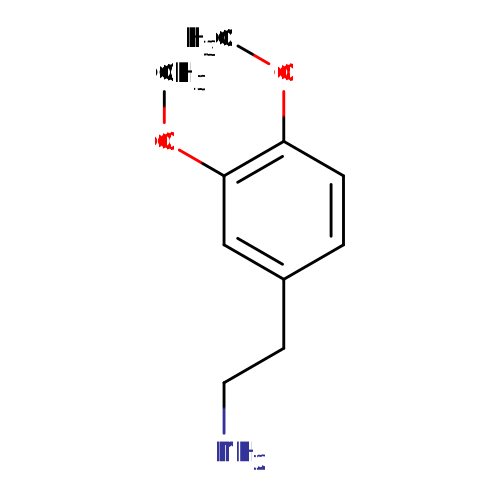
| Common Name | 3,4-Dimethoxyphenylethylamine |
|---|
| Description | 3,4-Dimethoxyphenylethylamine, also known as 3,4-DMPEA or DMPEA is an endogenous metabolite found in urine that belongs to both the phenethylamine and catecholamine families. DMPEA is an analogue of dopamine (3,4-dihydroxyphenethylamine), with a substitution of the hydroxy groups with methoxy groups. DMPEA is also structurally similar to mescaline (3,4,5-trimethoxyphenylethylamine) and occurs naturally alongside it in various species of cacti such as the San Pedro and Peruvian Torch (PMID: 5511715 , 925910 , 600028 ). DMPEA received wide attention after it was proposed as a biomarker in schizophrenic patients urine, however later studies revealed that DMPEA is also excreted by non-schizophrenics (PMID: 709888 ). DMPEA has little known bioactivity, but it has some action as a monoamine oxidase inhibitor (PMID: 886445 ). DMPEA has also been shown to have neurotoxic effects, especially in the nigrostriatal system and among dopaminergic neurons (PMID: 9409711 , 9134983 ). DMPEA appears to be an inhibitor of mitochondrial complex I (PMID: 9409711 ). |
|---|
| Structure | InChI=1S/C10H15NO2/c1-12-9-4-3-8(5-6-11)7-10(9)13-2/h3-4,7H,5-6,11H2,1-2H3 |
|---|
| Synonyms | | Value | Source |
|---|
| 2-(3,4-Dimethoxy-phenyl)-ethylamine | ChEBI | | 3,4-Di-O-methyldopamine | ChEBI | | 3,4-Dimethoxy-beta-phenylethylamine | ChEBI | | 3,4-Dimethoxybenzeneethanamine | ChEBI | | 3,4-Dimethoxydopamine | ChEBI | | 3,4-Dimethoxyphenethylamine | ChEBI | | beta-(3,4-Dimethyoxyphenyl)ethylamine | ChEBI | | Dimethoxydopamine | ChEBI | | Dimethoxyphenylethylamine | ChEBI | | Dimethylmescaline | ChEBI | | DIMPEA | ChEBI | | DMPEA | ChEBI | | Dopamine dimethyl ether | ChEBI | | Homoveratrylamine | ChEBI | | O,O-Dimethyldopamine | ChEBI | | 3,4-Dimethoxy-b-phenylethylamine | Generator | | 3,4-Dimethoxy-β-phenylethylamine | Generator | | b-(3,4-Dimethyoxyphenyl)ethylamine | Generator | | Β-(3,4-dimethyoxyphenyl)ethylamine | Generator | | 2-(3,4-Dimethoxyphenyl)ethanamine | HMDB | | 2-(3,4-Dimethoxyphenyl)ethanamine (acd/name 4.0) | HMDB | | 2-(3,4-Dimethoxyphenyl)ethylamine | HMDB | | 2-(3,4-Dimethoxyphenyl)ethylamine (acd/name 4.0) | HMDB | | 3, 4-Dimethoxy-beta-phenethylamine | HMDB | | 3, 4-Dimethoxy-beta-phenylethylamine | HMDB | | 3, 4-Dimethoxybenzeneethanamine | HMDB | | 3, 4-Dimethoxyphenethylamine | HMDB | | 3, 4-Dimethoxyphenylethylamine(base) | HMDB | | 3,4-Dimethoxy-benzeneethanamine | HMDB | | 3,4-Dimethoxy-benzenethanamine | HMDB | | 3,4-Dimethoxy-beta-phenethylamine | HMDB | | 3,4-Dimethoxy-phenethylamine | HMDB | | 3,4-Dimethoxypheneethylamine | HMDB | | 3,4-Dimethoxyphenylethylamine(base) | HMDB | | beta-(3,4-Dimethoxyphenyl)ethylamine | HMDB | | DMPE | HMDB |
|
|---|
| Chemical Formula | C10H15NO2 |
|---|
| Average Molecular Weight | 181.2316 |
|---|
| Monoisotopic Molecular Weight | 181.110278729 |
|---|
| IUPAC Name | 2-(3,4-dimethoxyphenyl)ethan-1-amine |
|---|
| Traditional Name | dimethoxyphenylethylamine |
|---|
| CAS Registry Number | 120-20-7 |
|---|
| SMILES | COC1=C(OC)C=C(CCN)C=C1 |
|---|
| InChI Identifier | InChI=1S/C10H15NO2/c1-12-9-4-3-8(5-6-11)7-10(9)13-2/h3-4,7H,5-6,11H2,1-2H3 |
|---|
| InChI Key | ANOUKFYBOAKOIR-UHFFFAOYSA-N |
|---|
| Chemical Taxonomy |
|---|
| Description | Belongs to the class of organic compounds known as dimethoxybenzenes. These are organic aromatic compounds containing a monocyclic benzene moiety carrying exactly two methoxy groups. |
|---|
| Kingdom | Organic compounds |
|---|
| Super Class | Benzenoids |
|---|
| Class | Benzene and substituted derivatives |
|---|
| Sub Class | Methoxybenzenes |
|---|
| Direct Parent | Dimethoxybenzenes |
|---|
| Alternative Parents | |
|---|
| Substituents | - O-dimethoxybenzene
- Dimethoxybenzene
- Phenethylamine
- Phenoxy compound
- Anisole
- 2-arylethylamine
- Phenol ether
- Alkyl aryl ether
- Aralkylamine
- Ether
- Organic nitrogen compound
- Primary amine
- Hydrocarbon derivative
- Organooxygen compound
- Organonitrogen compound
- Primary aliphatic amine
- Organopnictogen compound
- Organic oxygen compound
- Amine
- Aromatic homomonocyclic compound
|
|---|
| Molecular Framework | Aromatic homomonocyclic compounds |
|---|
| External Descriptors | |
|---|
| Ontology |
|---|
| Not Available | Not Available |
|---|
| Physical Properties |
|---|
| State | Solid |
|---|
| Experimental Molecular Properties | | Property | Value | Reference |
|---|
| Melting Point | Not Available | Not Available | | Boiling Point | 163 - 165 °C | Not Available | | Water Solubility | Not Available | Not Available | | LogP | 0.77 | Not Available |
|
|---|
| Experimental Chromatographic Properties | Not Available |
|---|
| Predicted Molecular Properties | |
|---|
| Predicted Chromatographic Properties | Predicted Collision Cross SectionsPredicted Retention Times Underivatized| Chromatographic Method | Retention Time | Reference |
|---|
| Measured using a Waters Acquity ultraperformance liquid chromatography (UPLC) ethylene-bridged hybrid (BEH) C18 column (100 mm × 2.1 mm; 1.7 μmparticle diameter). Predicted by Afia on May 17, 2022. | 2.3 minutes | 32390414 | | Predicted by Siyang on May 30, 2022 | 9.6605 minutes | 33406817 | | Predicted by Siyang using ReTip algorithm on June 8, 2022 | 4.09 minutes | 32390414 | | AjsUoB = Accucore 150 Amide HILIC with 10mM Ammonium Formate, 0.1% Formic Acid | 129.1 seconds | 40023050 | | Fem_Long = Waters ACQUITY UPLC HSS T3 C18 with Water:MeOH and 0.1% Formic Acid | 812.4 seconds | 40023050 | | Fem_Lipids = Ascentis Express C18 with (60:40 water:ACN):(90:10 IPA:ACN) and 10mM NH4COOH + 0.1% Formic Acid | 289.0 seconds | 40023050 | | Life_Old = Waters ACQUITY UPLC BEH C18 with Water:(20:80 acetone:ACN) and 0.1% Formic Acid | 122.1 seconds | 40023050 | | Life_New = RP Waters ACQUITY UPLC HSS T3 C18 with Water:(30:70 MeOH:ACN) and 0.1% Formic Acid | 176.2 seconds | 40023050 | | RIKEN = Waters ACQUITY UPLC BEH C18 with Water:ACN and 0.1% Formic Acid | 69.3 seconds | 40023050 | | Eawag_XBridgeC18 = XBridge C18 3.5u 2.1x50 mm with Water:MeOH and 0.1% Formic Acid | 280.8 seconds | 40023050 | | BfG_NTS_RP1 =Agilent Zorbax Eclipse Plus C18 (2.1 mm x 150 mm, 3.5 um) with Water:ACN and 0.1% Formic Acid | 292.4 seconds | 40023050 | | HILIC_BDD_2 = Merck SeQuant ZIC-HILIC with ACN(0.1% formic acid):water(16 mM ammonium formate) | 644.3 seconds | 40023050 | | UniToyama_Atlantis = RP Waters Atlantis T3 (2.1 x 150 mm, 5 um) with ACN:Water and 0.1% Formic Acid | 726.9 seconds | 40023050 | | BDD_C18 = Hypersil Gold 1.9µm C18 with Water:ACN and 0.1% Formic Acid | 240.0 seconds | 40023050 | | UFZ_Phenomenex = Kinetex Core-Shell C18 2.6 um, 3.0 x 100 mm, Phenomenex with Water:MeOH and 0.1% Formic Acid | 749.1 seconds | 40023050 | | SNU_RIKEN_POS = Waters ACQUITY UPLC BEH C18 with Water:ACN and 0.1% Formic Acid | 197.7 seconds | 40023050 | | RPMMFDA = Waters ACQUITY UPLC BEH C18 with Water:ACN and 0.1% Formic Acid | 249.9 seconds | 40023050 | | MTBLS87 = Merck SeQuant ZIC-pHILIC column with ACN:Water and :ammonium carbonate | 510.7 seconds | 40023050 | | KI_GIAR_zic_HILIC_pH2_7 = Merck SeQuant ZIC-HILIC with ACN:Water and 0.1% FA | 419.6 seconds | 40023050 | | Meister zic-pHILIC pH9.3 = Merck SeQuant ZIC-pHILIC column with ACN:Water 5mM NH4Ac pH9.3 and 5mM ammonium acetate in water | 75.4 seconds | 40023050 |
Predicted Kovats Retention IndicesUnderivatizedDerivatized| Derivative Name / Structure | SMILES | Kovats RI Value | Column Type | Reference |
|---|
| 3,4-Dimethoxyphenylethylamine,1TMS,isomer #1 | COC1=CC=C(CCN[Si](C)(C)C)C=C1OC | 1706.2 | Semi standard non polar | 33892256 | | 3,4-Dimethoxyphenylethylamine,1TMS,isomer #1 | COC1=CC=C(CCN[Si](C)(C)C)C=C1OC | 1779.1 | Standard non polar | 33892256 | | 3,4-Dimethoxyphenylethylamine,2TMS,isomer #1 | COC1=CC=C(CCN([Si](C)(C)C)[Si](C)(C)C)C=C1OC | 1949.1 | Semi standard non polar | 33892256 | | 3,4-Dimethoxyphenylethylamine,2TMS,isomer #1 | COC1=CC=C(CCN([Si](C)(C)C)[Si](C)(C)C)C=C1OC | 1996.0 | Standard non polar | 33892256 | | 3,4-Dimethoxyphenylethylamine,1TBDMS,isomer #1 | COC1=CC=C(CCN[Si](C)(C)C(C)(C)C)C=C1OC | 1954.5 | Semi standard non polar | 33892256 | | 3,4-Dimethoxyphenylethylamine,1TBDMS,isomer #1 | COC1=CC=C(CCN[Si](C)(C)C(C)(C)C)C=C1OC | 1985.3 | Standard non polar | 33892256 | | 3,4-Dimethoxyphenylethylamine,2TBDMS,isomer #1 | COC1=CC=C(CCN([Si](C)(C)C(C)(C)C)[Si](C)(C)C(C)(C)C)C=C1OC | 2377.3 | Semi standard non polar | 33892256 | | 3,4-Dimethoxyphenylethylamine,2TBDMS,isomer #1 | COC1=CC=C(CCN([Si](C)(C)C(C)(C)C)[Si](C)(C)C(C)(C)C)C=C1OC | 2378.1 | Standard non polar | 33892256 |
|
|---|
| General References | - Lundstrom J: Biosynthesis of mescaline and 3,4-dimethoxyphenethylamine in Trichocereus pachanoi Br&R. Acta Pharm Suec. 1970 Dec;7(6):651-66. [PubMed:5511715 ]
- Pummangura S, Nichols DE, McLaughlin JL: Cactus alkaloids XXXIII: beta-phenethylamines from the Guatemalan cactus Pilosocereus maxonii. J Pharm Sci. 1977 Oct;66(10):1485-7. doi: 10.1002/jps.2600661037. [PubMed:925910 ]
- Pardanani JH, McLaughlin JL, Kondrat RW, Cooks RG: Cactus alkaloids. XXXVI. Mescaline and related compounds from Trichocereus peruvianus. Lloydia. 1977 Nov-Dec;40(6):585-90. [PubMed:600028 ]
- Knoll E, Wisser H, Emrich HM: 3,4-Dimethoxyphenylethylamine excretion of normals and schizophrenics, behaviour during total fasting. Clin Chim Acta. 1978 Nov 1;89(3):493-502. doi: 10.1016/0009-8981(78)90415-1. [PubMed:709888 ]
- Keller WJ, Ferguson GG: Effects of 3,4-dimethoxyphenethylamine derivatives on monoamine oxidase. J Pharm Sci. 1977 Jul;66(7):1048-50. doi: 10.1002/jps.2600660741. [PubMed:886445 ]
- Koshimura I, Imai H, Hidano T, Endo K, Mochizuki H, Kondo T, Mizuno Y: Dimethoxyphenylethylamine and tetrahydropapaverine are toxic to the nigrostriatal system. Brain Res. 1997 Oct 31;773(1-2):108-16. doi: 10.1016/s0006-8993(97)00922-0. [PubMed:9409711 ]
- Goto K, Mochizuki H, Hattori T, Nakamura N, Mizuno Y: Neurotoxic effects of papaverine, tetrahydropapaverine and dimethoxyphenylethylamine on dopaminergic neurons in ventral mesencephalic-striatal co-culture. Brain Res. 1997 Apr 18;754(1-2):260-8. doi: 10.1016/s0006-8993(97)00093-0. [PubMed:9134983 ]
|
|---|