| Record Information |
|---|
| Version | 5.0 |
|---|
| Status | Detected and Quantified |
|---|
| Creation Date | 2012-09-13 11:51:21 UTC |
|---|
| Update Date | 2022-03-07 02:57:14 UTC |
|---|
| HMDB ID | HMDB0041980 |
|---|
| Secondary Accession Numbers | |
|---|
| Metabolite Identification |
|---|
| Common Name | Perchloroethylene |
|---|
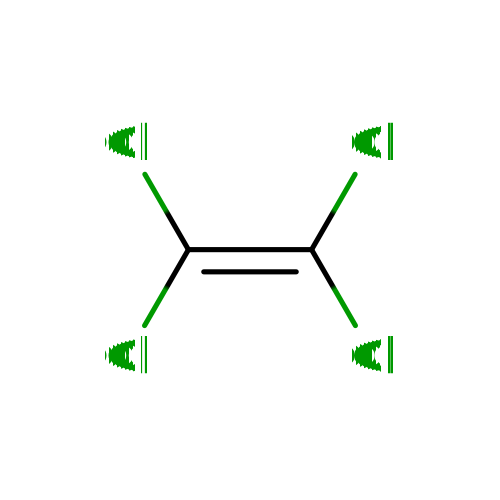
| Description | Animal studies and a study of 99 twins by Dr. Samuel Goldman and researchers at the Parkinson's Institute in Sunnyvale, California determined there is a 'lot of circumstantial evidence' that exposure to tetrachloroethene increases the risk of developing Parkinson's disease ninefold. Larger population studies are planned. Tetrachloroethene is a common soil contaminant. With a specific gravity greater than 1, tetrachloroethylene will be present as a dense nonaqueous phase liquid if sufficient quantities of liquid are spilled in the environment. Because of its mobility in groundwater, its toxicity at low levels, and its density (which causes it to sink below the water table), cleanup activities are more difficult than for oil spills. Recent research has focused on the in place remediation of soil and ground water pollution by tetrachloroethylene. Instead of excavation or extraction for above-ground treatment or disposal, tetrachloroethylene contamination has been successfully remediated by chemical treatment or bioremediation. Bioremediation has been successful under anaerobic conditions by reductive dechlorination by Dehalococcoides sp. and under aerobic conditions by cometabolism by Pseudomonas sp. Partial degradation daughter products include trichloroethylene, cis-1,2-dichloroethene and vinyl chloride; full degradation converts tetrachloroethylene to ethene and hydrogen chloride dissolved in water. Tetrachloroethylene is an excellent solvent for organic materials. Otherwise it is volatile, highly stable, and nonflammable. For these reasons, it is widely used in dry cleaning. Usually as a mixture with other chlorocarbons, it is also used to degrease metal parts in the automotive and other metalworking industries. It appears in a few consumer products including paint strippers and spot removers. Tetrachloroethylene, also known under the systematic name tetrachloroethene, or perchloroethylene ('perc'), and many other names, is a chlorocarbon with the formula Cl2C=CCl2. It is a colorless liquid widely used for dry cleaning of fabrics, hence it is sometimes called 'dry-cleaning fluid.' It has a sweet odor detectable by most people at a concentration of 1 part per million (1 ppm). Worldwide production was about one million metric tons in 1985. The International Agency for Research on Cancer has classified tetrachloroethene as a Group 2A carcinogen, which means that it is probably carcinogenic to humans. Like many chlorinated hydrocarbons, tetrachloroethene is a central nervous system depressant and can enter the body through respiratory or dermal exposure. Tetrachloroethene dissolves fats from the skin, potentially resulting in skin irritation. This reaction can be catalyzed by a mixture of potassium chloride and aluminium chloride or by activated carbon. Trichloroethylene is a major byproduct, which is separated by distillation. |
|---|
| Structure | InChI=1S/C2Cl4/c3-1(4)2(5)6 |
|---|
| Synonyms | | Value | Source |
|---|
| 1,1,2,2-Tetrachloroethylene | ChEBI | | Ethylene tetrachloride | ChEBI | | PCE | ChEBI | | PERC | ChEBI | | PERK | ChEBI | | Tetrachloraethen | ChEBI | | Tetrachlorethylene | ChEBI | | Tetrachloroethylene | ChEBI | | 1,1,2, 2-Tetrachloroethylene | HMDB | | 1,1,2,2-Tetrachloroethene | HMDB | | 1,1,2,2-Tetrachloroethylene (acd/name 4.0) | HMDB | | Ankilostin | HMDB | | Antisal 1 | HMDB | | Antisol 1 | HMDB | | Carbon bichloride | HMDB | | Carbon dichloride | HMDB | | Czterochloroetylen | HMDB | | Didakene | HMDB | | Dow-per | HMDB | | Fedal-un | HMDB | | Nema | HMDB | | Nema, veterinary | HMDB | | Perawin | HMDB | | Perchloorethyleen, per | HMDB | | Perchlor | HMDB | | Perchloraethylen, per | HMDB | | Perchlorethylene | HMDB | | Perchlorethylene, per | HMDB | | Perchloroethene | HMDB | | Perclene | HMDB | | Perclene D | HMDB | | Perclene TG | HMDB | | Percloroetilene | HMDB | | Percosolve | HMDB | | Perklone | HMDB | | PerSec | HMDB | | RCRA waste number u210 | HMDB | | Tetlen | HMDB | | Tetracap | HMDB | | Tetrachlooretheen | HMDB | | Tetrachlorathen | HMDB | | Tetrachloro-ethene | HMDB | | Tetrachloro-ethylene | HMDB | | Tetrachloroethene | HMDB | | Tetracloroetene | HMDB | | Tetraguer | HMDB | | Tetraleno | HMDB | | Tetralex | HMDB | | Tetravec | HMDB | | Tetroguer | HMDB | | Tetropil | HMDB | | Perchloroethylene | ChEBI |
|
|---|
| Chemical Formula | C2Cl4 |
|---|
| Average Molecular Weight | 165.833 |
|---|
| Monoisotopic Molecular Weight | 163.875410828 |
|---|
| IUPAC Name | tetrachloroethene |
|---|
| Traditional Name | perchloroethylene |
|---|
| CAS Registry Number | 127-18-4 |
|---|
| SMILES | ClC(Cl)=C(Cl)Cl |
|---|
| InChI Identifier | InChI=1S/C2Cl4/c3-1(4)2(5)6 |
|---|
| InChI Key | CYTYCFOTNPOANT-UHFFFAOYSA-N |
|---|
| Chemical Taxonomy |
|---|
| Description | Belongs to the class of organic compounds known as vinyl chlorides. These are vinyl halides in which a chlorine atom is bonded to an sp2-hybridised carbon atom. |
|---|
| Kingdom | Organic compounds |
|---|
| Super Class | Organohalogen compounds |
|---|
| Class | Vinyl halides |
|---|
| Sub Class | Vinyl chlorides |
|---|
| Direct Parent | Vinyl chlorides |
|---|
| Alternative Parents | |
|---|
| Substituents | - Chloroalkene
- Haloalkene
- Vinyl chloride
- Hydrocarbon derivative
- Organochloride
- Aliphatic acyclic compound
|
|---|
| Molecular Framework | Aliphatic acyclic compounds |
|---|
| External Descriptors | |
|---|
| Ontology |
|---|
| Physiological effect | Not Available |
|---|
| Disposition | |
|---|
| Process | Not Available |
|---|
| Role | |
|---|
| Physical Properties |
|---|
| State | Liquid |
|---|
| Experimental Molecular Properties | | Property | Value | Reference |
|---|
| Melting Point | -22.3 °C | Not Available | | Boiling Point | Not Available | Not Available | | Water Solubility | 0.21 mg/mL at 25 °C | Not Available | | LogP | 3.40 | Not Available |
|
|---|
| Experimental Chromatographic Properties | Not Available |
|---|
| Predicted Molecular Properties | |
|---|
| Predicted Chromatographic Properties | Predicted Collision Cross SectionsPredicted Retention Times Underivatized| Chromatographic Method | Retention Time | Reference |
|---|
| Measured using a Waters Acquity ultraperformance liquid chromatography (UPLC) ethylene-bridged hybrid (BEH) C18 column (100 mm × 2.1 mm; 1.7 μmparticle diameter). Predicted by Afia on May 17, 2022. Predicted by Afia on May 17, 2022. | 4.98 minutes | 32390414 | | Predicted by Siyang on May 30, 2022 | 15.0051 minutes | 33406817 | | Predicted by Siyang using ReTip algorithm on June 8, 2022 | 1.36 minutes | 32390414 | | AjsUoB = Accucore 150 Amide HILIC with 10mM Ammonium Formate, 0.1% Formic Acid | 251.6 seconds | 40023050 | | Fem_Long = Waters ACQUITY UPLC HSS T3 C18 with Water:MeOH and 0.1% Formic Acid | 1282.5 seconds | 40023050 | | Fem_Lipids = Ascentis Express C18 with (60:40 water:ACN):(90:10 IPA:ACN) and 10mM NH4COOH + 0.1% Formic Acid | 506.2 seconds | 40023050 | | Life_Old = Waters ACQUITY UPLC BEH C18 with Water:(20:80 acetone:ACN) and 0.1% Formic Acid | 216.1 seconds | 40023050 | | Life_New = RP Waters ACQUITY UPLC HSS T3 C18 with Water:(30:70 MeOH:ACN) and 0.1% Formic Acid | 399.4 seconds | 40023050 | | RIKEN = Waters ACQUITY UPLC BEH C18 with Water:ACN and 0.1% Formic Acid | 219.6 seconds | 40023050 | | Eawag_XBridgeC18 = XBridge C18 3.5u 2.1x50 mm with Water:MeOH and 0.1% Formic Acid | 388.7 seconds | 40023050 | | BfG_NTS_RP1 =Agilent Zorbax Eclipse Plus C18 (2.1 mm x 150 mm, 3.5 um) with Water:ACN and 0.1% Formic Acid | 500.0 seconds | 40023050 | | HILIC_BDD_2 = Merck SeQuant ZIC-HILIC with ACN(0.1% formic acid):water(16 mM ammonium formate) | 596.2 seconds | 40023050 | | UniToyama_Atlantis = RP Waters Atlantis T3 (2.1 x 150 mm, 5 um) with ACN:Water and 0.1% Formic Acid | 825.8 seconds | 40023050 | | BDD_C18 = Hypersil Gold 1.9µm C18 with Water:ACN and 0.1% Formic Acid | 296.7 seconds | 40023050 | | UFZ_Phenomenex = Kinetex Core-Shell C18 2.6 um, 3.0 x 100 mm, Phenomenex with Water:MeOH and 0.1% Formic Acid | 953.7 seconds | 40023050 | | SNU_RIKEN_POS = Waters ACQUITY UPLC BEH C18 with Water:ACN and 0.1% Formic Acid | 349.7 seconds | 40023050 | | RPMMFDA = Waters ACQUITY UPLC BEH C18 with Water:ACN and 0.1% Formic Acid | 457.5 seconds | 40023050 | | MTBLS87 = Merck SeQuant ZIC-pHILIC column with ACN:Water and :ammonium carbonate | 779.7 seconds | 40023050 | | KI_GIAR_zic_HILIC_pH2_7 = Merck SeQuant ZIC-HILIC with ACN:Water and 0.1% FA | 503.1 seconds | 40023050 | | Meister zic-pHILIC pH9.3 = Merck SeQuant ZIC-pHILIC column with ACN:Water 5mM NH4Ac pH9.3 and 5mM ammonium acetate in water | 279.2 seconds | 40023050 |
Predicted Kovats Retention IndicesUnderivatized |
|---|
| GC-MS Spectra| Spectrum Type | Description | Splash Key | Deposition Date | Source | View |
|---|
| Experimental GC-MS | GC-MS Spectrum - Perchloroethylene EI-B (Non-derivatized) | splash10-02u0-4900000000-9854a27a57b089103a95 | 2017-09-12 | HMDB team, MONA, MassBank | View Spectrum | | Experimental GC-MS | GC-MS Spectrum - Perchloroethylene EI-B (Non-derivatized) | splash10-02ce-9700000000-15e97c87ff2d3325dcde | 2017-09-12 | HMDB team, MONA, MassBank | View Spectrum | | Experimental GC-MS | GC-MS Spectrum - Perchloroethylene EI-B (Non-derivatized) | splash10-02u0-4900000000-9854a27a57b089103a95 | 2018-05-18 | HMDB team, MONA, MassBank | View Spectrum | | Experimental GC-MS | GC-MS Spectrum - Perchloroethylene EI-B (Non-derivatized) | splash10-02ce-9700000000-15e97c87ff2d3325dcde | 2018-05-18 | HMDB team, MONA, MassBank | View Spectrum | | Predicted GC-MS | Predicted GC-MS Spectrum - Perchloroethylene GC-MS (Non-derivatized) - 70eV, Positive | splash10-014i-0900000000-c9d94a196093a68ede77 | 2016-09-22 | Wishart Lab | View Spectrum | | Predicted GC-MS | Predicted GC-MS Spectrum - Perchloroethylene GC-MS (Non-derivatized) - 70eV, Positive | Not Available | 2021-10-12 | Wishart Lab | View Spectrum | | MS | Mass Spectrum (Electron Ionization) | splash10-02u0-2900000000-b8b0d0d4e84c9a237c39 | 2014-09-20 | Not Available | View Spectrum |
MS/MS Spectra| Spectrum Type | Description | Splash Key | Deposition Date | Source | View |
|---|
| Predicted LC-MS/MS | Predicted LC-MS/MS Spectrum - Perchloroethylene 10V, Positive-QTOF | splash10-03di-0900000000-8a7abc89fb2f94b90417 | 2016-08-03 | Wishart Lab | View Spectrum | | Predicted LC-MS/MS | Predicted LC-MS/MS Spectrum - Perchloroethylene 20V, Positive-QTOF | splash10-03di-0900000000-8a7abc89fb2f94b90417 | 2016-08-03 | Wishart Lab | View Spectrum | | Predicted LC-MS/MS | Predicted LC-MS/MS Spectrum - Perchloroethylene 40V, Positive-QTOF | splash10-03di-0900000000-8a7abc89fb2f94b90417 | 2016-08-03 | Wishart Lab | View Spectrum | | Predicted LC-MS/MS | Predicted LC-MS/MS Spectrum - Perchloroethylene 10V, Negative-QTOF | splash10-03di-0900000000-8296157f9f0ba5c9a39f | 2016-08-04 | Wishart Lab | View Spectrum | | Predicted LC-MS/MS | Predicted LC-MS/MS Spectrum - Perchloroethylene 20V, Negative-QTOF | splash10-03di-0900000000-8296157f9f0ba5c9a39f | 2016-08-04 | Wishart Lab | View Spectrum | | Predicted LC-MS/MS | Predicted LC-MS/MS Spectrum - Perchloroethylene 40V, Negative-QTOF | splash10-03di-0900000000-8296157f9f0ba5c9a39f | 2016-08-04 | Wishart Lab | View Spectrum | | Predicted LC-MS/MS | Predicted LC-MS/MS Spectrum - Perchloroethylene 10V, Positive-QTOF | splash10-03di-0900000000-502fa884cfe21613d14c | 2021-09-22 | Wishart Lab | View Spectrum | | Predicted LC-MS/MS | Predicted LC-MS/MS Spectrum - Perchloroethylene 20V, Positive-QTOF | splash10-03di-0900000000-502fa884cfe21613d14c | 2021-09-22 | Wishart Lab | View Spectrum | | Predicted LC-MS/MS | Predicted LC-MS/MS Spectrum - Perchloroethylene 40V, Positive-QTOF | splash10-004i-0900000000-81606de257ffa3a01ba5 | 2021-09-22 | Wishart Lab | View Spectrum |
NMR Spectra| Spectrum Type | Description | Deposition Date | Source | View |
|---|
|
|---|
| General References | - GRANDJEAN E, WANNER HU, RHINER A: [INVESTIGATIONS OF TETRACHLOROETHYLENE VAPORS IN 2 TYPES OF OPEN METAL CLEANING APPLIANCES]. Int Arch Gewerbepathol Gewerbehyg. 1964 Nov 3;21:69-79. [PubMed:14340446 ]
- Braeckevelt M, Seeger EM, Paschke H, Kuschk P, Kaestner M: Adaptation of a constructed wetland to simultaneous treatment of monochlorobenzene and perchloroethene. Int J Phytoremediation. 2011 Nov-Dec;13(10):998-1013. [PubMed:21972567 ]
- Tseng WJ, Guo SF: Synthesis of nanoporous Al2O3 membranes from polybutyl methacrylate functionalized SiO2 particles as a sacrificial template. J Nanosci Nanotechnol. 2012 Oct;12(10):7909-14. [PubMed:23421155 ]
- Tsuruta H: Skin absorption of organic solvent vapors in nude mice in vivo. Ind Health. 1989;27(2):37-47. [PubMed:2745160 ]
- Wroblewska K, Rogaczewska T: [Evaluation of occupational exposure to tetrachloroethylene (PER) in a dry cleaning business]. Med Pr. 1987;38(2):96-101. [PubMed:3626854 ]
|
|---|