| Record Information |
|---|
| Version | 5.0 |
|---|
| Status | Expected but not Quantified |
|---|
| Creation Date | 2013-02-26 19:10:05 UTC |
|---|
| Update Date | 2019-07-23 07:12:54 UTC |
|---|
| HMDB ID | HMDB0059785 |
|---|
| Secondary Accession Numbers | |
|---|
| Metabolite Identification |
|---|
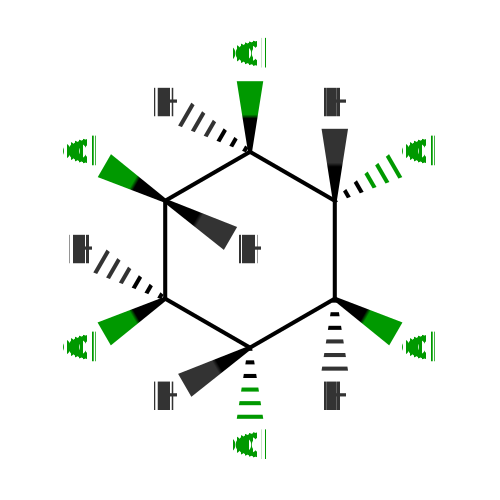
| Common Name | beta-Hexachlorocyclohexane |
|---|
| Description | beta-Hexachlorocyclohexane, also known as beta-BHC or beta-lindane, belongs to the class of organic compounds known as cyclohexyl halides. These are organohalogen compounds containing a monocyclic cyclohexane moiety that is substituted at one or more positions by an halogen atom. beta-Hexachlorocyclohexane is possibly neutral. beta-Hexachlorocyclohexane exists in all living organisms, ranging from bacteria to humans. Exposure to large amounts of hexachlorocyclohexane can harm the nervous system, producing a range of symptoms from headache and dizziness to seizures, convulsions and more rarely death. beta-Hexachlorocyclohexane causes nonestrogenic immune function changes in the adult mouse without gross changes in lymphoid organ weight, histology, or cellularity. beta-Hexachlorocyclohexane is formally rated as a possible carcinogen (by IARC 2B) and is also a potentially toxic compound. beta-Hexachlorocyclohexane is a by-product of the production of the insecticide lindane. It is used as an insecticide on fruit, vegetables, and forest crops and is also available as a prescription (lotion, cream, or shampoo) to treat head and body lice, and scabies. These are alkanes containing one or more saturated rings of carbon atoms. Metabolism occurs via dechlorination, dehydrogenation, dehydrochlorination, and hydroxylation by hepatic cytochrome P-450 enzymes. Hexachlorocyclohexane poisoning is treated symptomatically. |
|---|
| Structure | [H][C@]1(Cl)[C@]([H])(Cl)[C@@]([H])(Cl)[C@]([H])(Cl)[C@@]([H])(Cl)[C@]1([H])Cl InChI=1S/C6H6Cl6/c7-1-2(8)4(10)6(12)5(11)3(1)9/h1-6H/t1-,2-,3+,4+,5-,6- |
|---|
| Synonyms | | Value | Source |
|---|
| (1alpha,2beta,3alpha,4beta,5alpha,6beta)-1,2,3,4,5,6-Hexachlorocyclohexane | ChEBI | | beta-1,2,3,4,5,6-Hexachlorocyclohexane | ChEBI | | beta-Benzene hexachloride | ChEBI | | beta-BHC | ChEBI | | beta-HCH | ChEBI | | beta-Lindane | ChEBI | | trans-1,2,3,4,5,6-Hexachlorocyclohexane | ChEBI | | (1a,2b,3a,4b,5a,6b)-1,2,3,4,5,6-Hexachlorocyclohexane | Generator | | (1Α,2β,3α,4β,5α,6β)-1,2,3,4,5,6-hexachlorocyclohexane | Generator | | b-1,2,3,4,5,6-Hexachlorocyclohexane | Generator | | Β-1,2,3,4,5,6-hexachlorocyclohexane | Generator | | b-Benzene hexachloride | Generator | | Β-benzene hexachloride | Generator | | b-BHC | Generator | | Β-BHC | Generator | | b-HCH | Generator | | Β-HCH | Generator | | b-Lindane | Generator | | Β-lindane | Generator | | b-Hexachlorocyclohexane | Generator | | Β-hexachlorocyclohexane | Generator | | beta-Hexachlorocyclohexane | KEGG |
|
|---|
| Chemical Formula | C6H6Cl6 |
|---|
| Average Molecular Weight | 290.83 |
|---|
| Monoisotopic Molecular Weight | 287.860066434 |
|---|
| IUPAC Name | (1r,2r,3r,4r,5r,6r)-1,2,3,4,5,6-hexachlorocyclohexane |
|---|
| Traditional Name | lindex |
|---|
| CAS Registry Number | Not Available |
|---|
| SMILES | Cl[C@H]1[C@H](Cl)[C@@H](Cl)[C@H](Cl)[C@@H](Cl)[C@@H]1Cl |
|---|
| InChI Identifier | InChI=1S/C6H6Cl6/c7-1-2(8)4(10)6(12)5(11)3(1)9/h1-6H/t1-,2-,3+,4+,5-,6- |
|---|
| InChI Key | JLYXXMFPNIAWKQ-CDRYSYESSA-N |
|---|
| Chemical Taxonomy |
|---|
| Description | Belongs to the class of organic compounds known as cyclohexyl halides. These are organohalogen compounds containing a monocyclic cyclohexane moiety that is substituted at one or more positions by an halogen atom. |
|---|
| Kingdom | Organic compounds |
|---|
| Super Class | Organohalogen compounds |
|---|
| Class | Alkyl halides |
|---|
| Sub Class | Cyclohexyl halides |
|---|
| Direct Parent | Cyclohexyl halides |
|---|
| Alternative Parents | |
|---|
| Substituents | - Cyclohexyl halide
- Hydrocarbon derivative
- Organochloride
- Alkyl chloride
- Aliphatic homomonocyclic compound
|
|---|
| Molecular Framework | Aliphatic homomonocyclic compounds |
|---|
| External Descriptors | |
|---|
| Ontology |
|---|
| Physiological effect | Not Available |
|---|
| Disposition | |
|---|
| Process | |
|---|
| Role | |
|---|
| Physical Properties |
|---|
| State | Not Available |
|---|
| Experimental Molecular Properties | | Property | Value | Reference |
|---|
| Melting Point | Not Available | Not Available | | Boiling Point | Not Available | Not Available | | Water Solubility | Not Available | Not Available | | LogP | Not Available | Not Available |
|
|---|
| Experimental Chromatographic Properties | Not Available |
|---|
| Predicted Molecular Properties | |
|---|
| Predicted Chromatographic Properties | Predicted Collision Cross SectionsPredicted Retention Times Underivatized| Chromatographic Method | Retention Time | Reference |
|---|
| Measured using a Waters Acquity ultraperformance liquid chromatography (UPLC) ethylene-bridged hybrid (BEH) C18 column (100 mm × 2.1 mm; 1.7 μmparticle diameter). Predicted by Afia on May 17, 2022. Predicted by Afia on May 17, 2022. | 5.06 minutes | 32390414 | | Predicted by Siyang on May 30, 2022 | 27.5425 minutes | 33406817 | | Predicted by Siyang using ReTip algorithm on June 8, 2022 | 1.29 minutes | 32390414 | | Fem_Long = Waters ACQUITY UPLC HSS T3 C18 with Water:MeOH and 0.1% Formic Acid | 3268.8 seconds | 40023050 | | Fem_Lipids = Ascentis Express C18 with (60:40 water:ACN):(90:10 IPA:ACN) and 10mM NH4COOH + 0.1% Formic Acid | 1175.4 seconds | 40023050 | | Life_Old = Waters ACQUITY UPLC BEH C18 with Water:(20:80 acetone:ACN) and 0.1% Formic Acid | 456.0 seconds | 40023050 | | Life_New = RP Waters ACQUITY UPLC HSS T3 C18 with Water:(30:70 MeOH:ACN) and 0.1% Formic Acid | 864.8 seconds | 40023050 | | RIKEN = Waters ACQUITY UPLC BEH C18 with Water:ACN and 0.1% Formic Acid | 545.6 seconds | 40023050 | | Eawag_XBridgeC18 = XBridge C18 3.5u 2.1x50 mm with Water:MeOH and 0.1% Formic Acid | 1050.6 seconds | 40023050 | | BfG_NTS_RP1 =Agilent Zorbax Eclipse Plus C18 (2.1 mm x 150 mm, 3.5 um) with Water:ACN and 0.1% Formic Acid | 1243.2 seconds | 40023050 | | HILIC_BDD_2 = Merck SeQuant ZIC-HILIC with ACN(0.1% formic acid):water(16 mM ammonium formate) | 1267.4 seconds | 40023050 | | UniToyama_Atlantis = RP Waters Atlantis T3 (2.1 x 150 mm, 5 um) with ACN:Water and 0.1% Formic Acid | 2232.3 seconds | 40023050 | | BDD_C18 = Hypersil Gold 1.9µm C18 with Water:ACN and 0.1% Formic Acid | 845.7 seconds | 40023050 | | UFZ_Phenomenex = Kinetex Core-Shell C18 2.6 um, 3.0 x 100 mm, Phenomenex with Water:MeOH and 0.1% Formic Acid | 2298.7 seconds | 40023050 | | SNU_RIKEN_POS = Waters ACQUITY UPLC BEH C18 with Water:ACN and 0.1% Formic Acid | 872.6 seconds | 40023050 | | RPMMFDA = Waters ACQUITY UPLC BEH C18 with Water:ACN and 0.1% Formic Acid | 975.0 seconds | 40023050 | | MTBLS87 = Merck SeQuant ZIC-pHILIC column with ACN:Water and :ammonium carbonate | 1504.9 seconds | 40023050 | | KI_GIAR_zic_HILIC_pH2_7 = Merck SeQuant ZIC-HILIC with ACN:Water and 0.1% FA | 993.7 seconds | 40023050 | | Meister zic-pHILIC pH9.3 = Merck SeQuant ZIC-pHILIC column with ACN:Water 5mM NH4Ac pH9.3 and 5mM ammonium acetate in water | 510.2 seconds | 40023050 |
Predicted Kovats Retention IndicesUnderivatized |
|---|
| General References | - Porta D, Fantini F, De Felip E, Blasetti F, Abballe A, Dell'Orco V, Fano V, Ingelido AM, Narduzzi S, Forastiere F: A biomonitoring study on blood levels of beta-hexachlorocyclohexane among people living close to an industrial area. Environ Health. 2013 Jul 16;12:57. doi: 10.1186/1476-069X-12-57. [PubMed:23866943 ]
- Palou-Serra A, Murcia M, Lopez-Espinosa MJ, Grimalt JO, Rodriguez-Farre E, Ballester F, Sunol C: Influence of prenatal exposure to environmental pollutants on human cord blood levels of glutamate. Neurotoxicology. 2014 Jan;40:102-10. doi: 10.1016/j.neuro.2013.12.003. Epub 2013 Dec 19. [PubMed:24361731 ]
|
|---|