| Record Information |
|---|
| Version | 5.0 |
|---|
| Status | Detected and Quantified |
|---|
| Creation Date | 2005-11-16 15:48:42 UTC |
|---|
| Update Date | 2024-05-19 04:30:29 UTC |
|---|
| HMDB ID | HMDB0000956 |
|---|
| Secondary Accession Numbers | - HMDB0059916
- HMDB00956
- HMDB59916
|
|---|
| Metabolite Identification |
|---|
| Common Name | Tartaric acid |
|---|
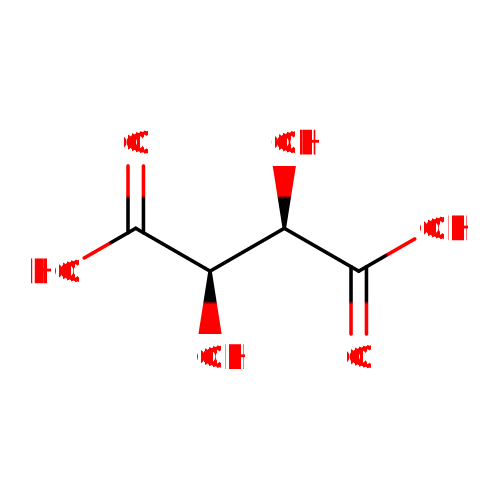
| Description | Tartaric acid is a white crystalline organic acid. It occurs naturally in many plants, particularly grapes and tamarinds, and is one of the main acids found in wine. It is added to other foods to give a sour taste, and is used as an antioxidant. Salts of tartaric acid are known as tartrates. It is a dihydroxy derivative of dicarboxylic acid. Tartaric acid is a muscle toxin, which works by inhibiting the production of malic acid, and in high doses causes paralysis and death. The minimum recorded fatal dose for a human is about 12 grams. In spite of that, it is included in many foods, especially sour-tasting sweets. As a food additive, tartaric acid is used as an antioxidant with E number E334, tartrates are other additives serving as antioxidants or emulsifiers. Naturally-occurring tartaric acid is chiral, meaning that it has molecules that are non-superimposable on their mirror-images. It is a useful raw material in organic chemistry for the synthesis of other chiral molecules. The naturally occurring form of the acid is L-(+)-tartaric acid or dextrotartaric acid. The mirror-image (enantiomeric) form, levotartaric acid or D-(-)-tartaric acid, and the achiral form, mesotartaric acid, can be made artificially. Tartarate is believed to play a role in inhibiting kidney stone formation. Most tartarate that is consumed by humans is metabolized by bacteria in the gastrointestinal tract -- primarily in the large instestine. Only about 15-20% of consumed tartaric acid is secreted in the urine unchanged. Tartaric acid is a biomarker for the consumption of wine and grapes (PMID:24507823 ). Tartaric acid is also a fungal metabolite, elevated levels in the urine (especially in children) may be due to the presence of yeast (in the gut or bladder). It can be produced by Agrobacterium, Nocardia, Rhizobium, Saccharomyces as well (PMID:7628083 ) (https://link.springer.com/article/10.1023/A:1005592104426). High levels of tartaric acid have been found in autistic children. In adults, tartaric acid may be due to the consumption of wine (https://www.greatplainslaboratory.com/articles-1/2015/11/13/candida-and-overgrowth-the-problem-bacteria-by-products) (PMID:15738524 ; PMID:24507823 ; PMID:7628083 ).Tartaric acid is elevated by a factor of two or more in the urine of patients with diet-controlled PKU or phenylketonuria. This is reflective of PKU patients consuming a diet that is exceptionally rich in fruits (grapes, avocados, bananas and oranges) (PMID: 37446577 ). |
|---|
| Structure | O[C@H]([C@@H](O)C(O)=O)C(O)=O InChI=1S/C4H6O6/c5-1(3(7)8)2(6)4(9)10/h1-2,5-6H,(H,7,8)(H,9,10)/t1-,2-/m1/s1 |
|---|
| Synonyms | | Value | Source |
|---|
| (+)-(R,R)-Tartaric acid | ChEBI | | (+)-L-Tartaric acid | ChEBI | | (+)-Tartaric acid | ChEBI | | (+)-Weinsaeure | ChEBI | | (2R,3R)-2,3-Dihydroxybernsteinsaeure | ChEBI | | (2R,3R)-2,3-Dihydroxysuccinic acid | ChEBI | | (2R,3R)-Tartaric acid | ChEBI | | (R,R)-(+)-Tartaric acid | ChEBI | | (R,R)-Tartaric acid | ChEBI | | L(+)-TARTARIC ACID | ChEBI | | L-Threaric acid | ChEBI | | Rechtsweinsaeure | ChEBI | | Weinsteinsaeure | ChEBI | | (R,R)-Tartrate | Kegg | | L-Tartaric acid | Kegg | | Tartrate | Kegg | | 2,3-Dihydroxybutanedioic acid | Kegg | | (+)-(R,R)-Tartarate | Generator | | (+)-L-Tartarate | Generator | | (+)-Tartarate | Generator | | (2R,3R)-2,3-Dihydroxysuccinate | Generator | | (2R,3R)-Tartarate | Generator | | (R,R)-(+)-Tartarate | Generator | | (R,R)-Tartarate | Generator | | L(+)-TARTARate | Generator | | L-Threarate | Generator | | (R,R)-Tartric acid | Generator | | L-Tartarate | Generator | | Tartric acid | Generator | | 2,3-Dihydroxybutanedioate | Generator | | Tartarate | Generator | | Aluminum tartrate | HMDB | | Ammonium tartrate | HMDB | | Potassium tartrate | HMDB | | Seignette salt | HMDB | | Sodium ammonium tartrate | HMDB | | Stannous tartrate | HMDB | | Tartaric acid, calcium salt, (R-r*,r*)-isomer | HMDB | | Calcium tartrate tetrahydrate | HMDB | | Sodium tartrate | HMDB | | Tartaric acid, ((r*,r*)-(+-))-isomer | HMDB | | Tartaric acid, monoammonium salt, (R-(r*,r*))-isomer | HMDB | | (R*,r*)-(+-)-2,3-dihydroxybutanedioic acid, monoammonium monosodium salt | HMDB | | MN(III) tartrate | HMDB | | Calcium tartrate | HMDB | | Tartaric acid, (R-(r*,r*))-isomer | HMDB | | Sodium potassium tartrate | HMDB | | Tartaric acid, (r*,s*)-isomer | HMDB | | Tartaric acid, (S-(r*,r*))-isomer | HMDB | | Tartaric acid, ammonium sodium salt, (1:1:1) salt, (r*,r*)-(+-)-isomer | HMDB | | (+)-(2R,3R)-Tartaric acid | HMDB | | (1R,2R)-1,2-Dihydroxyethane-1,2-dicarboxylic acid | HMDB | | (2R,3R)-2,3-Dihydroxybutanedioate | HMDB | | (2R,3R)-2,3-Dihydroxybutanedioic acid | HMDB | | (2R,3R)-2,3-Tartaric acid | HMDB | | 1,2-Dihydroxyethane-1,2-dicarboxylic acid | HMDB | | 2,3-Dihydroxy-succinate | HMDB | | 2,3-Dihydroxy-succinic acid | HMDB | | 2,3-Dihydroxysuccinic acid | HMDB | | D-a,b-Dihydroxysuccinic acid | HMDB | | D-Tartaric acid | HMDB | | Dextrotartaric acid | HMDB | | L-(+)-Tartaric acid | HMDB | | Natural tartaric acid | HMDB | | TAR | HMDB | | Threaric acid | HMDB | | TLA | HMDB | | Weinsaeure | HMDB | | (2R,3R)-(+)-Tartaric acid | HMDB | | Dihydroxysuccinic acid | HMDB | | Tartaric acid | HMDB |
|
|---|
| Chemical Formula | C4H6O6 |
|---|
| Average Molecular Weight | 150.0868 |
|---|
| Monoisotopic Molecular Weight | 150.016437924 |
|---|
| IUPAC Name | (2R,3R)-2,3-dihydroxybutanedioic acid |
|---|
| Traditional Name | L(+)-tartaric acid |
|---|
| CAS Registry Number | 87-69-4 |
|---|
| SMILES | O[C@H]([C@@H](O)C(O)=O)C(O)=O |
|---|
| InChI Identifier | InChI=1S/C4H6O6/c5-1(3(7)8)2(6)4(9)10/h1-2,5-6H,(H,7,8)(H,9,10)/t1-,2-/m1/s1 |
|---|
| InChI Key | FEWJPZIEWOKRBE-JCYAYHJZSA-N |
|---|
| Chemical Taxonomy |
|---|
| Description | Belongs to the class of organic compounds known as sugar acids and derivatives. Sugar acids and derivatives are compounds containing a saccharide unit which bears a carboxylic acid group. |
|---|
| Kingdom | Organic compounds |
|---|
| Super Class | Organic oxygen compounds |
|---|
| Class | Organooxygen compounds |
|---|
| Sub Class | Carbohydrates and carbohydrate conjugates |
|---|
| Direct Parent | Sugar acids and derivatives |
|---|
| Alternative Parents | |
|---|
| Substituents | - Sugar acid
- Short-chain hydroxy acid
- Beta-hydroxy acid
- Fatty acid
- Monosaccharide
- Hydroxy acid
- Dicarboxylic acid or derivatives
- Alpha-hydroxy acid
- Secondary alcohol
- 1,2-diol
- Carboxylic acid
- Carboxylic acid derivative
- Organic oxide
- Hydrocarbon derivative
- Carbonyl group
- Alcohol
- Aliphatic acyclic compound
|
|---|
| Molecular Framework | Aliphatic acyclic compounds |
|---|
| External Descriptors | |
|---|
| Ontology |
|---|
| Physiological effect | |
|---|
| Disposition | |
|---|
| Process | |
|---|
| Role | |
|---|
| Physical Properties |
|---|
| State | Solid |
|---|
| Experimental Molecular Properties | | Property | Value | Reference |
|---|
| Melting Point | 169 °C | Not Available | | Boiling Point | Not Available | Not Available | | Water Solubility | 582 mg/mL at 20 °C | Not Available | | LogP | Not Available | Not Available |
|
|---|
| Experimental Chromatographic Properties | Not Available |
|---|
| Predicted Molecular Properties | |
|---|
| Predicted Chromatographic Properties | Predicted Collision Cross SectionsPredicted Retention Times Underivatized| Chromatographic Method | Retention Time | Reference |
|---|
| Measured using a Waters Acquity ultraperformance liquid chromatography (UPLC) ethylene-bridged hybrid (BEH) C18 column (100 mm × 2.1 mm; 1.7 μmparticle diameter). Predicted by Afia on May 17, 2022. Predicted by Afia on May 17, 2022. | 0.89 minutes | 32390414 | | Predicted by Siyang on May 30, 2022 | 10.5396 minutes | 33406817 | | Predicted by Siyang using ReTip algorithm on June 8, 2022 | 6.26 minutes | 32390414 | | AjsUoB = Accucore 150 Amide HILIC with 10mM Ammonium Formate, 0.1% Formic Acid | 342.1 seconds | 40023050 | | Fem_Long = Waters ACQUITY UPLC HSS T3 C18 with Water:MeOH and 0.1% Formic Acid | 714.7 seconds | 40023050 | | Fem_Lipids = Ascentis Express C18 with (60:40 water:ACN):(90:10 IPA:ACN) and 10mM NH4COOH + 0.1% Formic Acid | 403.9 seconds | 40023050 | | Life_Old = Waters ACQUITY UPLC BEH C18 with Water:(20:80 acetone:ACN) and 0.1% Formic Acid | 37.2 seconds | 40023050 | | Life_New = RP Waters ACQUITY UPLC HSS T3 C18 with Water:(30:70 MeOH:ACN) and 0.1% Formic Acid | 253.0 seconds | 40023050 | | RIKEN = Waters ACQUITY UPLC BEH C18 with Water:ACN and 0.1% Formic Acid | 124.2 seconds | 40023050 | | Eawag_XBridgeC18 = XBridge C18 3.5u 2.1x50 mm with Water:MeOH and 0.1% Formic Acid | 311.1 seconds | 40023050 | | BfG_NTS_RP1 =Agilent Zorbax Eclipse Plus C18 (2.1 mm x 150 mm, 3.5 um) with Water:ACN and 0.1% Formic Acid | 258.5 seconds | 40023050 | | HILIC_BDD_2 = Merck SeQuant ZIC-HILIC with ACN(0.1% formic acid):water(16 mM ammonium formate) | 762.1 seconds | 40023050 | | UniToyama_Atlantis = RP Waters Atlantis T3 (2.1 x 150 mm, 5 um) with ACN:Water and 0.1% Formic Acid | 661.2 seconds | 40023050 | | BDD_C18 = Hypersil Gold 1.9µm C18 with Water:ACN and 0.1% Formic Acid | 54.8 seconds | 40023050 | | UFZ_Phenomenex = Kinetex Core-Shell C18 2.6 um, 3.0 x 100 mm, Phenomenex with Water:MeOH and 0.1% Formic Acid | 858.9 seconds | 40023050 | | SNU_RIKEN_POS = Waters ACQUITY UPLC BEH C18 with Water:ACN and 0.1% Formic Acid | 248.8 seconds | 40023050 | | RPMMFDA = Waters ACQUITY UPLC BEH C18 with Water:ACN and 0.1% Formic Acid | 351.5 seconds | 40023050 | | MTBLS87 = Merck SeQuant ZIC-pHILIC column with ACN:Water and :ammonium carbonate | 800.8 seconds | 40023050 | | KI_GIAR_zic_HILIC_pH2_7 = Merck SeQuant ZIC-HILIC with ACN:Water and 0.1% FA | 357.3 seconds | 40023050 | | Meister zic-pHILIC pH9.3 = Merck SeQuant ZIC-pHILIC column with ACN:Water 5mM NH4Ac pH9.3 and 5mM ammonium acetate in water | 478.8 seconds | 40023050 |
Predicted Kovats Retention IndicesUnderivatizedDerivatized| Derivative Name / Structure | SMILES | Kovats RI Value | Column Type | Reference |
|---|
| Tartaric acid,1TMS,isomer #1 | C[Si](C)(C)O[C@@H](C(=O)O)[C@@H](O)C(=O)O | 1393.8 | Semi standard non polar | 33892256 | | Tartaric acid,1TMS,isomer #2 | C[Si](C)(C)OC(=O)[C@H](O)[C@@H](O)C(=O)O | 1372.7 | Semi standard non polar | 33892256 | | Tartaric acid,2TMS,isomer #1 | C[Si](C)(C)OC(=O)[C@H](O[Si](C)(C)C)[C@@H](O)C(=O)O | 1459.4 | Semi standard non polar | 33892256 | | Tartaric acid,2TMS,isomer #2 | C[Si](C)(C)O[C@@H](C(=O)O)[C@@H](O[Si](C)(C)C)C(=O)O | 1490.2 | Semi standard non polar | 33892256 | | Tartaric acid,2TMS,isomer #3 | C[Si](C)(C)OC(=O)[C@H](O)[C@@H](O[Si](C)(C)C)C(=O)O | 1471.2 | Semi standard non polar | 33892256 | | Tartaric acid,2TMS,isomer #4 | C[Si](C)(C)OC(=O)[C@H](O)[C@@H](O)C(=O)O[Si](C)(C)C | 1461.5 | Semi standard non polar | 33892256 | | Tartaric acid,3TMS,isomer #1 | C[Si](C)(C)OC(=O)[C@H](O[Si](C)(C)C)[C@@H](O[Si](C)(C)C)C(=O)O | 1549.0 | Semi standard non polar | 33892256 | | Tartaric acid,3TMS,isomer #2 | C[Si](C)(C)OC(=O)[C@H](O)[C@@H](O[Si](C)(C)C)C(=O)O[Si](C)(C)C | 1567.0 | Semi standard non polar | 33892256 | | Tartaric acid,4TMS,isomer #1 | C[Si](C)(C)OC(=O)[C@H](O[Si](C)(C)C)[C@@H](O[Si](C)(C)C)C(=O)O[Si](C)(C)C | 1665.8 | Semi standard non polar | 33892256 | | Tartaric acid,1TBDMS,isomer #1 | CC(C)(C)[Si](C)(C)O[C@@H](C(=O)O)[C@@H](O)C(=O)O | 1670.2 | Semi standard non polar | 33892256 | | Tartaric acid,1TBDMS,isomer #2 | CC(C)(C)[Si](C)(C)OC(=O)[C@H](O)[C@@H](O)C(=O)O | 1648.3 | Semi standard non polar | 33892256 | | Tartaric acid,2TBDMS,isomer #1 | CC(C)(C)[Si](C)(C)OC(=O)[C@H](O[Si](C)(C)C(C)(C)C)[C@@H](O)C(=O)O | 1926.6 | Semi standard non polar | 33892256 | | Tartaric acid,2TBDMS,isomer #2 | CC(C)(C)[Si](C)(C)O[C@@H](C(=O)O)[C@@H](O[Si](C)(C)C(C)(C)C)C(=O)O | 1947.7 | Semi standard non polar | 33892256 | | Tartaric acid,2TBDMS,isomer #3 | CC(C)(C)[Si](C)(C)OC(=O)[C@H](O)[C@@H](O[Si](C)(C)C(C)(C)C)C(=O)O | 1944.5 | Semi standard non polar | 33892256 | | Tartaric acid,2TBDMS,isomer #4 | CC(C)(C)[Si](C)(C)OC(=O)[C@H](O)[C@@H](O)C(=O)O[Si](C)(C)C(C)(C)C | 1914.7 | Semi standard non polar | 33892256 | | Tartaric acid,3TBDMS,isomer #1 | CC(C)(C)[Si](C)(C)OC(=O)[C@H](O[Si](C)(C)C(C)(C)C)[C@@H](O[Si](C)(C)C(C)(C)C)C(=O)O | 2219.8 | Semi standard non polar | 33892256 | | Tartaric acid,3TBDMS,isomer #2 | CC(C)(C)[Si](C)(C)OC(=O)[C@H](O)[C@@H](O[Si](C)(C)C(C)(C)C)C(=O)O[Si](C)(C)C(C)(C)C | 2201.9 | Semi standard non polar | 33892256 | | Tartaric acid,4TBDMS,isomer #1 | CC(C)(C)[Si](C)(C)OC(=O)[C@H](O[Si](C)(C)C(C)(C)C)[C@@H](O[Si](C)(C)C(C)(C)C)C(=O)O[Si](C)(C)C(C)(C)C | 2425.8 | Semi standard non polar | 33892256 |
|
|---|
| General References | - Sreekumar A, Poisson LM, Rajendiran TM, Khan AP, Cao Q, Yu J, Laxman B, Mehra R, Lonigro RJ, Li Y, Nyati MK, Ahsan A, Kalyana-Sundaram S, Han B, Cao X, Byun J, Omenn GS, Ghosh D, Pennathur S, Alexander DC, Berger A, Shuster JR, Wei JT, Varambally S, Beecher C, Chinnaiyan AM: Metabolomic profiles delineate potential role for sarcosine in prostate cancer progression. Nature. 2009 Feb 12;457(7231):910-4. doi: 10.1038/nature07762. [PubMed:19212411 ]
- Petrarulo M, Marangella M, Bianco O, Linari F: Ion-chromatographic determination of L-tartrate in urine samples. Clin Chem. 1991 Jan;37(1):90-3. [PubMed:1988215 ]
- Lord RS, Burdette CK, Bralley JA: Significance of urinary tartaric acid. Clin Chem. 2005 Mar;51(3):672-3. [PubMed:15738524 ]
- Shaw W, Kassen E, Chaves E: Increased urinary excretion of analogs of Krebs cycle metabolites and arabinose in two brothers with autistic features. Clin Chem. 1995 Aug;41(8 Pt 1):1094-104. [PubMed:7628083 ]
- Regueiro J, Vallverdu-Queralt A, Simal-Gandara J, Estruch R, Lamuela-Raventos RM: Urinary tartaric acid as a potential biomarker for the dietary assessment of moderate wine consumption: a randomised controlled trial. Br J Nutr. 2014 May;111(9):1680-5. doi: 10.1017/S0007114513004108. Epub 2014 Feb 10. [PubMed:24507823 ]
- Cannet C, Bayat A, Frauendienst-Egger G, Freisinger P, Spraul M, Himmelreich N, Kockaya M, Ahring K, Godejohann M, MacDonald A, Trefz F: Phenylketonuria (PKU) Urinary Metabolomic Phenotype Is Defined by Genotype and Metabolite Imbalance: Results in 51 Early Treated Patients Using Ex Vivo (1)H-NMR Analysis. Molecules. 2023 Jun 22;28(13):4916. doi: 10.3390/molecules28134916. [PubMed:37446577 ]
|
|---|