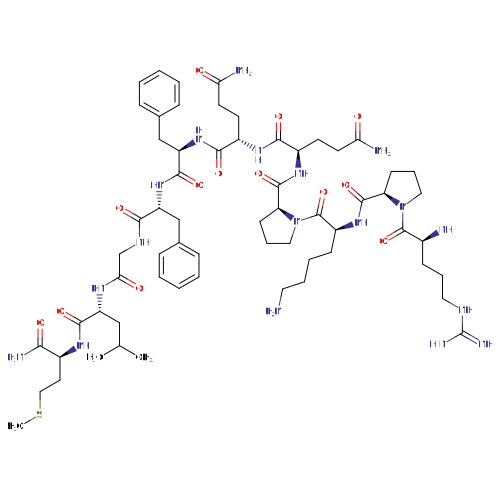
| Record Information |
|---|
| Version | 5.0 |
|---|
| Status | Detected and Quantified |
|---|
| Creation Date | 2006-03-08 15:00:54 UTC |
|---|
| Update Date | 2021-09-14 15:45:51 UTC |
|---|
| HMDB ID | HMDB0001897 |
|---|
| Secondary Accession Numbers | |
|---|
| Metabolite Identification |
|---|
| Common Name | Substance P |
|---|
| Description | Substance P (SP), is an 11-amino acid neuropeptide. SP is a member of the tachykinin family of peptides because it induces rapid smooth muscle contraction in guinea pig ileum and rat duodenum. Other members of the tachykinin family, sharing common carboxyl terminal Phe-X-Gly-Leu-met-NH2 sequences in mammals, include neurokinin A and neurokinin B. In mammals, tachykinins are produced by two genes, preprotachykinin-A (PPT-A) and preprotachykinin-B (PPT-B), and SP is a product of the PPT-A gene. SP is localized in the central nervous system as well as in several peripheral tissues, including the entire length of the gastrointestinal tract as well as the colon. The main sources of SP in the gut include the myenteric and submucosal plexus, intrinsic sensory neurons, as well as sensory neurons originating from the dorsal root ganglia. A newly identified gene, preprotachykinin C gene, encodes for the sequence of a new preprotachykinin protein designated hemokinin (HK) and produced primarily by hematopoietic cells. HK binds with high selectivity to NK-1R and has similar in vivo potency to SP. Like SP, HK is an 11-amino acid peptide having ~55% amino acid similarity to SP. The effects of SP are mediated by three different G-protein-coupled receptors (GPCRs), namely neurokinin (NK)-1, 2, and 3. SP binds with high affinity to NK-1 receptor (NK-1R), and with low affinity to NK-2 and 3 receptors. NK-1 receptors are present in both small intestine and colon of animals and humans and are localized in a variety of cells, including nerves, smooth muscle, immune cells, glands, endothelial cells, as well as epithelial cells. Although NK-1 receptors have been associated with several intestinal pathophysiologic conditions (see below), NK-2 receptors have been linked mostly with circular muscle contraction, and are localized in circular muscle and muscularis mucosae. Although NK-2 receptors are present predominantly on smooth muscle and, like NK-1, can affect gut motility, NK-3 receptors are expressed predominantly in neurons and can stimulate or diminish muscle contraction indirectly following SP binding to neuronal cells in the submucosal and myenteric nerve plexuses of the gastrointestinal tract. NK-3 receptors also provide slow excitatory synaptic input to neurons in ganglia of the sphincter of Oddi. Thus, both NK-2 and NK-3 receptors affect motility responses in the GI, but there is very little evidence that they are involved in neuroimmune interactions. (PMID: 17192554 ). |
|---|
| Structure | CSCC[C@H](NC(=O)[C@@H](CC(C)C)NC(=O)CNC(=O)[C@@H](CC1=CC=CC=C1)NC(=O)[C@@H](CC1=CC=CC=C1)NC(=O)[C@H](CCC(N)=O)NC(=O)[C@@H](CCC(N)=O)NC(=O)[C@@H]1CCCN1C(=O)[C@H](CCCCN)NC(=O)[C@H]1CCCN1C(=O)[C@@H](N)CCCNC(N)=N)C(N)=O InChI=1S/C63H98N18O13S/c1-37(2)33-45(57(89)74-41(53(68)85)27-32-95-3)73-52(84)36-72-54(86)46(34-38-15-6-4-7-16-38)78-58(90)47(35-39-17-8-5-9-18-39)79-56(88)42(23-25-50(66)82)75-55(87)43(24-26-51(67)83)76-59(91)49-22-14-31-81(49)62(94)44(20-10-11-28-64)77-60(92)48-21-13-30-80(48)61(93)40(65)19-12-29-71-63(69)70/h4-9,15-18,37,40-49H,10-14,19-36,64-65H2,1-3H3,(H2,66,82)(H2,67,83)(H2,68,85)(H,72,86)(H,73,84)(H,74,89)(H,75,87)(H,76,91)(H,77,92)(H,78,90)(H,79,88)(H4,69,70,71)/t40-,41-,42-,43+,44-,45+,46+,47+,48+,49-/m0/s1 |
|---|
| Synonyms | | Value | Source |
|---|
| Arg-pro-lys-pro-GLN-GLN-phe-phe-gly-leu-met-NH2 | HMDB | | (2S)-2-{[(2R)-2-({[(2S)-1-[(2S)-6-amino-2-({[(2R)-1-[(2S)-2-amino-5-carbamimidamidopentanoyl]pyrrolidin-2-yl](hydroxy)methylidene}amino)hexanoyl]pyrrolidin-2-yl](hydroxy)methylidene}amino)-1-hydroxy-4-(C-hydroxycarbonimidoyl)butylidene]amino}-N-[(1R)-1-{[(1R)-1-[({[(1R)-1-{[(1S)-1-(C-hydroxycarbonimidoyl)-3-(methylsulfanyl)propyl]-C-hydroxycarbonimidoyl}-3-methylbutyl]-C-hydroxycarbonimidoyl}methyl)-C-hydroxycarbonimidoyl]-2-phenylethyl]-C-hydroxycarbonimidoyl}-2-phenylethyl]pentanediimidate | HMDB | | (2S)-2-{[(2R)-2-({[(2S)-1-[(2S)-6-amino-2-({[(2R)-1-[(2S)-2-amino-5-carbamimidamidopentanoyl]pyrrolidin-2-yl](hydroxy)methylidene}amino)hexanoyl]pyrrolidin-2-yl](hydroxy)methylidene}amino)-1-hydroxy-4-(C-hydroxycarbonimidoyl)butylidene]amino}-N-[(1R)-1-{[(1R)-1-[({[(1R)-1-{[(1S)-1-(C-hydroxycarbonimidoyl)-3-(methylsulphanyl)propyl]-C-hydroxycarbonimidoyl}-3-methylbutyl]-C-hydroxycarbonimidoyl}methyl)-C-hydroxycarbonimidoyl]-2-phenylethyl]-C-hydroxycarbonimidoyl}-2-phenylethyl]pentanediimidate | HMDB | | (2S)-2-{[(2R)-2-({[(2S)-1-[(2S)-6-amino-2-({[(2R)-1-[(2S)-2-amino-5-carbamimidamidopentanoyl]pyrrolidin-2-yl](hydroxy)methylidene}amino)hexanoyl]pyrrolidin-2-yl](hydroxy)methylidene}amino)-1-hydroxy-4-(C-hydroxycarbonimidoyl)butylidene]amino}-N-[(1R)-1-{[(1R)-1-[({[(1R)-1-{[(1S)-1-(C-hydroxycarbonimidoyl)-3-(methylsulphanyl)propyl]-C-hydroxycarbonimidoyl}-3-methylbutyl]-C-hydroxycarbonimidoyl}methyl)-C-hydroxycarbonimidoyl]-2-phenylethyl]-C-hydroxycarbonimidoyl}-2-phenylethyl]pentanediimidic acid | HMDB |
|
|---|
| Chemical Formula | C63H98N18O13S |
|---|
| Average Molecular Weight | 1347.63 |
|---|
| Monoisotopic Molecular Weight | 1346.728146002 |
|---|
| IUPAC Name | (2S)-2-[(2R)-2-{[(2S)-1-[(2S)-6-amino-2-{[(2R)-1-[(2S)-2-amino-5-carbamimidamidopentanoyl]pyrrolidin-2-yl]formamido}hexanoyl]pyrrolidin-2-yl]formamido}-4-carbamoylbutanamido]-N-[(1R)-1-{[(1R)-1-[({[(1R)-1-{[(1S)-1-carbamoyl-3-(methylsulfanyl)propyl]carbamoyl}-3-methylbutyl]carbamoyl}methyl)carbamoyl]-2-phenylethyl]carbamoyl}-2-phenylethyl]pentanediamide |
|---|
| Traditional Name | (2S)-2-[(2R)-2-{[(2S)-1-[(2S)-6-amino-2-{[(2R)-1-[(2S)-2-amino-5-carbamimidamidopentanoyl]pyrrolidin-2-yl]formamido}hexanoyl]pyrrolidin-2-yl]formamido}-4-carbamoylbutanamido]-N-[(1R)-1-{[(1R)-1-[({[(1R)-1-{[(1S)-1-carbamoyl-3-(methylsulfanyl)propyl]carbamoyl}-3-methylbutyl]carbamoyl}methyl)carbamoyl]-2-phenylethyl]carbamoyl}-2-phenylethyl]pentanediamide |
|---|
| CAS Registry Number | 33507-63-0 |
|---|
| SMILES | CSCC[C@H](NC(=O)[C@@H](CC(C)C)NC(=O)CNC(=O)[C@@H](CC1=CC=CC=C1)NC(=O)[C@@H](CC1=CC=CC=C1)NC(=O)[C@H](CCC(N)=O)NC(=O)[C@@H](CCC(N)=O)NC(=O)[C@@H]1CCCN1C(=O)[C@H](CCCCN)NC(=O)[C@H]1CCCN1C(=O)[C@@H](N)CCCNC(N)=N)C(N)=O |
|---|
| InChI Identifier | InChI=1S/C63H98N18O13S/c1-37(2)33-45(57(89)74-41(53(68)85)27-32-95-3)73-52(84)36-72-54(86)46(34-38-15-6-4-7-16-38)78-58(90)47(35-39-17-8-5-9-18-39)79-56(88)42(23-25-50(66)82)75-55(87)43(24-26-51(67)83)76-59(91)49-22-14-31-81(49)62(94)44(20-10-11-28-64)77-60(92)48-21-13-30-80(48)61(93)40(65)19-12-29-71-63(69)70/h4-9,15-18,37,40-49H,10-14,19-36,64-65H2,1-3H3,(H2,66,82)(H2,67,83)(H2,68,85)(H,72,86)(H,73,84)(H,74,89)(H,75,87)(H,76,91)(H,77,92)(H,78,90)(H,79,88)(H4,69,70,71)/t40-,41-,42-,43+,44-,45+,46+,47+,48+,49-/m0/s1 |
|---|
| InChI Key | ADNPLDHMAVUMIW-SGTHPBLKSA-N |
|---|
| Chemical Taxonomy |
|---|
| Description | Belongs to the class of organic compounds known as tocopherols. These are vitamin E derivatives containing a saturated trimethyltridecyl chain attached to the carbon C6 atom of a benzopyran ring system. The differ from tocotrienols that contain an unsaturated trimethyltrideca-3,7,11-trien-1-yl chain. |
|---|
| Kingdom | Organic compounds |
|---|
| Super Class | Lipids and lipid-like molecules |
|---|
| Class | Prenol lipids |
|---|
| Sub Class | Quinone and hydroquinone lipids |
|---|
| Direct Parent | Tocopherols |
|---|
| Alternative Parents | |
|---|
| Substituents | - Tocopherol
- Diterpenoid
- 1-benzopyran
- Benzopyran
- Chromane
- Alkyl aryl ether
- Benzenoid
- Oxacycle
- Organoheterocyclic compound
- Ether
- Organic oxygen compound
- Hydrocarbon derivative
- Organooxygen compound
- Aromatic heteropolycyclic compound
|
|---|
| Molecular Framework | Aromatic heteropolycyclic compounds |
|---|
| External Descriptors | |
|---|
| Ontology |
|---|
| Physiological effect | |
|---|
| Disposition | |
|---|
| Process | Not Available |
|---|
| Role | Not Available |
|---|
| Physical Properties |
|---|
| State | Solid |
|---|
| Experimental Molecular Properties | | Property | Value | Reference |
|---|
| Melting Point | 148 °C | Not Available | | Boiling Point | Not Available | Not Available | | Water Solubility | Not Available | Not Available | | LogP | Not Available | Not Available |
|
|---|
| Experimental Chromatographic Properties | Not Available |
|---|
| Predicted Molecular Properties | |
|---|
| Predicted Chromatographic Properties | Predicted Collision Cross Sections| Predictor | Adduct Type | CCS Value (Å2) | Reference |
|---|
| DeepCCS | [M+H]+ | 350.625 | 30932474 | | DeepCCS | [M-H]- | 348.901 | 30932474 | | DeepCCS | [M-2H]- | 382.933 | 30932474 | | DeepCCS | [M+Na]+ | 356.914 | 30932474 |
Predicted Retention Times Underivatized| Chromatographic Method | Retention Time | Reference |
|---|
| Measured using a Waters Acquity ultraperformance liquid chromatography (UPLC) ethylene-bridged hybrid (BEH) C18 column (100 mm × 2.1 mm; 1.7 μmparticle diameter). Predicted by Afia on May 17, 2022. Predicted by Afia on May 17, 2022. | 0.18 minutes | 32390414 | | Predicted by Siyang on May 30, 2022 | 16.9947 minutes | 33406817 | | Predicted by Siyang using ReTip algorithm on June 8, 2022 | 6.55 minutes | 32390414 | | AjsUoB = Accucore 150 Amide HILIC with 10mM Ammonium Formate, 0.1% Formic Acid | 541.1 seconds | 40023050 | | Fem_Long = Waters ACQUITY UPLC HSS T3 C18 with Water:MeOH and 0.1% Formic Acid | 2168.1 seconds | 40023050 | | Fem_Lipids = Ascentis Express C18 with (60:40 water:ACN):(90:10 IPA:ACN) and 10mM NH4COOH + 0.1% Formic Acid | 149.0 seconds | 40023050 | | Life_Old = Waters ACQUITY UPLC BEH C18 with Water:(20:80 acetone:ACN) and 0.1% Formic Acid | 276.0 seconds | 40023050 | | Life_New = RP Waters ACQUITY UPLC HSS T3 C18 with Water:(30:70 MeOH:ACN) and 0.1% Formic Acid | 210.5 seconds | 40023050 | | RIKEN = Waters ACQUITY UPLC BEH C18 with Water:ACN and 0.1% Formic Acid | 181.7 seconds | 40023050 | | Eawag_XBridgeC18 = XBridge C18 3.5u 2.1x50 mm with Water:MeOH and 0.1% Formic Acid | 463.9 seconds | 40023050 | | BfG_NTS_RP1 =Agilent Zorbax Eclipse Plus C18 (2.1 mm x 150 mm, 3.5 um) with Water:ACN and 0.1% Formic Acid | 554.1 seconds | 40023050 | | HILIC_BDD_2 = Merck SeQuant ZIC-HILIC with ACN(0.1% formic acid):water(16 mM ammonium formate) | 1850.8 seconds | 40023050 | | UniToyama_Atlantis = RP Waters Atlantis T3 (2.1 x 150 mm, 5 um) with ACN:Water and 0.1% Formic Acid | 1228.7 seconds | 40023050 | | BDD_C18 = Hypersil Gold 1.9µm C18 with Water:ACN and 0.1% Formic Acid | 611.1 seconds | 40023050 | | UFZ_Phenomenex = Kinetex Core-Shell C18 2.6 um, 3.0 x 100 mm, Phenomenex with Water:MeOH and 0.1% Formic Acid | 1404.7 seconds | 40023050 | | SNU_RIKEN_POS = Waters ACQUITY UPLC BEH C18 with Water:ACN and 0.1% Formic Acid | 372.6 seconds | 40023050 | | RPMMFDA = Waters ACQUITY UPLC BEH C18 with Water:ACN and 0.1% Formic Acid | 472.8 seconds | 40023050 | | MTBLS87 = Merck SeQuant ZIC-pHILIC column with ACN:Water and :ammonium carbonate | 529.7 seconds | 40023050 | | KI_GIAR_zic_HILIC_pH2_7 = Merck SeQuant ZIC-HILIC with ACN:Water and 0.1% FA | 1306.3 seconds | 40023050 | | Meister zic-pHILIC pH9.3 = Merck SeQuant ZIC-pHILIC column with ACN:Water 5mM NH4Ac pH9.3 and 5mM ammonium acetate in water | 93.3 seconds | 40023050 |
Predicted Kovats Retention IndicesNot Available |
|---|
| Disease References | | Migraine |
|---|
- Fusayasu E, Kowa H, Takeshima T, Nakaso K, Nakashima K: Increased plasma substance P and CGRP levels, and high ACE activity in migraineurs during headache-free periods. Pain. 2007 Apr;128(3):209-14. Epub 2006 Nov 22. [PubMed:17123735 ]
| | Vitamin B12 deficiency |
|---|
- Allen RH, Stabler SP, Savage DG, Lindenbaum J: Elevation of 2-methylcitric acid I and II levels in serum, urine, and cerebrospinal fluid of patients with cobalamin deficiency. Metabolism. 1993 Aug;42(8):978-88. [PubMed:8345822 ]
| | Spina Bifida |
|---|
- Tam PK, Lister J: Elevation of cerebrospinal fluid substance P concentrations in spina bifida. Z Kinderchir. 1984 Dec;39 Suppl 2:89-90. [PubMed:6084371 ]
| | Fibromyalgia |
|---|
- Vaeroy H, Helle R, Forre O, Kass E, Terenius L: Elevated CSF levels of substance P and high incidence of Raynaud phenomenon in patients with fibromyalgia: new features for diagnosis. Pain. 1988 Jan;32(1):21-6. [PubMed:2448729 ]
- Vaeroy H, Sakurada T, Forre O, Kass E, Terenius L: Modulation of pain in fibromyalgia (fibrositis syndrome): cerebrospinal fluid (CSF) investigation of pain related neuropeptides with special reference to calcitonin gene related peptide (CGRP). J Rheumatol Suppl. 1989 Nov;19:94-7. [PubMed:2481742 ]
| | Sleep apnea |
|---|
- Gislason T, Hedner J, Terenius L, Bisette G, Nemeroff CB: Substance P, thyrotropin-releasing hormone, and monoamine metabolites in cerebrospinal fluid in sleep apnea patients. Am Rev Respir Dis. 1992 Sep;146(3):784-6. [PubMed:1381567 ]
| | Alzheimer's disease |
|---|
- Rosler N, Wichart I, Jellinger KA: Clinical significance of neurobiochemical profiles in the lumbar cerebrospinal fluid of Alzheimer's disease patients. J Neural Transm (Vienna). 2001;108(2):231-46. [PubMed:11314776 ]
| | Narcolepsy |
|---|
- Strittmatter M, Isenberg E, Grauer MT, Hamann G, Schimrigk K: CSF substance P somatostatin and monoaminergic transmitter metabolites in patients with narcolepsy. Neurosci Lett. 1996 Nov 1;218(2):99-102. [PubMed:8945737 ]
|
|
|---|