| Record Information |
|---|
| Version | 5.0 |
|---|
| Status | Detected and Quantified |
|---|
| Creation Date | 2005-11-16 15:48:42 UTC |
|---|
| Update Date | 2023-02-21 17:14:31 UTC |
|---|
| HMDB ID | HMDB0000119 |
|---|
| Secondary Accession Numbers | |
|---|
| Metabolite Identification |
|---|
| Common Name | Glyoxylic acid |
|---|
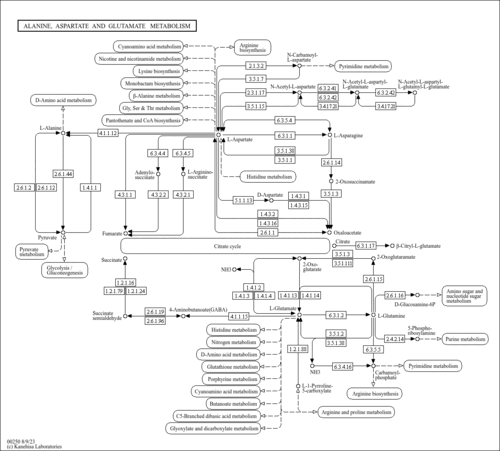
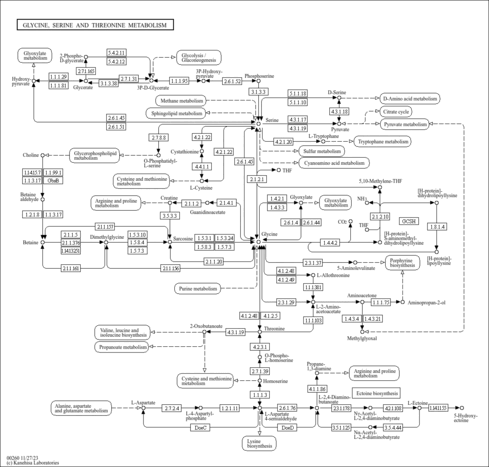
| Description | Glyoxylic acid or oxoacetic acid is an organic compound that is both an aldehyde and a carboxylic acid. Glyoxylic acid is a liquid with a melting point of -93°C and a boiling point of 111°C. It is an intermediate of the glyoxylate cycle, which enables certain organisms to convert fatty acids into carbohydrates. The conjugate base of glyoxylic acid is known as glyoxylate (PMID: 16396466 ). In humans, glyoxylate is produced via two pathways: (1) through the oxidation of glycolate in peroxisomes and (2) through the catabolism of hydroxyproline in mitochondria. In the peroxisomes, glyoxylate is converted into glycine by glyoxylate aminotransferase (AGT1) or into oxalate by glycolate oxidase. In the mitochondria, glyoxylate is converted into glycine by mitochondrial glyoxylate aminotransferase AGT2 or into glycolate by glycolate reductase. A small amount of glyoxylate is converted into oxalate by cytoplasmic lactate dehydrogenase. Glyoxylic acid is found to be associated with primary hyperoxaluria I, which is an inborn error of metabolism. Under certain circumstances, glyoxylate can be a nephrotoxin and a metabotoxin. A nephrotoxin is a compound that causes damage to the kidney and kidney tissues. A metabotoxin is an endogenously produced metabolite that causes adverse health effects at chronically high levels. High levels of glyoxylate are involved in the development of hyperoxaluria, a key cause of nephrolithiasis (commonly known as kidney stones). Glyoxylate is both a substrate and inductor of sulfate anion transporter-1 (SAT-1), a gene responsible for oxalate transportation, allowing it to increase SAT-1 mRNA expression, and as a result oxalate efflux from the cell. The increased oxalate release allows the buildup of calcium oxalate in the urine, and thus the eventual formation of kidney stones. As an aldehyde, glyoxylate is also highly reactive and will modify proteins to form advanced glycation products (AGEs). |
|---|
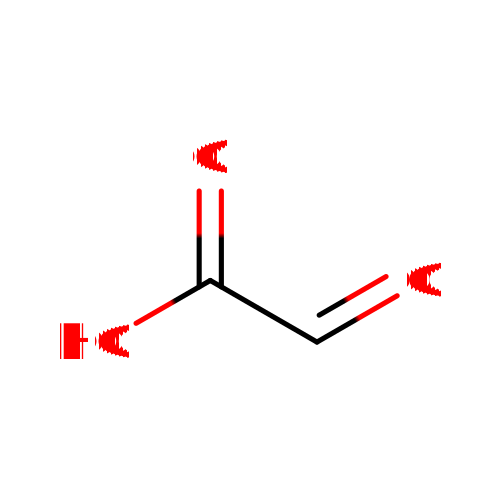
| Structure | InChI=1S/C2H2O3/c3-1-2(4)5/h1H,(H,4,5) |
|---|
| Synonyms | | Value | Source |
|---|
| alpha-Ketoacetic acid | ChEBI | | Formylformic acid | ChEBI | | Glyoxalate | ChEBI | | Glyoxalsaeure | ChEBI | | Glyoxylate | ChEBI | | Glyoxylsaeure | ChEBI | | Oxalaldehydic acid | ChEBI | | Oxoethanoic acid | ChEBI | | a-Ketoacetate | Generator | | a-Ketoacetic acid | Generator | | alpha-Ketoacetate | Generator | | Α-ketoacetate | Generator | | Α-ketoacetic acid | Generator | | Formylformate | Generator | | Glyoxalic acid | Generator | | Oxalaldehydate | Generator | | Oxoethanoate | Generator | | Oxoacetate | HMDB | | Oxoacetic acid | HMDB | | Glyoxylic acid, 2-(14)C-labeled | HMDB | | Glyoxylic acid, sodium salt | HMDB | | Glyoxylic acid, sodium salt, 2-(14)C-labeled | HMDB | | Glyoxylic acid, 14c2-labeled | HMDB | | Glyoxylic acid, calcium salt | HMDB | | Glyoxylic acid, sodium salt, 14C-labeled | HMDB |
|
|---|
| Chemical Formula | C2H2O3 |
|---|
| Average Molecular Weight | 74.0355 |
|---|
| Monoisotopic Molecular Weight | 74.00039393 |
|---|
| IUPAC Name | 2-oxoacetic acid |
|---|
| Traditional Name | glyoxylic acid |
|---|
| CAS Registry Number | 298-12-4 |
|---|
| SMILES | OC(=O)C=O |
|---|
| InChI Identifier | InChI=1S/C2H2O3/c3-1-2(4)5/h1H,(H,4,5) |
|---|
| InChI Key | HHLFWLYXYJOTON-UHFFFAOYSA-N |
|---|
| Chemical Taxonomy |
|---|
| Description | Belongs to the class of organic compounds known as carboxylic acids. Carboxylic acids are compounds containing a carboxylic acid group with the formula -C(=O)OH. |
|---|
| Kingdom | Organic compounds |
|---|
| Super Class | Organic acids and derivatives |
|---|
| Class | Carboxylic acids and derivatives |
|---|
| Sub Class | Carboxylic acids |
|---|
| Direct Parent | Carboxylic acids |
|---|
| Alternative Parents | |
|---|
| Substituents | - Monocarboxylic acid or derivatives
- Carboxylic acid
- Organic oxygen compound
- Organic oxide
- Hydrocarbon derivative
- Short-chain aldehyde
- Organooxygen compound
- Carbonyl group
- Aldehyde
- Aliphatic acyclic compound
|
|---|
| Molecular Framework | Aliphatic acyclic compounds |
|---|
| External Descriptors | |
|---|
| Ontology |
|---|
| Physiological effect | Not Available |
|---|
| Disposition | |
|---|
| Process | |
|---|
| Role | |
|---|
| Physical Properties |
|---|
| State | Liquid |
|---|
| Experimental Molecular Properties | | Property | Value | Reference |
|---|
| Melting Point | -93 °C | Not Available | | Boiling Point | Not Available | Not Available | | Water Solubility | Not Available | Not Available | | LogP | Not Available | Not Available |
|
|---|
| Experimental Chromatographic Properties | Not Available |
|---|
| Predicted Molecular Properties | |
|---|
| Predicted Chromatographic Properties | Predicted Collision Cross SectionsPredicted Retention Times Underivatized| Chromatographic Method | Retention Time | Reference |
|---|
| Measured using a Waters Acquity ultraperformance liquid chromatography (UPLC) ethylene-bridged hybrid (BEH) C18 column (100 mm × 2.1 mm; 1.7 μmparticle diameter). Predicted by Afia on May 17, 2022. Predicted by Afia on May 17, 2022. | 1.07 minutes | 32390414 | | Predicted by Siyang on May 30, 2022 | 9.0848 minutes | 33406817 | | Predicted by Siyang using ReTip algorithm on June 8, 2022 | 4.14 minutes | 32390414 | | AjsUoB = Accucore 150 Amide HILIC with 10mM Ammonium Formate, 0.1% Formic Acid | 235.3 seconds | 40023050 | | Fem_Long = Waters ACQUITY UPLC HSS T3 C18 with Water:MeOH and 0.1% Formic Acid | 768.2 seconds | 40023050 | | Fem_Lipids = Ascentis Express C18 with (60:40 water:ACN):(90:10 IPA:ACN) and 10mM NH4COOH + 0.1% Formic Acid | 381.9 seconds | 40023050 | | Life_Old = Waters ACQUITY UPLC BEH C18 with Water:(20:80 acetone:ACN) and 0.1% Formic Acid | 128.1 seconds | 40023050 | | Life_New = RP Waters ACQUITY UPLC HSS T3 C18 with Water:(30:70 MeOH:ACN) and 0.1% Formic Acid | 294.0 seconds | 40023050 | | RIKEN = Waters ACQUITY UPLC BEH C18 with Water:ACN and 0.1% Formic Acid | 125.0 seconds | 40023050 | | Eawag_XBridgeC18 = XBridge C18 3.5u 2.1x50 mm with Water:MeOH and 0.1% Formic Acid | 291.1 seconds | 40023050 | | BfG_NTS_RP1 =Agilent Zorbax Eclipse Plus C18 (2.1 mm x 150 mm, 3.5 um) with Water:ACN and 0.1% Formic Acid | 374.5 seconds | 40023050 | | HILIC_BDD_2 = Merck SeQuant ZIC-HILIC with ACN(0.1% formic acid):water(16 mM ammonium formate) | 498.0 seconds | 40023050 | | UniToyama_Atlantis = RP Waters Atlantis T3 (2.1 x 150 mm, 5 um) with ACN:Water and 0.1% Formic Acid | 611.3 seconds | 40023050 | | BDD_C18 = Hypersil Gold 1.9µm C18 with Water:ACN and 0.1% Formic Acid | 117.1 seconds | 40023050 | | UFZ_Phenomenex = Kinetex Core-Shell C18 2.6 um, 3.0 x 100 mm, Phenomenex with Water:MeOH and 0.1% Formic Acid | 813.5 seconds | 40023050 | | SNU_RIKEN_POS = Waters ACQUITY UPLC BEH C18 with Water:ACN and 0.1% Formic Acid | 250.2 seconds | 40023050 | | RPMMFDA = Waters ACQUITY UPLC BEH C18 with Water:ACN and 0.1% Formic Acid | 337.0 seconds | 40023050 | | MTBLS87 = Merck SeQuant ZIC-pHILIC column with ACN:Water and :ammonium carbonate | 733.2 seconds | 40023050 | | KI_GIAR_zic_HILIC_pH2_7 = Merck SeQuant ZIC-HILIC with ACN:Water and 0.1% FA | 301.8 seconds | 40023050 | | Meister zic-pHILIC pH9.3 = Merck SeQuant ZIC-pHILIC column with ACN:Water 5mM NH4Ac pH9.3 and 5mM ammonium acetate in water | 358.3 seconds | 40023050 |
Predicted Kovats Retention IndicesUnderivatizedDerivatized |
|---|
| GC-MS Spectra| Spectrum Type | Description | Splash Key | Deposition Date | Source | View |
|---|
| Experimental GC-MS | GC-MS Spectrum - Glyoxylic acid GC-MS (1 MEOX; 1 TMS) | splash10-03di-3900000000-16bc69e0e9d51e54854e | 2014-06-16 | HMDB team, MONA, MassBank | View Spectrum | | Experimental GC-MS | GC-MS Spectrum - Glyoxylic acid GC-MS (Non-derivatized) | splash10-03di-3900000000-16bc69e0e9d51e54854e | 2017-09-12 | HMDB team, MONA, MassBank | View Spectrum | | Predicted GC-MS | Predicted GC-MS Spectrum - Glyoxylic acid GC-MS (Non-derivatized) - 70eV, Positive | splash10-0096-9000000000-042540a05be250278f8b | 2016-09-22 | Wishart Lab | View Spectrum | | Predicted GC-MS | Predicted GC-MS Spectrum - Glyoxylic acid GC-MS (1 TMS) - 70eV, Positive | splash10-00fr-9200000000-c60b627ed670285ec37f | 2017-10-06 | Wishart Lab | View Spectrum | | Predicted GC-MS | Predicted GC-MS Spectrum - Glyoxylic acid GC-MS (Non-derivatized) - 70eV, Positive | Not Available | 2021-10-12 | Wishart Lab | View Spectrum | | Predicted GC-MS | Predicted GC-MS Spectrum - Glyoxylic acid GC-MS (TBDMS_1_1) - 70eV, Positive | Not Available | 2021-11-05 | Wishart Lab | View Spectrum | | MS | Mass Spectrum (Electron Ionization) | splash10-004l-9000000000-a04bafbf8e0b990094a3 | 2014-09-20 | Not Available | View Spectrum |
MS/MS Spectra| Spectrum Type | Description | Splash Key | Deposition Date | Source | View |
|---|
| Experimental LC-MS/MS | LC-MS/MS Spectrum - Glyoxylic acid Quattro_QQQ 10V, Negative-QTOF (Annotated) | splash10-00di-9000000000-72c34bc34b8c3341442b | 2012-07-24 | HMDB team, MONA | View Spectrum | | Experimental LC-MS/MS | LC-MS/MS Spectrum - Glyoxylic acid Quattro_QQQ 25V, Negative-QTOF (Annotated) | splash10-00di-9000000000-920a0dc738957201d4ba | 2012-07-24 | HMDB team, MONA | View Spectrum | | Experimental LC-MS/MS | LC-MS/MS Spectrum - Glyoxylic acid Quattro_QQQ 40V, Negative-QTOF (Annotated) | splash10-00di-9000000000-857c7f2d72c3d4c10dbf | 2012-07-24 | HMDB team, MONA | View Spectrum | | Experimental LC-MS/MS | LC-MS/MS Spectrum - Glyoxylic acid LC-ESI-QQ (API3000, Applied Biosystems) 10V, Negative-QTOF | splash10-00di-9000000000-9b5825d5d9d8b094fefa | 2012-08-31 | HMDB team, MONA | View Spectrum | | Experimental LC-MS/MS | LC-MS/MS Spectrum - Glyoxylic acid LC-ESI-QQ (API3000, Applied Biosystems) 20V, Negative-QTOF | splash10-00di-9000000000-de556f03ea428deff5e2 | 2012-08-31 | HMDB team, MONA | View Spectrum | | Experimental LC-MS/MS | LC-MS/MS Spectrum - Glyoxylic acid LC-ESI-QQ (API3000, Applied Biosystems) 30V, Negative-QTOF | splash10-00dl-9000000000-74b253632894213d473c | 2012-08-31 | HMDB team, MONA | View Spectrum | | Experimental LC-MS/MS | LC-MS/MS Spectrum - Glyoxylic acid LC-ESI-QQ , negative-QTOF | splash10-00di-9000000000-9b5825d5d9d8b094fefa | 2017-09-14 | HMDB team, MONA | View Spectrum | | Experimental LC-MS/MS | LC-MS/MS Spectrum - Glyoxylic acid LC-ESI-QQ , negative-QTOF | splash10-00di-9000000000-de556f03ea428deff5e2 | 2017-09-14 | HMDB team, MONA | View Spectrum | | Experimental LC-MS/MS | LC-MS/MS Spectrum - Glyoxylic acid LC-ESI-QQ , negative-QTOF | splash10-00dl-9000000000-74b253632894213d473c | 2017-09-14 | HMDB team, MONA | View Spectrum | | Predicted LC-MS/MS | Predicted LC-MS/MS Spectrum - Glyoxylic acid 10V, Positive-QTOF | splash10-004i-9000000000-a8cc2c89793394fdf9e4 | 2015-04-24 | Wishart Lab | View Spectrum | | Predicted LC-MS/MS | Predicted LC-MS/MS Spectrum - Glyoxylic acid 20V, Positive-QTOF | splash10-0a6r-9000000000-d20183b08984d4766e8a | 2015-04-24 | Wishart Lab | View Spectrum | | Predicted LC-MS/MS | Predicted LC-MS/MS Spectrum - Glyoxylic acid 40V, Positive-QTOF | splash10-0a4i-9000000000-ea9968e3933fd734506c | 2015-04-24 | Wishart Lab | View Spectrum | | Predicted LC-MS/MS | Predicted LC-MS/MS Spectrum - Glyoxylic acid 10V, Negative-QTOF | splash10-00di-9000000000-cef8efc477a2500a7ead | 2015-04-25 | Wishart Lab | View Spectrum | | Predicted LC-MS/MS | Predicted LC-MS/MS Spectrum - Glyoxylic acid 20V, Negative-QTOF | splash10-00di-9000000000-3817c0865df629803538 | 2015-04-25 | Wishart Lab | View Spectrum | | Predicted LC-MS/MS | Predicted LC-MS/MS Spectrum - Glyoxylic acid 40V, Negative-QTOF | splash10-00di-9000000000-bb935f857fb5fd08c7e3 | 2015-04-25 | Wishart Lab | View Spectrum | | Predicted LC-MS/MS | Predicted LC-MS/MS Spectrum - Glyoxylic acid 10V, Positive-QTOF | splash10-0a4i-9000000000-8f50f0d32d4c40b5b935 | 2021-09-24 | Wishart Lab | View Spectrum | | Predicted LC-MS/MS | Predicted LC-MS/MS Spectrum - Glyoxylic acid 20V, Positive-QTOF | splash10-0a4i-9000000000-b6216caa16afdf328489 | 2021-09-24 | Wishart Lab | View Spectrum | | Predicted LC-MS/MS | Predicted LC-MS/MS Spectrum - Glyoxylic acid 40V, Positive-QTOF | splash10-0a4i-9000000000-aa6a654e73df38a43273 | 2021-09-24 | Wishart Lab | View Spectrum | | Predicted LC-MS/MS | Predicted LC-MS/MS Spectrum - Glyoxylic acid 10V, Negative-QTOF | splash10-00di-9000000000-c6f38ec60bcf8724ecd1 | 2021-09-24 | Wishart Lab | View Spectrum | | Predicted LC-MS/MS | Predicted LC-MS/MS Spectrum - Glyoxylic acid 20V, Negative-QTOF | splash10-00di-9000000000-c6f38ec60bcf8724ecd1 | 2021-09-24 | Wishart Lab | View Spectrum | | Predicted LC-MS/MS | Predicted LC-MS/MS Spectrum - Glyoxylic acid 40V, Negative-QTOF | splash10-00dl-9000000000-641421c616a0929ce01e | 2021-09-24 | Wishart Lab | View Spectrum |
NMR Spectra| Spectrum Type | Description | Deposition Date | Source | View |
|---|
| Experimental 1D NMR | 1H NMR Spectrum (1D, 600 MHz, H2O, experimental) | 2012-12-04 | Wishart Lab | View Spectrum | | Predicted 1D NMR | 1H NMR Spectrum (1D, 100 MHz, D2O, predicted) | 2021-09-29 | Wishart Lab | View Spectrum | | Predicted 1D NMR | 13C NMR Spectrum (1D, 100 MHz, D2O, predicted) | 2021-09-29 | Wishart Lab | View Spectrum | | Predicted 1D NMR | 1H NMR Spectrum (1D, 1000 MHz, D2O, predicted) | 2021-09-29 | Wishart Lab | View Spectrum | | Predicted 1D NMR | 13C NMR Spectrum (1D, 1000 MHz, D2O, predicted) | 2021-09-29 | Wishart Lab | View Spectrum | | Predicted 1D NMR | 1H NMR Spectrum (1D, 200 MHz, D2O, predicted) | 2021-09-29 | Wishart Lab | View Spectrum | | Predicted 1D NMR | 13C NMR Spectrum (1D, 200 MHz, D2O, predicted) | 2021-09-29 | Wishart Lab | View Spectrum | | Predicted 1D NMR | 1H NMR Spectrum (1D, 300 MHz, D2O, predicted) | 2021-09-29 | Wishart Lab | View Spectrum | | Predicted 1D NMR | 13C NMR Spectrum (1D, 300 MHz, D2O, predicted) | 2021-09-29 | Wishart Lab | View Spectrum | | Predicted 1D NMR | 1H NMR Spectrum (1D, 400 MHz, D2O, predicted) | 2021-09-29 | Wishart Lab | View Spectrum | | Predicted 1D NMR | 13C NMR Spectrum (1D, 400 MHz, D2O, predicted) | 2021-09-29 | Wishart Lab | View Spectrum | | Predicted 1D NMR | 1H NMR Spectrum (1D, 500 MHz, D2O, predicted) | 2021-09-29 | Wishart Lab | View Spectrum | | Predicted 1D NMR | 13C NMR Spectrum (1D, 500 MHz, D2O, predicted) | 2021-09-29 | Wishart Lab | View Spectrum | | Predicted 1D NMR | 1H NMR Spectrum (1D, 600 MHz, D2O, predicted) | 2021-09-29 | Wishart Lab | View Spectrum | | Predicted 1D NMR | 13C NMR Spectrum (1D, 600 MHz, D2O, predicted) | 2021-09-29 | Wishart Lab | View Spectrum | | Predicted 1D NMR | 1H NMR Spectrum (1D, 700 MHz, D2O, predicted) | 2021-09-29 | Wishart Lab | View Spectrum | | Predicted 1D NMR | 13C NMR Spectrum (1D, 700 MHz, D2O, predicted) | 2021-09-29 | Wishart Lab | View Spectrum | | Predicted 1D NMR | 1H NMR Spectrum (1D, 800 MHz, D2O, predicted) | 2021-09-29 | Wishart Lab | View Spectrum | | Predicted 1D NMR | 13C NMR Spectrum (1D, 800 MHz, D2O, predicted) | 2021-09-29 | Wishart Lab | View Spectrum | | Predicted 1D NMR | 1H NMR Spectrum (1D, 900 MHz, D2O, predicted) | 2021-09-29 | Wishart Lab | View Spectrum | | Predicted 1D NMR | 13C NMR Spectrum (1D, 900 MHz, D2O, predicted) | 2021-09-29 | Wishart Lab | View Spectrum | | Experimental 2D NMR | [1H, 13C]-HSQC NMR Spectrum (2D, 600 MHz, H2O, experimental) | 2012-12-04 | Wishart Lab | View Spectrum |
IR Spectra| Spectrum Type | Description | Deposition Date | Source | View |
|---|
| Predicted IR Spectrum | IR Ion Spectrum (Predicted IRIS Spectrum, Adduct: [M-H]-) | 2023-02-03 | FELIX lab | View Spectrum | | Predicted IR Spectrum | IR Ion Spectrum (Predicted IRIS Spectrum, Adduct: [M+H]+) | 2023-02-03 | FELIX lab | View Spectrum | | Predicted IR Spectrum | IR Ion Spectrum (Predicted IRIS Spectrum, Adduct: [M+Na]+) | 2023-02-03 | FELIX lab | View Spectrum |
|
|---|
| Disease References | | Transurethral resection of the prostate |
|---|
- Perier C, Mahul P, Molliex S, Auboyer C, Frey J: Progressive changes in glycine and glycine derivatives in plasma and cerebrospinal fluid after transurethral prostatic resection. Clin Chem. 1990 Dec;36(12):2152-3. [PubMed:2253377 ]
| | Bladder infections |
|---|
- Braundmeier-Fleming A, Russell NT, Yang W, Nas MY, Yaggie RE, Berry M, Bachrach L, Flury SC, Marko DS, Bushell CB, Welge ME, White BA, Schaeffer AJ, Klumpp DJ: Stool-based biomarkers of interstitial cystitis/bladder pain syndrome. Sci Rep. 2016 May 18;6:26083. doi: 10.1038/srep26083. [PubMed:27188581 ]
| | Primary hyperoxaluria I |
|---|
- Holmgren G, Hornstrom T, Johansson S, Samuelson G: Primary hyperoxaluria (glycolic acid variant): a clinical and genetical investigation of eight cases. Ups J Med Sci. 1978;83(1):65-70. [PubMed:705974 ]
|
|
|---|
| General References | - Lee SH, Kim SO, Chung BC: Gas chromatographic-mass spectrometric determination of urinary oxoacids using O-(2,3,4,5,6-pentafluorobenzyl)oxime-trimethylsilyl ester derivatization and cation-exchange chromatography. J Chromatogr B Biomed Sci Appl. 1998 Nov 20;719(1-2):1-7. [PubMed:9869358 ]
- Booth ED, Dofferhoff O, Boogaard PJ, Watson WP: Comparison of the metabolism of ethylene glycol and glycolic acid in vitro by precision-cut tissue slices from female rat, rabbit and human liver. Xenobiotica. 2004 Jan;34(1):31-48. [PubMed:14742135 ]
- Naghizadeh F, Barlow D, King J: The reduction of oxo-acids by human tissue extracts. Clin Biochem. 1976 Apr;9(2):65-6. [PubMed:1261003 ]
- Borondy PE, Michniewicz BM: Metabolic disposition of isoxicam in man, monkey, dog, and rat. Drug Metab Dispos. 1984 Jul-Aug;12(4):444-51. [PubMed:6148211 ]
- Arvesen A, Maehlen J, Rosen L, Aas P: Myointimal hyperplasia and sympathetic reinnervation following local cold injury and rapid rewarming in the rabbit central ear artery. Vasa. 2001 Jul;30(3):176-83. [PubMed:11582947 ]
- Motomiya Y, Oyama N, Iwamoto H, Uchimura T, Maruyama I: N epsilon-(carboxymethyl)lysine in blood from maintenance hemodialysis patients may contribute to dialysis-related amyloidosis. Kidney Int. 1998 Oct;54(4):1357-66. [PubMed:9767556 ]
- Holmes E, Foxall PJ, Spraul M, Farrant RD, Nicholson JK, Lindon JC: 750 MHz 1H NMR spectroscopy characterisation of the complex metabolic pattern of urine from patients with inborn errors of metabolism: 2-hydroxyglutaric aciduria and maple syrup urine disease. J Pharm Biomed Anal. 1997 Jul;15(11):1647-59. [PubMed:9260660 ]
- Mentasti E, Savigliano M, Marangella M, Petrarulo M, Linari F: High-performance liquid chromatographic determination of glyoxylic acid and other carbonyl compounds in urine. J Chromatogr. 1987 Jul 3;417(2):253-60. [PubMed:3654878 ]
- Bruzzese FJ, Dix JA, Rava RP, Cerny LC: Resonance Raman spectroscopy of chemically modified hemoglobins. Biomater Artif Cells Artif Organs. 1990;18(2):143-56. [PubMed:2369642 ]
- Schmitt A, Gasic-Milenkovic J, Schmitt J: Characterization of advanced glycation end products: mass changes in correlation to side chain modifications. Anal Biochem. 2005 Nov 1;346(1):101-6. Epub 2005 Aug 15. [PubMed:16168380 ]
- Tainio H, Vaalasti A, Rechardt L: The distribution of sympathetic adrenergic, tyrosine hydroxylase- and neuropeptide Y-immunoreactive nerves in human axillary sweat glands. Histochemistry. 1986;85(2):117-20. [PubMed:2875046 ]
- Davis WL, Goodman DB: Evidence for the glyoxylate cycle in human liver. Anat Rec. 1992 Dec;234(4):461-8. [PubMed:1456449 ]
- Arvesen A, Maehlen J, Rosen L, Aas P: Early and late functional and histopathological perturbations in the rabbit ear-artery following local cold injury. Vasa. 1999 May;28(2):85-94. [PubMed:10409918 ]
- Popov VN, Moskalev EA, Shevchenko MIu, Eprintsev AT: [Comparative analysis of the glyoxylate cycle clue enzyme isocitrate lyases from organisms of different systemic groups]. Zh Evol Biokhim Fiziol. 2005 Nov-Dec;41(6):507-13. [PubMed:16396466 ]
|
|---|