| Record Information |
|---|
| Version | 5.0 |
|---|
| Status | Detected and Quantified |
|---|
| Creation Date | 2005-11-16 15:48:42 UTC |
|---|
| Update Date | 2023-02-21 17:14:34 UTC |
|---|
| HMDB ID | HMDB0000152 |
|---|
| Secondary Accession Numbers | |
|---|
| Metabolite Identification |
|---|
| Common Name | Gentisic acid |
|---|
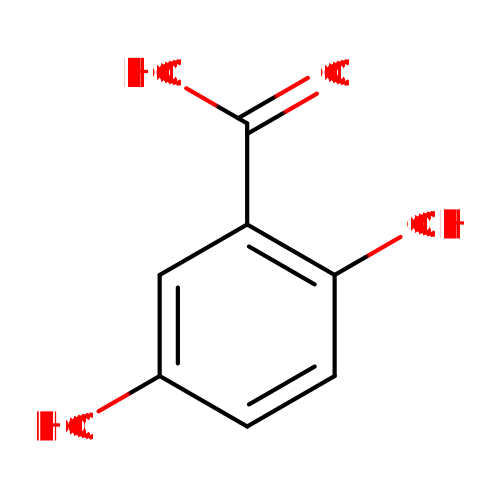
| Description | Gentisic acid, also known as gentisate or 2,5-dioxybenzoate, belongs to the class of organic compounds known as hydroxybenzoic acid derivatives. Hydroxybenzoic acid derivatives are compounds containing a hydroxybenzoic acid (or a derivative), which is a benzene ring bearing a carboxyl and a hydroxyl groups. Gentisic acid is also classified as a dihydroxybenzoic acid. It is a derivative of benzoic acid and a minor (1%) product of the metabolic break down of aspirin, which is excreted by the kidneys. Gentisic acid is found in essentially all organisms ranging from bacteria to fungi to plants to animals. Gentisic acid has been associated with a number of useful effects on human health and exhibits anti-inflammatory, antigenotoxic, hepatoprotective, neuroprotective, antimicrobial, and especially antioxidant activities (PMID: 31825145 ). It is widely distributed in plants as a secondary plant product such as Gentiana spp., Citrus spp., Vitis vinifera, Pterocarpus santalinus, Helianthus tuberosus, Hibiscus rosa-sinensis, Olea europaea, and Sesamum indicum and in fruits such as avocados, batoko plum, kiwi fruits, apple, bitter melon, black berries, pears, and some mushrooms (PMID: 31825145 ). Gentisic acid is found in higher concentrations in a number of foods such as tarragons, common thymes, and common sages and in a lower concentration in grape wines, rosemaries, and sweet marjorams. Gentisic acid has also been shown to act as a pathogen-inducible signal for the activation of plant defenses in tomato plants and cucumbers (PMID: 16321412 ; https://doi.org/10.1094/MPMI.1999.12.3.227). |
|---|
| Structure | InChI=1S/C7H6O4/c8-4-1-2-6(9)5(3-4)7(10)11/h1-3,8-9H,(H,10,11) |
|---|
| Synonyms | | Value | Source |
|---|
| 2,5-Dihydroxybenzoate | ChEBI | | 5-Hydroxysalicylic acid | ChEBI | | Gentisate | ChEBI | | Hydroquinonecarboxylic acid | ChEBI | | 2,5-Dihydroxybenzoic acid | Kegg | | 5-Hydroxysalicylate | Generator | | Hydroquinonecarboxylate | Generator | | 2,5-Dioxybenzoate | HMDB | | 2,5-Dioxybenzoic acid | HMDB | | 3,6-Dihydroxybenzoate | HMDB | | 3,6-Dihydroxybenzoic acid | HMDB | | 5-Hydroxy-salicylate | HMDB | | 5-Hydroxy-salicylic acid | HMDB | | Carboxyhydroquinone | HMDB | | Dihydroxybenzoicacid | HMDB | | Gensigen | HMDB | | Gensigon | HMDB | | Gentisinate | HMDB | | Gentisinic acid | HMDB | | 2,5-Dihydroxybenzoic acid, monosodium salt | HMDB | | Lithium 2,5-dihydroxybenzoate | HMDB | | Gentisic acid | ChEBI | | Hydroquinone carboxylic acid | HMDB |
|
|---|
| Chemical Formula | C7H6O4 |
|---|
| Average Molecular Weight | 154.121 |
|---|
| Monoisotopic Molecular Weight | 154.026608673 |
|---|
| IUPAC Name | 2,5-dihydroxybenzoic acid |
|---|
| Traditional Name | 2,5-dihydroxybenzoic acid |
|---|
| CAS Registry Number | 490-79-9 |
|---|
| SMILES | OC(=O)C1=C(O)C=CC(O)=C1 |
|---|
| InChI Identifier | InChI=1S/C7H6O4/c8-4-1-2-6(9)5(3-4)7(10)11/h1-3,8-9H,(H,10,11) |
|---|
| InChI Key | WXTMDXOMEHJXQO-UHFFFAOYSA-N |
|---|
| Chemical Taxonomy |
|---|
| Description | Belongs to the class of organic compounds known as hydroxybenzoic acid derivatives. Hydroxybenzoic acid derivatives are compounds containing a hydroxybenzoic acid (or a derivative), which is a benzene ring bearing a carboxyl and a hydroxyl groups. |
|---|
| Kingdom | Organic compounds |
|---|
| Super Class | Benzenoids |
|---|
| Class | Benzene and substituted derivatives |
|---|
| Sub Class | Benzoic acids and derivatives |
|---|
| Direct Parent | Hydroxybenzoic acid derivatives |
|---|
| Alternative Parents | |
|---|
| Substituents | - Dihydroxybenzoic acid
- Salicylic acid
- Salicylic acid or derivatives
- Hydroxybenzoic acid
- Benzoic acid
- Benzoyl
- Hydroquinone
- 1-hydroxy-2-unsubstituted benzenoid
- Phenol
- Vinylogous acid
- Carboxylic acid derivative
- Carboxylic acid
- Monocarboxylic acid or derivatives
- Organic oxygen compound
- Hydrocarbon derivative
- Organooxygen compound
- Organic oxide
- Aromatic homomonocyclic compound
|
|---|
| Molecular Framework | Aromatic homomonocyclic compounds |
|---|
| External Descriptors | |
|---|
| Ontology |
|---|
| Not Available | Not Available |
|---|
| Physical Properties |
|---|
| State | Solid |
|---|
| Experimental Molecular Properties | | Property | Value | Reference |
|---|
| Melting Point | 199.5 °C | Not Available | | Boiling Point | Not Available | Not Available | | Water Solubility | 5 mg/mL at 5 °C | Not Available | | LogP | 1.74 | SANGSTER (1994) |
|
|---|
| Experimental Chromatographic Properties | Experimental Collision Cross Sections |
|---|
| Predicted Molecular Properties | |
|---|
| Predicted Chromatographic Properties | Predicted Collision Cross SectionsPredicted Retention Times Underivatized| Chromatographic Method | Retention Time | Reference |
|---|
| Measured using a Waters Acquity ultraperformance liquid chromatography (UPLC) ethylene-bridged hybrid (BEH) C18 column (100 mm × 2.1 mm; 1.7 μmparticle diameter). Predicted by Afia on May 17, 2022. Predicted by Afia on May 17, 2022. | 2.39 minutes | 32390414 | | Predicted by Siyang on May 30, 2022 | 9.8664 minutes | 33406817 | | Predicted by Siyang using ReTip algorithm on June 8, 2022 | 3.1 minutes | 32390414 | | AjsUoB = Accucore 150 Amide HILIC with 10mM Ammonium Formate, 0.1% Formic Acid | 80.9 seconds | 40023050 | | Fem_Long = Waters ACQUITY UPLC HSS T3 C18 with Water:MeOH and 0.1% Formic Acid | 1080.0 seconds | 40023050 | | Fem_Lipids = Ascentis Express C18 with (60:40 water:ACN):(90:10 IPA:ACN) and 10mM NH4COOH + 0.1% Formic Acid | 324.5 seconds | 40023050 | | Life_Old = Waters ACQUITY UPLC BEH C18 with Water:(20:80 acetone:ACN) and 0.1% Formic Acid | 80.3 seconds | 40023050 | | Life_New = RP Waters ACQUITY UPLC HSS T3 C18 with Water:(30:70 MeOH:ACN) and 0.1% Formic Acid | 195.0 seconds | 40023050 | | RIKEN = Waters ACQUITY UPLC BEH C18 with Water:ACN and 0.1% Formic Acid | 95.2 seconds | 40023050 | | Eawag_XBridgeC18 = XBridge C18 3.5u 2.1x50 mm with Water:MeOH and 0.1% Formic Acid | 367.9 seconds | 40023050 | | BfG_NTS_RP1 =Agilent Zorbax Eclipse Plus C18 (2.1 mm x 150 mm, 3.5 um) with Water:ACN and 0.1% Formic Acid | 356.2 seconds | 40023050 | | HILIC_BDD_2 = Merck SeQuant ZIC-HILIC with ACN(0.1% formic acid):water(16 mM ammonium formate) | 152.6 seconds | 40023050 | | UniToyama_Atlantis = RP Waters Atlantis T3 (2.1 x 150 mm, 5 um) with ACN:Water and 0.1% Formic Acid | 655.8 seconds | 40023050 | | BDD_C18 = Hypersil Gold 1.9µm C18 with Water:ACN and 0.1% Formic Acid | 255.8 seconds | 40023050 | | UFZ_Phenomenex = Kinetex Core-Shell C18 2.6 um, 3.0 x 100 mm, Phenomenex with Water:MeOH and 0.1% Formic Acid | 1012.5 seconds | 40023050 | | SNU_RIKEN_POS = Waters ACQUITY UPLC BEH C18 with Water:ACN and 0.1% Formic Acid | 228.2 seconds | 40023050 | | RPMMFDA = Waters ACQUITY UPLC BEH C18 with Water:ACN and 0.1% Formic Acid | 288.6 seconds | 40023050 | | MTBLS87 = Merck SeQuant ZIC-pHILIC column with ACN:Water and :ammonium carbonate | 639.7 seconds | 40023050 | | KI_GIAR_zic_HILIC_pH2_7 = Merck SeQuant ZIC-HILIC with ACN:Water and 0.1% FA | 231.2 seconds | 40023050 | | Meister zic-pHILIC pH9.3 = Merck SeQuant ZIC-pHILIC column with ACN:Water 5mM NH4Ac pH9.3 and 5mM ammonium acetate in water | 261.2 seconds | 40023050 |
Predicted Kovats Retention IndicesUnderivatizedDerivatized| Derivative Name / Structure | SMILES | Kovats RI Value | Column Type | Reference |
|---|
| Gentisic acid,1TMS,isomer #1 | C[Si](C)(C)OC(=O)C1=CC(O)=CC=C1O | 1724.4 | Semi standard non polar | 33892256 | | Gentisic acid,1TMS,isomer #2 | C[Si](C)(C)OC1=CC=C(O)C=C1C(=O)O | 1744.4 | Semi standard non polar | 33892256 | | Gentisic acid,1TMS,isomer #3 | C[Si](C)(C)OC1=CC=C(O)C(C(=O)O)=C1 | 1736.1 | Semi standard non polar | 33892256 | | Gentisic acid,2TMS,isomer #1 | C[Si](C)(C)OC(=O)C1=CC(O[Si](C)(C)C)=CC=C1O | 1711.3 | Semi standard non polar | 33892256 | | Gentisic acid,2TMS,isomer #2 | C[Si](C)(C)OC(=O)C1=CC(O)=CC=C1O[Si](C)(C)C | 1765.1 | Semi standard non polar | 33892256 | | Gentisic acid,2TMS,isomer #3 | C[Si](C)(C)OC1=CC=C(O[Si](C)(C)C)C(C(=O)O)=C1 | 1783.2 | Semi standard non polar | 33892256 | | Gentisic acid,3TMS,isomer #1 | C[Si](C)(C)OC(=O)C1=CC(O[Si](C)(C)C)=CC=C1O[Si](C)(C)C | 1811.8 | Semi standard non polar | 33892256 | | Gentisic acid,1TBDMS,isomer #1 | CC(C)(C)[Si](C)(C)OC(=O)C1=CC(O)=CC=C1O | 1986.2 | Semi standard non polar | 33892256 | | Gentisic acid,1TBDMS,isomer #2 | CC(C)(C)[Si](C)(C)OC1=CC=C(O)C=C1C(=O)O | 1995.7 | Semi standard non polar | 33892256 | | Gentisic acid,1TBDMS,isomer #3 | CC(C)(C)[Si](C)(C)OC1=CC=C(O)C(C(=O)O)=C1 | 1995.8 | Semi standard non polar | 33892256 | | Gentisic acid,2TBDMS,isomer #1 | CC(C)(C)[Si](C)(C)OC(=O)C1=CC(O[Si](C)(C)C(C)(C)C)=CC=C1O | 2180.3 | Semi standard non polar | 33892256 | | Gentisic acid,2TBDMS,isomer #2 | CC(C)(C)[Si](C)(C)OC(=O)C1=CC(O)=CC=C1O[Si](C)(C)C(C)(C)C | 2248.9 | Semi standard non polar | 33892256 | | Gentisic acid,2TBDMS,isomer #3 | CC(C)(C)[Si](C)(C)OC1=CC=C(O[Si](C)(C)C(C)(C)C)C(C(=O)O)=C1 | 2272.3 | Semi standard non polar | 33892256 | | Gentisic acid,3TBDMS,isomer #1 | CC(C)(C)[Si](C)(C)OC(=O)C1=CC(O[Si](C)(C)C(C)(C)C)=CC=C1O[Si](C)(C)C(C)(C)C | 2451.4 | Semi standard non polar | 33892256 |
|
|---|
| Disease References | | Idiopathic oro-facial pain |
|---|
- Aghabeigi B, Haque M, Wasil M, Hodges SJ, Henderson B, Harris M: The role of oxygen free radicals in idiopathic facial pain. Br J Oral Maxillofac Surg. 1997 Jun;35(3):161-5. [PubMed:9212290 ]
| | Colorectal cancer |
|---|
- Brown DG, Rao S, Weir TL, O'Malia J, Bazan M, Brown RJ, Ryan EP: Metabolomics and metabolic pathway networks from human colorectal cancers, adjacent mucosa, and stool. Cancer Metab. 2016 Jun 6;4:11. doi: 10.1186/s40170-016-0151-y. eCollection 2016. [PubMed:27275383 ]
- Goedert JJ, Sampson JN, Moore SC, Xiao Q, Xiong X, Hayes RB, Ahn J, Shi J, Sinha R: Fecal metabolomics: assay performance and association with colorectal cancer. Carcinogenesis. 2014 Sep;35(9):2089-96. doi: 10.1093/carcin/bgu131. Epub 2014 Jul 18. [PubMed:25037050 ]
|
|
|---|
| General References | - Ohsako M, Matsumoto Y, Goto S: Transport of aspirin and its metabolites through human erythrocyte membrane. Biol Pharm Bull. 1993 Feb;16(2):154-7. [PubMed:8364451 ]
- Almaas R, Rootwelt T, Oyasaeter S, Saugstad OD: Ascorbic acid enhances hydroxyl radical formation in iron-fortified infant cereals and infant formulas. Eur J Pediatr. 1997 Jun;156(6):488-92. [PubMed:9208249 ]
- Verhaeghe BJ, Lefevere MF, De Leenheer AP: Solid-phase extraction with strong anion-exchange columns for selective isolation and concentration of urinary organic acids. Clin Chem. 1988 Jun;34(6):1077-83. [PubMed:3378323 ]
- Palumbo G, Carlucci G, Mazzeo P, Frieri G, Pimpo MT, Fanini D: Simultaneous determination of 5-aminosalicylic acid, acetyl-5-aminosalicylic acid and 2,5-dihydroxybenzoic acid in endoscopic intestinal biopsy samples in humans by high-performance liquid chromatography with electrochemical detection. J Pharm Biomed Anal. 1995 Dec;14(1-2):175-80. [PubMed:8833980 ]
- Grootveld M, Halliwell B: Aromatic hydroxylation as a potential measure of hydroxyl-radical formation in vivo. Identification of hydroxylated derivatives of salicylate in human body fluids. Biochem J. 1986 Jul 15;237(2):499-504. [PubMed:3026319 ]
- Peleg H, Noble AC: Perceptual properties of benzoic acid derivatives. Chem Senses. 1995 Aug;20(4):393-400. [PubMed:8590024 ]
- Buskin JN, Upton RA, Williams RL: Improved liquid-chromatography of aspirin, salicylate, and salicyluric acid in plasma, with a modification for determining aspirin metabolites in urine. Clin Chem. 1982 May;28(5):1200-3. [PubMed:7074905 ]
- Liu JH, Smith PC: Direct analysis of salicylic acid, salicyl acyl glucuronide, salicyluric acid and gentisic acid in human plasma and urine by high-performance liquid chromatography. J Chromatogr B Biomed Appl. 1996 Jan 12;675(1):61-70. [PubMed:8634769 ]
- Coudray C, Talla M, Martin S, Fatome M, Favier A: High-performance liquid chromatography-electrochemical determination of salicylate hydroxylation products as an in vivo marker of oxidative stress. Anal Biochem. 1995 May 1;227(1):101-11. [PubMed:7668368 ]
- Bochner F, Graham GG, Cham BE, Imhoff DM, Haavisto TM: Salicylate metabolite kinetics after several salicylates. Clin Pharmacol Ther. 1981 Aug;30(2):266-75. [PubMed:7249509 ]
- Cham BE, Bochner F, Imhoff DM, Johns D, Rowland M: Simultaneous liquid-chromatographic quantitation of salicylic acid, salicyluric acid, and gentisic acid in urine. Clin Chem. 1980 Jan;26(1):111-4. [PubMed:7356541 ]
- Abedi F, Razavi BM, Hosseinzadeh H: A review on gentisic acid as a plant derived phenolic acid and metabolite of aspirin: Comprehensive pharmacology, toxicology, and some pharmaceutical aspects. Phytother Res. 2020 Apr;34(4):729-741. doi: 10.1002/ptr.6573. Epub 2019 Dec 11. [PubMed:31825145 ]
- Fayos J, Belles JM, Lopez-Gresa MP, Primo J, Conejero V: Induction of gentisic acid 5-O-beta-D-xylopyranoside in tomato and cucumber plants infected by different pathogens. Phytochemistry. 2006 Jan;67(2):142-8. doi: 10.1016/j.phytochem.2005.10.014. [PubMed:16321412 ]
|
|---|