| Record Information |
|---|
| Version | 5.0 |
|---|
| Status | Detected and Quantified |
|---|
| Creation Date | 2005-11-16 15:48:42 UTC |
|---|
| Update Date | 2023-02-21 17:15:44 UTC |
|---|
| HMDB ID | HMDB0001476 |
|---|
| Secondary Accession Numbers | |
|---|
| Metabolite Identification |
|---|
| Common Name | 3-Hydroxyanthranilic acid |
|---|
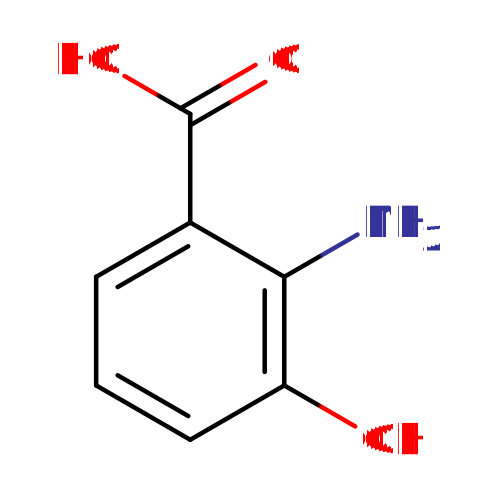
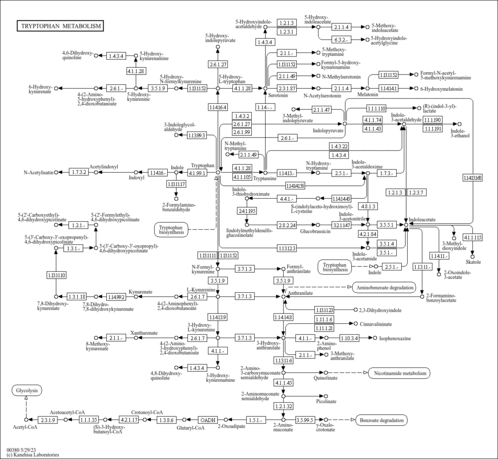
| Description | 3-Hydroxyanthranilic acid, also known as 2-amino-3-hydroxy-benzoate or 3-ohaa, belongs to the class of organic compounds known as hydroxybenzoic acid derivatives. Hydroxybenzoic acid derivatives are compounds containing a hydroxybenzoic acid (or a derivative), which is a benzene ring bearing a carboxyl and a hydroxyl groups. 3-Hydroxyanthranilic acid is a drug. 3-Hydroxyanthranilic acid exists in all living species, ranging from bacteria to humans. Within humans, 3-hydroxyanthranilic acid participates in a number of enzymatic reactions. In particular, 3-hydroxyanthranilic acid and L-alanine can be biosynthesized from L-3-hydroxykynurenine through the action of the enzyme kynureninase. In addition, 3-hydroxyanthranilic acid can be converted into cinnavalininate through the action of the enzyme catalase. 3-Hydroxyanthranilic acid is an intermediate in the metabolism of tryptophan. In humans, 3-hydroxyanthranilic acid is involved in tryptophan metabolism. Outside of the human body, 3-hydroxyanthranilic acid has been detected, but not quantified in brassicas. This could make 3-hydroxyanthranilic acid a potential biomarker for the consumption of these foods. It is new antioxidant isolated from methanol extract of tempeh. It is effective in preventing autoxidation of soybean oil and powder, while antioxidant 6,7,4'-trihydroxyisoflavone is not. |
|---|
| Structure | InChI=1S/C7H7NO3/c8-6-4(7(10)11)2-1-3-5(6)9/h1-3,9H,8H2,(H,10,11) |
|---|
| Synonyms | | Value | Source |
|---|
| 2-Amino-3-hydroxy-benzoic acid | ChEBI | | 2-Amino-3-hydroxybenzoic acid | ChEBI | | 3-Ohaa | ChEBI | | 3-Oxyanthranilic acid | ChEBI | | 2-Amino-3-hydroxy-benzoate | Generator | | 2-Amino-3-hydroxybenzoate | Generator | | 3-Oxyanthranilate | Generator | | 3-Hydroxyanthranilate | Generator | | 3-Hydroxanthranilate | HMDB | | 3-Hydroxy-2-aminobenzoate | HMDB | | 3-Hydroxy-2-aminobenzoic acid | HMDB | | 3-Hydroxy-anthranilate | HMDB | | 3-Hydroxy-anthranilic acid | HMDB | | 3-Hydroxy-anthranilsaeure | HMDB | | 3-Hydroxyantranilic acid | HMDB | | 3-OH-Anthranilic acid | HMDB | | 3 Hydroxyanthranilic acid | HMDB | | Acid, 3-hydroxyanthranilic | HMDB |
|
|---|
| Chemical Formula | C7H7NO3 |
|---|
| Average Molecular Weight | 153.1354 |
|---|
| Monoisotopic Molecular Weight | 153.042593095 |
|---|
| IUPAC Name | 2-amino-3-hydroxybenzoic acid |
|---|
| Traditional Name | 3-hydroxyanthranilic acid |
|---|
| CAS Registry Number | 548-93-6 |
|---|
| SMILES | NC1=C(O)C=CC=C1C(O)=O |
|---|
| InChI Identifier | InChI=1S/C7H7NO3/c8-6-4(7(10)11)2-1-3-5(6)9/h1-3,9H,8H2,(H,10,11) |
|---|
| InChI Key | WJXSWCUQABXPFS-UHFFFAOYSA-N |
|---|
| Chemical Taxonomy |
|---|
| Description | Belongs to the class of organic compounds known as hydroxybenzoic acid derivatives. Hydroxybenzoic acid derivatives are compounds containing a hydroxybenzoic acid (or a derivative), which is a benzene ring bearing a carboxyl and a hydroxyl groups. |
|---|
| Kingdom | Organic compounds |
|---|
| Super Class | Benzenoids |
|---|
| Class | Benzene and substituted derivatives |
|---|
| Sub Class | Benzoic acids and derivatives |
|---|
| Direct Parent | Hydroxybenzoic acid derivatives |
|---|
| Alternative Parents | |
|---|
| Substituents | - Aminobenzoic acid
- Aminobenzoic acid or derivatives
- Hydroxybenzoic acid
- Benzoic acid
- O-aminophenol
- Aminophenol
- Benzoyl
- Aniline or substituted anilines
- 1-hydroxy-4-unsubstituted benzenoid
- 1-hydroxy-2-unsubstituted benzenoid
- Phenol
- Vinylogous amide
- Amino acid or derivatives
- Amino acid
- Monocarboxylic acid or derivatives
- Carboxylic acid
- Carboxylic acid derivative
- Organonitrogen compound
- Hydrocarbon derivative
- Amine
- Organic oxide
- Organopnictogen compound
- Organic oxygen compound
- Organic nitrogen compound
- Organooxygen compound
- Primary amine
- Aromatic homomonocyclic compound
|
|---|
| Molecular Framework | Aromatic homomonocyclic compounds |
|---|
| External Descriptors | |
|---|
| Ontology |
|---|
| Physiological effect | |
|---|
| Disposition | |
|---|
| Process | |
|---|
| Role | |
|---|
| Physical Properties |
|---|
| State | Solid |
|---|
| Experimental Molecular Properties | | Property | Value | Reference |
|---|
| Melting Point | Not Available | Not Available | | Boiling Point | Not Available | Not Available | | Water Solubility | Not Available | Not Available | | LogP | Not Available | Not Available |
|
|---|
| Experimental Chromatographic Properties | Experimental Collision Cross Sections |
|---|
| Predicted Molecular Properties | |
|---|
| Predicted Chromatographic Properties | Predicted Collision Cross SectionsPredicted Retention Times Underivatized| Chromatographic Method | Retention Time | Reference |
|---|
| Measured using a Waters Acquity ultraperformance liquid chromatography (UPLC) ethylene-bridged hybrid (BEH) C18 column (100 mm × 2.1 mm; 1.7 μmparticle diameter). Predicted by Afia on May 17, 2022. Predicted by Afia on May 17, 2022. | 2.07 minutes | 32390414 | | Predicted by Siyang on May 30, 2022 | 10.9236 minutes | 33406817 | | Predicted by Siyang using ReTip algorithm on June 8, 2022 | 2.31 minutes | 32390414 | | AjsUoB = Accucore 150 Amide HILIC with 10mM Ammonium Formate, 0.1% Formic Acid | 52.1 seconds | 40023050 | | Fem_Long = Waters ACQUITY UPLC HSS T3 C18 with Water:MeOH and 0.1% Formic Acid | 1340.4 seconds | 40023050 | | Fem_Lipids = Ascentis Express C18 with (60:40 water:ACN):(90:10 IPA:ACN) and 10mM NH4COOH + 0.1% Formic Acid | 352.5 seconds | 40023050 | | Life_Old = Waters ACQUITY UPLC BEH C18 with Water:(20:80 acetone:ACN) and 0.1% Formic Acid | 89.6 seconds | 40023050 | | Life_New = RP Waters ACQUITY UPLC HSS T3 C18 with Water:(30:70 MeOH:ACN) and 0.1% Formic Acid | 230.1 seconds | 40023050 | | RIKEN = Waters ACQUITY UPLC BEH C18 with Water:ACN and 0.1% Formic Acid | 100.0 seconds | 40023050 | | Eawag_XBridgeC18 = XBridge C18 3.5u 2.1x50 mm with Water:MeOH and 0.1% Formic Acid | 349.1 seconds | 40023050 | | BfG_NTS_RP1 =Agilent Zorbax Eclipse Plus C18 (2.1 mm x 150 mm, 3.5 um) with Water:ACN and 0.1% Formic Acid | 447.4 seconds | 40023050 | | HILIC_BDD_2 = Merck SeQuant ZIC-HILIC with ACN(0.1% formic acid):water(16 mM ammonium formate) | 145.6 seconds | 40023050 | | UniToyama_Atlantis = RP Waters Atlantis T3 (2.1 x 150 mm, 5 um) with ACN:Water and 0.1% Formic Acid | 799.0 seconds | 40023050 | | BDD_C18 = Hypersil Gold 1.9µm C18 with Water:ACN and 0.1% Formic Acid | 182.2 seconds | 40023050 | | UFZ_Phenomenex = Kinetex Core-Shell C18 2.6 um, 3.0 x 100 mm, Phenomenex with Water:MeOH and 0.1% Formic Acid | 1014.1 seconds | 40023050 | | SNU_RIKEN_POS = Waters ACQUITY UPLC BEH C18 with Water:ACN and 0.1% Formic Acid | 262.7 seconds | 40023050 | | RPMMFDA = Waters ACQUITY UPLC BEH C18 with Water:ACN and 0.1% Formic Acid | 366.3 seconds | 40023050 | | MTBLS87 = Merck SeQuant ZIC-pHILIC column with ACN:Water and :ammonium carbonate | 530.1 seconds | 40023050 | | KI_GIAR_zic_HILIC_pH2_7 = Merck SeQuant ZIC-HILIC with ACN:Water and 0.1% FA | 230.8 seconds | 40023050 | | Meister zic-pHILIC pH9.3 = Merck SeQuant ZIC-pHILIC column with ACN:Water 5mM NH4Ac pH9.3 and 5mM ammonium acetate in water | 227.2 seconds | 40023050 |
Predicted Kovats Retention IndicesUnderivatizedDerivatized| Derivative Name / Structure | SMILES | Kovats RI Value | Column Type | Reference |
|---|
| 3-Hydroxyanthranilic acid,1TMS,isomer #1 | C[Si](C)(C)OC1=CC=CC(C(=O)O)=C1N | 1728.0 | Semi standard non polar | 33892256 | | 3-Hydroxyanthranilic acid,1TMS,isomer #2 | C[Si](C)(C)OC(=O)C1=CC=CC(O)=C1N | 1748.9 | Semi standard non polar | 33892256 | | 3-Hydroxyanthranilic acid,1TMS,isomer #3 | C[Si](C)(C)NC1=C(O)C=CC=C1C(=O)O | 1793.1 | Semi standard non polar | 33892256 | | 3-Hydroxyanthranilic acid,2TMS,isomer #1 | C[Si](C)(C)OC(=O)C1=CC=CC(O[Si](C)(C)C)=C1N | 1746.9 | Semi standard non polar | 33892256 | | 3-Hydroxyanthranilic acid,2TMS,isomer #2 | C[Si](C)(C)NC1=C(O[Si](C)(C)C)C=CC=C1C(=O)O | 1829.3 | Semi standard non polar | 33892256 | | 3-Hydroxyanthranilic acid,2TMS,isomer #3 | C[Si](C)(C)NC1=C(O)C=CC=C1C(=O)O[Si](C)(C)C | 1788.5 | Semi standard non polar | 33892256 | | 3-Hydroxyanthranilic acid,2TMS,isomer #4 | C[Si](C)(C)N(C1=C(O)C=CC=C1C(=O)O)[Si](C)(C)C | 1850.4 | Semi standard non polar | 33892256 | | 3-Hydroxyanthranilic acid,3TMS,isomer #1 | C[Si](C)(C)NC1=C(O[Si](C)(C)C)C=CC=C1C(=O)O[Si](C)(C)C | 1857.7 | Semi standard non polar | 33892256 | | 3-Hydroxyanthranilic acid,3TMS,isomer #1 | C[Si](C)(C)NC1=C(O[Si](C)(C)C)C=CC=C1C(=O)O[Si](C)(C)C | 1856.9 | Standard non polar | 33892256 | | 3-Hydroxyanthranilic acid,3TMS,isomer #1 | C[Si](C)(C)NC1=C(O[Si](C)(C)C)C=CC=C1C(=O)O[Si](C)(C)C | 1948.5 | Standard polar | 33892256 | | 3-Hydroxyanthranilic acid,3TMS,isomer #2 | C[Si](C)(C)OC1=CC=CC(C(=O)O)=C1N([Si](C)(C)C)[Si](C)(C)C | 1863.7 | Semi standard non polar | 33892256 | | 3-Hydroxyanthranilic acid,3TMS,isomer #2 | C[Si](C)(C)OC1=CC=CC(C(=O)O)=C1N([Si](C)(C)C)[Si](C)(C)C | 1964.0 | Standard non polar | 33892256 | | 3-Hydroxyanthranilic acid,3TMS,isomer #2 | C[Si](C)(C)OC1=CC=CC(C(=O)O)=C1N([Si](C)(C)C)[Si](C)(C)C | 1908.7 | Standard polar | 33892256 | | 3-Hydroxyanthranilic acid,3TMS,isomer #3 | C[Si](C)(C)OC(=O)C1=CC=CC(O)=C1N([Si](C)(C)C)[Si](C)(C)C | 1815.4 | Semi standard non polar | 33892256 | | 3-Hydroxyanthranilic acid,3TMS,isomer #3 | C[Si](C)(C)OC(=O)C1=CC=CC(O)=C1N([Si](C)(C)C)[Si](C)(C)C | 1884.2 | Standard non polar | 33892256 | | 3-Hydroxyanthranilic acid,3TMS,isomer #3 | C[Si](C)(C)OC(=O)C1=CC=CC(O)=C1N([Si](C)(C)C)[Si](C)(C)C | 1962.5 | Standard polar | 33892256 | | 3-Hydroxyanthranilic acid,4TMS,isomer #1 | C[Si](C)(C)OC(=O)C1=CC=CC(O[Si](C)(C)C)=C1N([Si](C)(C)C)[Si](C)(C)C | 1909.2 | Semi standard non polar | 33892256 | | 3-Hydroxyanthranilic acid,4TMS,isomer #1 | C[Si](C)(C)OC(=O)C1=CC=CC(O[Si](C)(C)C)=C1N([Si](C)(C)C)[Si](C)(C)C | 1937.3 | Standard non polar | 33892256 | | 3-Hydroxyanthranilic acid,4TMS,isomer #1 | C[Si](C)(C)OC(=O)C1=CC=CC(O[Si](C)(C)C)=C1N([Si](C)(C)C)[Si](C)(C)C | 1820.5 | Standard polar | 33892256 | | 3-Hydroxyanthranilic acid,1TBDMS,isomer #1 | CC(C)(C)[Si](C)(C)OC1=CC=CC(C(=O)O)=C1N | 2011.6 | Semi standard non polar | 33892256 | | 3-Hydroxyanthranilic acid,1TBDMS,isomer #2 | CC(C)(C)[Si](C)(C)OC(=O)C1=CC=CC(O)=C1N | 2037.1 | Semi standard non polar | 33892256 | | 3-Hydroxyanthranilic acid,1TBDMS,isomer #3 | CC(C)(C)[Si](C)(C)NC1=C(O)C=CC=C1C(=O)O | 2063.8 | Semi standard non polar | 33892256 | | 3-Hydroxyanthranilic acid,2TBDMS,isomer #1 | CC(C)(C)[Si](C)(C)OC(=O)C1=CC=CC(O[Si](C)(C)C(C)(C)C)=C1N | 2247.2 | Semi standard non polar | 33892256 | | 3-Hydroxyanthranilic acid,2TBDMS,isomer #2 | CC(C)(C)[Si](C)(C)NC1=C(O[Si](C)(C)C(C)(C)C)C=CC=C1C(=O)O | 2351.3 | Semi standard non polar | 33892256 | | 3-Hydroxyanthranilic acid,2TBDMS,isomer #3 | CC(C)(C)[Si](C)(C)NC1=C(O)C=CC=C1C(=O)O[Si](C)(C)C(C)(C)C | 2283.5 | Semi standard non polar | 33892256 | | 3-Hydroxyanthranilic acid,2TBDMS,isomer #4 | CC(C)(C)[Si](C)(C)N(C1=C(O)C=CC=C1C(=O)O)[Si](C)(C)C(C)(C)C | 2328.7 | Semi standard non polar | 33892256 | | 3-Hydroxyanthranilic acid,3TBDMS,isomer #1 | CC(C)(C)[Si](C)(C)NC1=C(O[Si](C)(C)C(C)(C)C)C=CC=C1C(=O)O[Si](C)(C)C(C)(C)C | 2529.0 | Semi standard non polar | 33892256 | | 3-Hydroxyanthranilic acid,3TBDMS,isomer #1 | CC(C)(C)[Si](C)(C)NC1=C(O[Si](C)(C)C(C)(C)C)C=CC=C1C(=O)O[Si](C)(C)C(C)(C)C | 2471.3 | Standard non polar | 33892256 | | 3-Hydroxyanthranilic acid,3TBDMS,isomer #1 | CC(C)(C)[Si](C)(C)NC1=C(O[Si](C)(C)C(C)(C)C)C=CC=C1C(=O)O[Si](C)(C)C(C)(C)C | 2347.5 | Standard polar | 33892256 | | 3-Hydroxyanthranilic acid,3TBDMS,isomer #2 | CC(C)(C)[Si](C)(C)OC1=CC=CC(C(=O)O)=C1N([Si](C)(C)C(C)(C)C)[Si](C)(C)C(C)(C)C | 2550.8 | Semi standard non polar | 33892256 | | 3-Hydroxyanthranilic acid,3TBDMS,isomer #2 | CC(C)(C)[Si](C)(C)OC1=CC=CC(C(=O)O)=C1N([Si](C)(C)C(C)(C)C)[Si](C)(C)C(C)(C)C | 2560.4 | Standard non polar | 33892256 | | 3-Hydroxyanthranilic acid,3TBDMS,isomer #2 | CC(C)(C)[Si](C)(C)OC1=CC=CC(C(=O)O)=C1N([Si](C)(C)C(C)(C)C)[Si](C)(C)C(C)(C)C | 2286.0 | Standard polar | 33892256 | | 3-Hydroxyanthranilic acid,3TBDMS,isomer #3 | CC(C)(C)[Si](C)(C)OC(=O)C1=CC=CC(O)=C1N([Si](C)(C)C(C)(C)C)[Si](C)(C)C(C)(C)C | 2500.5 | Semi standard non polar | 33892256 | | 3-Hydroxyanthranilic acid,3TBDMS,isomer #3 | CC(C)(C)[Si](C)(C)OC(=O)C1=CC=CC(O)=C1N([Si](C)(C)C(C)(C)C)[Si](C)(C)C(C)(C)C | 2460.6 | Standard non polar | 33892256 | | 3-Hydroxyanthranilic acid,3TBDMS,isomer #3 | CC(C)(C)[Si](C)(C)OC(=O)C1=CC=CC(O)=C1N([Si](C)(C)C(C)(C)C)[Si](C)(C)C(C)(C)C | 2320.9 | Standard polar | 33892256 | | 3-Hydroxyanthranilic acid,4TBDMS,isomer #1 | CC(C)(C)[Si](C)(C)OC(=O)C1=CC=CC(O[Si](C)(C)C(C)(C)C)=C1N([Si](C)(C)C(C)(C)C)[Si](C)(C)C(C)(C)C | 2770.7 | Semi standard non polar | 33892256 | | 3-Hydroxyanthranilic acid,4TBDMS,isomer #1 | CC(C)(C)[Si](C)(C)OC(=O)C1=CC=CC(O[Si](C)(C)C(C)(C)C)=C1N([Si](C)(C)C(C)(C)C)[Si](C)(C)C(C)(C)C | 2686.1 | Standard non polar | 33892256 | | 3-Hydroxyanthranilic acid,4TBDMS,isomer #1 | CC(C)(C)[Si](C)(C)OC(=O)C1=CC=CC(O[Si](C)(C)C(C)(C)C)=C1N([Si](C)(C)C(C)(C)C)[Si](C)(C)C(C)(C)C | 2317.0 | Standard polar | 33892256 |
|
|---|
| Disease References | | Stroke |
|---|
- Darlington LG, Mackay GM, Forrest CM, Stoy N, George C, Stone TW: Altered kynurenine metabolism correlates with infarct volume in stroke. Eur J Neurosci. 2007 Oct;26(8):2211-21. Epub 2007 Sep 24. [PubMed:17892481 ]
| | Nicotinamide Adenine Dinucleotide Deficiency |
|---|
- Shi H, Enriquez A, Rapadas M, Martin EMMA, Wang R, Moreau J, Lim CK, Szot JO, Ip E, Hughes JN, Sugimoto K, Humphreys DT, McInerney-Leo AM, Leo PJ, Maghzal GJ, Halliday J, Smith J, Colley A, Mark PR, Collins F, Sillence DO, Winlaw DS, Ho JWK, Guillemin GJ, Brown MA, Kikuchi K, Thomas PQ, Stocker R, Giannoulatou E, Chapman G, Duncan EL, Sparrow DB, Dunwoodie SL: NAD Deficiency, Congenital Malformations, and Niacin Supplementation. N Engl J Med. 2017 Aug 10;377(6):544-552. doi: 10.1056/NEJMoa1616361. [PubMed:28792876 ]
|
|
|---|
| General References | - De Antoni A, Rubaltelli FF, Costa C, Allegri G: Effect of phototherapy on the urinary excretion of tryptophan metabolites in neonatal hyperbilirubinemia. Acta Vitaminol Enzymol. 1975;29(1-6):145-50. [PubMed:1244083 ]
- Calandra P: Research on tryptophan metabolites "via kynurenine" in epidermis of man and mouse. Acta Vitaminol Enzymol. 1975;29(1-6):158-60. [PubMed:1244085 ]
- Hegedus ZL, Frank HA, Altschule MD, Nayak U: Human plasma lipofuscin melanins formed from tryptophan metabolites. Arch Int Physiol Biochim. 1986 Dec;94(5):339-48. [PubMed:2440410 ]
- Werner ER, Lutz H, Fuchs D, Hausen A, Huber C, Niederwieser D, Pfleiderer W, Reibnegger G, Troppmair J, Wachter H: Identification of 3-hydroxyanthranilic acid in mixed lymphocyte cultures. Biol Chem Hoppe Seyler. 1985 Jan;366(1):99-102. [PubMed:3159398 ]
- Teulings FA, Mulder-Kooy GE, Peters HA, Fokkens W, Van Der Werf-Messing B: The excretion of 3-hydroxyanthranilic acid in patients with bladder and kidney carcinoma. Acta Vitaminol Enzymol. 1975;29(1-6):108-12. [PubMed:1244078 ]
- Lopez AS, Alegre E, LeMaoult J, Carosella E, Gonzalez A: Regulatory role of tryptophan degradation pathway in HLA-G expression by human monocyte-derived dendritic cells. Mol Immunol. 2006 Jul;43(14):2151-60. Epub 2006 Feb 21. [PubMed:16490253 ]
- Yeh JK, Brown RR: Effects of vitamin B-6 deficiency and tryptophan loading on urinary excretion of tryptophan metabolites in mammals. J Nutr. 1977 Feb;107(2):261-71. [PubMed:833687 ]
- Herve C, Beyne P, Jamault H, Delacoux E: Determination of tryptophan and its kynurenine pathway metabolites in human serum by high-performance liquid chromatography with simultaneous ultraviolet and fluorimetric detection. J Chromatogr B Biomed Appl. 1996 Jan 12;675(1):157-61. [PubMed:8634758 ]
- Teulings FA, Lems PH, Portengen H, Henkelman MS, Blonk DI: The action of 3-hydroxyanthranilic acid and other tryptophan metabolites on stimulated human lymphocytes. Acta Vitaminol Enzymol. 1975;29(1-6):113-6. [PubMed:1244079 ]
|
|---|