| Record Information |
|---|
| Version | 5.0 |
|---|
| Status | Detected and Quantified |
|---|
| Creation Date | 2006-08-13 17:43:18 UTC |
|---|
| Update Date | 2023-02-21 17:17:01 UTC |
|---|
| HMDB ID | HMDB0004370 |
|---|
| Secondary Accession Numbers | |
|---|
| Metabolite Identification |
|---|
| Common Name | N-Methyltryptamine |
|---|
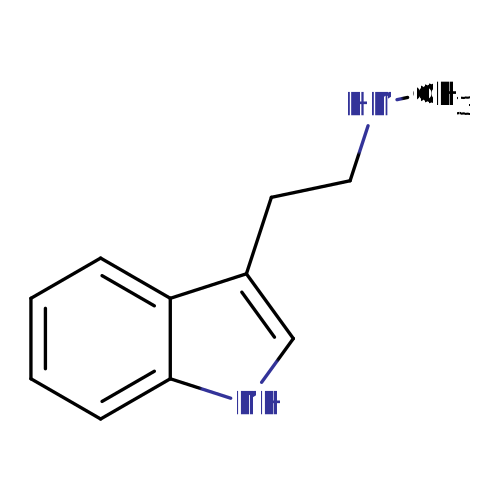
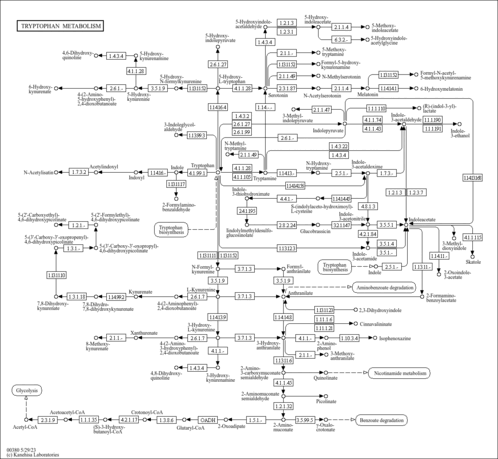
| Description | N-Methyltryptamine belongs to the class of organic compounds known as tryptamines and derivatives. Tryptamines and derivatives are compounds containing the tryptamine backbone, which is structurally characterized by an indole ring substituted at the 3-position by an ethanamine. In humans, N-methyltryptamine is involved in the tryptophan metabolism pathway. N-Methyltryptamine has been detected, but not quantified in, milk (cow). This could make N-methyltryptamine a potential biomarker for the consumption of these foods. N-Methyltryptamine is a primary metabolite. Primary metabolites are metabolically or physiologically essential metabolites. They are directly involved in an organism’s growth, development or reproduction. Based on a literature review a small amount of articles have been published on N-Methyltryptamine. |
|---|
| Structure | InChI=1S/C11H14N2/c1-12-7-6-9-8-13-11-5-3-2-4-10(9)11/h2-5,8,12-13H,6-7H2,1H3 |
|---|
| Synonyms | | Value | Source |
|---|
| 3-(2-Methylaminoethyl)indole | ChEBI | | N-Methyl-1H-indole-3-ethanamine | ChEBI | | N-Monomethyltryptamine | ChEBI | | N(Omega)-methyltryptamine | ChEBI | | N-Methylindoleethylamine | Kegg | | 1-Methyl-2-(3-indolyl)ethylamine | Kegg | | 2-(1H-indol-3-yl)-N-Methylethanamine | HMDB, MeSH | | 3-(2-(methylamino)Ethyl)indole | HMDB | | Dipterine | HMDB | | DL-Methyltryptamine | HMDB | | Methyltryptamine | HMDB | | N-Omega-methyltryptamine | HMDB | | N-Methyltryptamine oxalate | MeSH, HMDB | | N-Methyltryptamine hydrochloride | MeSH, HMDB |
|
|---|
| Chemical Formula | C11H14N2 |
|---|
| Average Molecular Weight | 174.2423 |
|---|
| Monoisotopic Molecular Weight | 174.115698458 |
|---|
| IUPAC Name | [2-(1H-indol-3-yl)ethyl](methyl)amine |
|---|
| Traditional Name | methyltryptamine |
|---|
| CAS Registry Number | 61-49-4 |
|---|
| SMILES | CNCCC1=CNC2=CC=CC=C12 |
|---|
| InChI Identifier | InChI=1S/C11H14N2/c1-12-7-6-9-8-13-11-5-3-2-4-10(9)11/h2-5,8,12-13H,6-7H2,1H3 |
|---|
| InChI Key | NCIKQJBVUNUXLW-UHFFFAOYSA-N |
|---|
| Chemical Taxonomy |
|---|
| Description | Belongs to the class of organic compounds known as tryptamines and derivatives. Tryptamines and derivatives are compounds containing the tryptamine backbone, which is structurally characterized by an indole ring substituted at the 3-position by an ethanamine. |
|---|
| Kingdom | Organic compounds |
|---|
| Super Class | Organoheterocyclic compounds |
|---|
| Class | Indoles and derivatives |
|---|
| Sub Class | Tryptamines and derivatives |
|---|
| Direct Parent | Tryptamines and derivatives |
|---|
| Alternative Parents | |
|---|
| Substituents | - Tryptamine
- 3-alkylindole
- Indole
- Aralkylamine
- Substituted pyrrole
- Benzenoid
- Pyrrole
- Heteroaromatic compound
- Secondary aliphatic amine
- Secondary amine
- Azacycle
- Organopnictogen compound
- Organonitrogen compound
- Organic nitrogen compound
- Hydrocarbon derivative
- Amine
- Aromatic heteropolycyclic compound
|
|---|
| Molecular Framework | Aromatic heteropolycyclic compounds |
|---|
| External Descriptors | |
|---|
| Ontology |
|---|
| Physiological effect | Not Available |
|---|
| Disposition | |
|---|
| Process | |
|---|
| Role | Not Available |
|---|
| Physical Properties |
|---|
| State | Solid |
|---|
| Experimental Molecular Properties | | Property | Value | Reference |
|---|
| Melting Point | 87 - 89 °C | Not Available | | Boiling Point | Not Available | Not Available | | Water Solubility | Not Available | Not Available | | LogP | Not Available | Not Available |
|
|---|
| Experimental Chromatographic Properties | Experimental Collision Cross Sections |
|---|
| Predicted Molecular Properties | |
|---|
| Predicted Chromatographic Properties | Predicted Collision Cross SectionsPredicted Retention Times Underivatized| Chromatographic Method | Retention Time | Reference |
|---|
| Measured using a Waters Acquity ultraperformance liquid chromatography (UPLC) ethylene-bridged hybrid (BEH) C18 column (100 mm × 2.1 mm; 1.7 μmparticle diameter). Predicted by Afia on May 17, 2022. Predicted by Afia on May 17, 2022. | 3.37 minutes | 32390414 | | Predicted by Siyang on May 30, 2022 | 9.8816 minutes | 33406817 | | Predicted by Siyang using ReTip algorithm on June 8, 2022 | 3.75 minutes | 32390414 | | AjsUoB = Accucore 150 Amide HILIC with 10mM Ammonium Formate, 0.1% Formic Acid | 72.2 seconds | 40023050 | | Fem_Long = Waters ACQUITY UPLC HSS T3 C18 with Water:MeOH and 0.1% Formic Acid | 978.4 seconds | 40023050 | | Fem_Lipids = Ascentis Express C18 with (60:40 water:ACN):(90:10 IPA:ACN) and 10mM NH4COOH + 0.1% Formic Acid | 306.2 seconds | 40023050 | | Life_Old = Waters ACQUITY UPLC BEH C18 with Water:(20:80 acetone:ACN) and 0.1% Formic Acid | 116.7 seconds | 40023050 | | Life_New = RP Waters ACQUITY UPLC HSS T3 C18 with Water:(30:70 MeOH:ACN) and 0.1% Formic Acid | 177.4 seconds | 40023050 | | RIKEN = Waters ACQUITY UPLC BEH C18 with Water:ACN and 0.1% Formic Acid | 132.8 seconds | 40023050 | | Eawag_XBridgeC18 = XBridge C18 3.5u 2.1x50 mm with Water:MeOH and 0.1% Formic Acid | 294.7 seconds | 40023050 | | BfG_NTS_RP1 =Agilent Zorbax Eclipse Plus C18 (2.1 mm x 150 mm, 3.5 um) with Water:ACN and 0.1% Formic Acid | 280.7 seconds | 40023050 | | HILIC_BDD_2 = Merck SeQuant ZIC-HILIC with ACN(0.1% formic acid):water(16 mM ammonium formate) | 430.1 seconds | 40023050 | | UniToyama_Atlantis = RP Waters Atlantis T3 (2.1 x 150 mm, 5 um) with ACN:Water and 0.1% Formic Acid | 730.4 seconds | 40023050 | | BDD_C18 = Hypersil Gold 1.9µm C18 with Water:ACN and 0.1% Formic Acid | 288.9 seconds | 40023050 | | UFZ_Phenomenex = Kinetex Core-Shell C18 2.6 um, 3.0 x 100 mm, Phenomenex with Water:MeOH and 0.1% Formic Acid | 935.3 seconds | 40023050 | | SNU_RIKEN_POS = Waters ACQUITY UPLC BEH C18 with Water:ACN and 0.1% Formic Acid | 234.5 seconds | 40023050 | | RPMMFDA = Waters ACQUITY UPLC BEH C18 with Water:ACN and 0.1% Formic Acid | 246.1 seconds | 40023050 | | MTBLS87 = Merck SeQuant ZIC-pHILIC column with ACN:Water and :ammonium carbonate | 527.3 seconds | 40023050 | | KI_GIAR_zic_HILIC_pH2_7 = Merck SeQuant ZIC-HILIC with ACN:Water and 0.1% FA | 329.8 seconds | 40023050 | | Meister zic-pHILIC pH9.3 = Merck SeQuant ZIC-pHILIC column with ACN:Water 5mM NH4Ac pH9.3 and 5mM ammonium acetate in water | 65.4 seconds | 40023050 |
Predicted Kovats Retention IndicesUnderivatizedDerivatized| Derivative Name / Structure | SMILES | Kovats RI Value | Column Type | Reference |
|---|
| N-Methyltryptamine,1TMS,isomer #1 | CN(CCC1=C[NH]C2=CC=CC=C12)[Si](C)(C)C | 1962.9 | Semi standard non polar | 33892256 | | N-Methyltryptamine,1TMS,isomer #1 | CN(CCC1=C[NH]C2=CC=CC=C12)[Si](C)(C)C | 1946.6 | Standard non polar | 33892256 | | N-Methyltryptamine,1TMS,isomer #1 | CN(CCC1=C[NH]C2=CC=CC=C12)[Si](C)(C)C | 2301.0 | Standard polar | 33892256 | | N-Methyltryptamine,1TMS,isomer #2 | CNCCC1=CN([Si](C)(C)C)C2=CC=CC=C12 | 1767.8 | Semi standard non polar | 33892256 | | N-Methyltryptamine,1TMS,isomer #2 | CNCCC1=CN([Si](C)(C)C)C2=CC=CC=C12 | 1834.2 | Standard non polar | 33892256 | | N-Methyltryptamine,1TMS,isomer #2 | CNCCC1=CN([Si](C)(C)C)C2=CC=CC=C12 | 2107.4 | Standard polar | 33892256 | | N-Methyltryptamine,2TMS,isomer #1 | CN(CCC1=CN([Si](C)(C)C)C2=CC=CC=C12)[Si](C)(C)C | 2045.3 | Semi standard non polar | 33892256 | | N-Methyltryptamine,2TMS,isomer #1 | CN(CCC1=CN([Si](C)(C)C)C2=CC=CC=C12)[Si](C)(C)C | 2049.1 | Standard non polar | 33892256 | | N-Methyltryptamine,2TMS,isomer #1 | CN(CCC1=CN([Si](C)(C)C)C2=CC=CC=C12)[Si](C)(C)C | 2092.0 | Standard polar | 33892256 | | N-Methyltryptamine,1TBDMS,isomer #1 | CN(CCC1=C[NH]C2=CC=CC=C12)[Si](C)(C)C(C)(C)C | 2201.1 | Semi standard non polar | 33892256 | | N-Methyltryptamine,1TBDMS,isomer #1 | CN(CCC1=C[NH]C2=CC=CC=C12)[Si](C)(C)C(C)(C)C | 2169.8 | Standard non polar | 33892256 | | N-Methyltryptamine,1TBDMS,isomer #1 | CN(CCC1=C[NH]C2=CC=CC=C12)[Si](C)(C)C(C)(C)C | 2415.7 | Standard polar | 33892256 | | N-Methyltryptamine,1TBDMS,isomer #2 | CNCCC1=CN([Si](C)(C)C(C)(C)C)C2=CC=CC=C12 | 2003.7 | Semi standard non polar | 33892256 | | N-Methyltryptamine,1TBDMS,isomer #2 | CNCCC1=CN([Si](C)(C)C(C)(C)C)C2=CC=CC=C12 | 2044.0 | Standard non polar | 33892256 | | N-Methyltryptamine,1TBDMS,isomer #2 | CNCCC1=CN([Si](C)(C)C(C)(C)C)C2=CC=CC=C12 | 2237.6 | Standard polar | 33892256 | | N-Methyltryptamine,2TBDMS,isomer #1 | CN(CCC1=CN([Si](C)(C)C(C)(C)C)C2=CC=CC=C12)[Si](C)(C)C(C)(C)C | 2456.1 | Semi standard non polar | 33892256 | | N-Methyltryptamine,2TBDMS,isomer #1 | CN(CCC1=CN([Si](C)(C)C(C)(C)C)C2=CC=CC=C12)[Si](C)(C)C(C)(C)C | 2476.7 | Standard non polar | 33892256 | | N-Methyltryptamine,2TBDMS,isomer #1 | CN(CCC1=CN([Si](C)(C)C(C)(C)C)C2=CC=CC=C12)[Si](C)(C)C(C)(C)C | 2334.3 | Standard polar | 33892256 |
|
|---|
| General References | - Takeda N, Ikeda R, Ohba K, Kondo M: Bufotenine reconsidered as a diagnostic indicator of psychiatric disorders. Neuroreport. 1995 Nov 27;6(17):2378-80. [PubMed:8747157 ]
- Forsstrom T, Tuominen J, Karkkainen J: Determination of potentially hallucinogenic N-dimethylated indoleamines in human urine by HPLC/ESI-MS-MS. Scand J Clin Lab Invest. 2001;61(7):547-56. [PubMed:11763413 ]
- VandenHeuvel WJ, Carlin JR, Walker RW: Biochemical and biomedical applications of capillary column GLC using SIM. J Chromatogr Sci. 1983 Mar;21(3):119-24. [PubMed:6574135 ]
- Oon MC, Murray RM, Rodnight R, Murphy MP, Birley JL: Factors affecting the urinary excretion of endogenously formed dimethyltryptamine in normal human subjects. Psychopharmacology (Berl). 1977 Oct 20;54(2):171-5. [PubMed:22091 ]
|
|---|