| Record Information |
|---|
| Version | 5.0 |
|---|
| Status | Detected and Quantified |
|---|
| Creation Date | 2005-11-16 15:48:42 UTC |
|---|
| Update Date | 2021-09-14 15:20:01 UTC |
|---|
| HMDB ID | HMDB0000248 |
|---|
| Secondary Accession Numbers | - HMDB0001918
- HMDB00248
- HMDB01918
|
|---|
| Metabolite Identification |
|---|
| Common Name | Thyroxine |
|---|
| Description | Thyroxine (3,5,3′,5′-tetraiodothyronine) or T4 is one of two major hormones derived from the thyroid gland, the other being triiodothyronine (T3). The major form of thyroid hormone in the blood is thyroxine (T4), which has a longer half-life than T3. In humans, the ratio of T4 to T3 released into the blood is approximately 14:1. T4 is converted to the active T3 (three to four times more potent than T4) within cells by enzymes known as deiodinases (5′-iodinase). Thyroxine is synthesized via the iodination of tyrosines (monoiodotyrosine) and the coupling of iodotyrosines (diiodotyrosine) in the thyroglobulin. Iodine is critical to the synthesis of thyroxine and other thyroid hormones. Through a reaction with the enzyme thyroperoxidase, iodine is covalently bound to tyrosine residues found in the thyroglobulin protein, forming monoiodotyrosine (MIT) and diiodotyrosine (DIT). Linking two moieties of DIT produces thyroxine. Combining one molecule of MIT and one molecule of DIT produces triiodothyronine. Thyroxine is released from thyroglobulin by proteolysis and secreted into the blood. Iodide is actively absorbed from the bloodstream and concentrated in the thyroid follicles where thyroxine is produced. If there is a deficiency of dietary iodine, the thyroid enlarges in an attempt to trap more iodine, resulting in a condition called goitre. More specifically, the lack of thyroid hormones will lead to decreased negative feedback on the pituitary gland, leading to increased production of thyroid-stimulating hormone, which causes the thyroid to enlarge, leading to goitre. Thyroxine can be peripherally de-iodinated to form triiodothyronine which exerts a broad spectrum of stimulatory effects on cell metabolism. Thyroid hormones function via a well-studied set of nuclear receptors, termed the thyroid hormone receptors. They act on nearly every cell in the body. In particular, thyroid hormones act to increase the basal metabolic rate, affect protein synthesis, help regulate long bone growth (synergy with growth hormone) and neural maturation, and increase the body's sensitivity to catecholamines (such as adrenaline) by permissiveness. The thyroid hormones are essential to proper development and differentiation of all cells of the human body. These hormones also regulate protein, fat, and carbohydrate metabolism, affecting how human cells use energetic compounds. They also stimulate vitamin metabolism. Numerous physiological and pathological stimuli influence thyroid hormone synthesis. Levothyroxine, a manufactured form of thyroxine, was the most prescribed medication in the United States with more than 114 million prescriptions. |
|---|
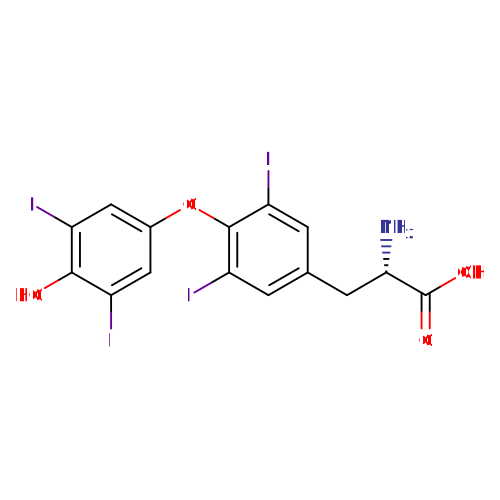
| Structure | N[C@@H](CC1=CC(I)=C(OC2=CC(I)=C(O)C(I)=C2)C(I)=C1)C(O)=O InChI=1S/C15H11I4NO4/c16-8-4-7(5-9(17)13(8)21)24-14-10(18)1-6(2-11(14)19)3-12(20)15(22)23/h1-2,4-5,12,21H,3,20H2,(H,22,23)/t12-/m0/s1 |
|---|
| Synonyms | | Value | Source |
|---|
| 3,3',5,5'-Tetraiodo-L-thyronine | ChEBI | | 3,5,3',5'-TETRAIODO-L-thyronine | ChEBI | | 4-(4-Hydroxy-3,5-diiodophenoxy)-3,5-diiodo-L-phenylalanine | ChEBI | | L-T4 | ChEBI | | Levothyroxin | ChEBI | | Levothyroxine | ChEBI | | LT4 | ChEBI | | O-(4-Hydroxy-3,5-diiodophenyl)-3,5-diiodo-L-tyrosine | ChEBI | | T4 | ChEBI | | L-Thyroxine | Kegg | | O-(4-Hydroxy-3,5-diidophenyl)-3,5-diiodo-L-tyrosine | Kegg | | 3,5,3'5'-Tetraiodo-L-thyronine | Kegg | | Forthyron | Kegg | | (-)-Thyroxine | HMDB | | 3,3',5,5''-tetraiodo-L-Thyronine | HMDB | | 3,5,3',5'-Tetraiodothyronine | HMDB, MeSH | | D-Thyroxine | HMDB | | DL-Thyroxin | HMDB | | Henning | HMDB | | L-3,5,3',5'-Tetraiodothyronine | HMDB, MeSH | | L-Thyroxin | HMDB | | Laevothyroxinum | HMDB | | Levothroid | HMDB, MeSH | | Levothyroxine sodium | HMDB, MeSH | | Levothyroxinum | HMDB | | Levoxyl | HMDB, MeSH | | Prestwick_548 | HMDB | | Synthroid | HMDB, MeSH | | Tetraiodothyronine | HMDB | | Tetramet | HMDB | | THX | HMDB | | Thyratabs | HMDB | | Thyrax | HMDB, MeSH | | Thyreoideum | HMDB | | Thyroxin | HMDB, MeSH | | Thyroxinal | HMDB | | Thyroxine I 125 | HMDB | | Thyroxine iodine | HMDB | | Allphar brand OF levothyroxine sodium | MeSH, HMDB | | Berlthyrox | MeSH, HMDB | | Delalande, levothyroxin | MeSH, HMDB | | Dexnon | MeSH, HMDB | | Eferox | MeSH, HMDB | | Eltroxin | MeSH, HMDB | | Kern brand OF levothyroxine sodium | MeSH, HMDB | | L-Thyrox | MeSH, HMDB | | L-Thyroxin henning | MeSH, HMDB | | L-Thyroxin beta | MeSH, HMDB | | L-Thyroxine roche | MeSH, HMDB | | Levothyroxin deladande | MeSH, HMDB | | Lévothyrox | MeSH, HMDB | | Merck lipha santé brand OF levothyroxine sodium | MeSH, HMDB | | Nourypharma brand OF levothyroxine sodium | MeSH, HMDB | | Oroxine | MeSH, HMDB | | Aventis brand OF levothyroxine sodium | MeSH, HMDB | | Euthyrox | MeSH, HMDB | | Eutirox | MeSH, HMDB | | Forest brand OF levothyroxine sodium | MeSH, HMDB | | Genpharm brand OF levothyroxine sodium | MeSH, HMDB | | GlaxoSmithKline brand OF levothyroxine sodium | MeSH, HMDB | | Goldshield brand OF levothyroxine sodium | MeSH, HMDB | | LThyroxin henning | MeSH, HMDB | | levo-T | MeSH, HMDB | | Sanofi synthelabo brand OF levothyroxine sodium | MeSH, HMDB | | Sigma brand OF levothyroxine sodium | MeSH, HMDB | | Synthrox | MeSH, HMDB | | Thevier | MeSH, HMDB | | Watson brand OF levothyroxine sodium | MeSH, HMDB | | Berlin chemie brand OF levothyroxine sodium | MeSH, HMDB | | Delalande brand OF levothyroxine sodium | MeSH, HMDB | | Eltroxine | MeSH, HMDB | | Hexal brand 2 OF levothyroxine sodium | MeSH, HMDB | | L Thyroxine roche | MeSH, HMDB | | Novothyral | MeSH, HMDB | | Tiroidine | MeSH, HMDB | | Vortex brand OF levothyroxine sodium | MeSH, HMDB | | Abbot brand OF levothyroxine sodium | MeSH, HMDB | | Berlin-chemie brand OF levothyroxine sodium | MeSH, HMDB | | Byk brand OF levothyroxine sodium | MeSH, HMDB | | Deladande, levothyroxin | MeSH, HMDB | | GlaxoWellcome brand OF levothyroxine sodium | MeSH, HMDB | | Henning berlin brand OF levothyroxine sodium | MeSH, HMDB | | Hexal brand 1 OF levothyroxine sodium | MeSH, HMDB | | L Thyrox | MeSH, HMDB | | L Thyroxin henning | MeSH, HMDB | | L Thyroxin beta | MeSH, HMDB | | L Thyroxine | MeSH, HMDB | | LThyroxin beta | MeSH, HMDB | | leo, Tiroxina | MeSH, HMDB | | levo T | MeSH, HMDB | | LevoT | MeSH, HMDB | | Levothyroid | MeSH, HMDB | | Levothyroxin delalande | MeSH, HMDB | | Levoxine | MeSH, HMDB | | Merck brand OF levothyroxine sodium | MeSH, HMDB | | Monarch brand OF levothyroxine sodium | MeSH, HMDB | | Mova brand OF levothyroxine sodium | MeSH, HMDB | | Novothyrox | MeSH, HMDB | | O-(4-Hydroxy-3,5-diiodophenyl) 3,5-diiodo-L-tyrosine | MeSH, HMDB | | O-(4-Hydroxy-3,5-diiodophenyl)-3,5-diiodotyrosine | MeSH, HMDB | | Roche brand OF levothyroxine sodium | MeSH, HMDB | | Rudefsa brand OF levothyroxine sodium | MeSH, HMDB | | Sodium levothyroxine | MeSH, HMDB | | T4 Thyroid hormone | MeSH, HMDB | | Thyroid hormone, T4 | MeSH, HMDB | | Tiroxina leo | MeSH, HMDB | | Unithroid | MeSH, HMDB | | Betapharm brand OF levothyroxine sodium | MeSH, HMDB |
|
|---|
| Chemical Formula | C15H11I4NO4 |
|---|
| Average Molecular Weight | 776.87 |
|---|
| Monoisotopic Molecular Weight | 776.686681525 |
|---|
| IUPAC Name | (2S)-2-amino-3-[4-(4-hydroxy-3,5-diiodophenoxy)-3,5-diiodophenyl]propanoic acid |
|---|
| Traditional Name | levothyroxine |
|---|
| CAS Registry Number | 51-48-9 |
|---|
| SMILES | N[C@@H](CC1=CC(I)=C(OC2=CC(I)=C(O)C(I)=C2)C(I)=C1)C(O)=O |
|---|
| InChI Identifier | InChI=1S/C15H11I4NO4/c16-8-4-7(5-9(17)13(8)21)24-14-10(18)1-6(2-11(14)19)3-12(20)15(22)23/h1-2,4-5,12,21H,3,20H2,(H,22,23)/t12-/m0/s1 |
|---|
| InChI Key | XUIIKFGFIJCVMT-LBPRGKRZSA-N |
|---|
| Chemical Taxonomy |
|---|
| Description | Belongs to the class of organic compounds known as phenylalanine and derivatives. Phenylalanine and derivatives are compounds containing phenylalanine or a derivative thereof resulting from reaction of phenylalanine at the amino group or the carboxy group, or from the replacement of any hydrogen of glycine by a heteroatom. |
|---|
| Kingdom | Organic compounds |
|---|
| Super Class | Organic acids and derivatives |
|---|
| Class | Carboxylic acids and derivatives |
|---|
| Sub Class | Amino acids, peptides, and analogues |
|---|
| Direct Parent | Phenylalanine and derivatives |
|---|
| Alternative Parents | |
|---|
| Substituents | - Phenylalanine or derivatives
- Diphenylether
- Diaryl ether
- 3-phenylpropanoic-acid
- Alpha-amino acid
- Amphetamine or derivatives
- L-alpha-amino acid
- Phenoxy compound
- Phenol ether
- 2-halophenol
- 2-iodophenol
- Aralkylamine
- Phenol
- Halobenzene
- Iodobenzene
- Aryl halide
- Aryl iodide
- Benzenoid
- Monocyclic benzene moiety
- Amino acid
- Carboxylic acid
- Ether
- Monocarboxylic acid or derivatives
- Organoiodide
- Organonitrogen compound
- Organooxygen compound
- Organopnictogen compound
- Organic nitrogen compound
- Organic oxide
- Carbonyl group
- Primary amine
- Amine
- Hydrocarbon derivative
- Primary aliphatic amine
- Organic oxygen compound
- Organohalogen compound
- Aromatic homomonocyclic compound
|
|---|
| Molecular Framework | Aromatic homomonocyclic compounds |
|---|
| External Descriptors | |
|---|
| Ontology |
|---|
| Physiological effect | Not Available |
|---|
| Disposition | |
|---|
| Process | |
|---|
| Role | |
|---|
| Physical Properties |
|---|
| State | Solid |
|---|
| Experimental Molecular Properties | | Property | Value | Reference |
|---|
| Melting Point | 235.5 °C | Not Available | | Boiling Point | Not Available | Not Available | | Water Solubility | Not Available | Not Available | | LogP | Not Available | Not Available |
|
|---|
| Experimental Chromatographic Properties | Experimental Collision Cross Sections |
|---|
| Predicted Molecular Properties | |
|---|
| Predicted Chromatographic Properties | Predicted Collision Cross SectionsPredicted Kovats Retention IndicesUnderivatized |
|---|
| Spectra |
|---|
| GC-MS Spectra| Spectrum Type | Description | Splash Key | Deposition Date | Source | View |
|---|
| Predicted GC-MS | Predicted GC-MS Spectrum - Thyroxine GC-MS (Non-derivatized) - 70eV, Positive | splash10-0f89-4002002900-0d489fed1cb888a2d9d0 | 2017-11-06 | Wishart Lab | View Spectrum | | Predicted GC-MS | Predicted GC-MS Spectrum - Thyroxine GC-MS (TMS_1_1) - 70eV, Positive | Not Available | 2021-10-18 | Wishart Lab | View Spectrum | | Predicted GC-MS | Predicted GC-MS Spectrum - Thyroxine GC-MS (TMS_1_2) - 70eV, Positive | Not Available | 2021-10-18 | Wishart Lab | View Spectrum | | Predicted GC-MS | Predicted GC-MS Spectrum - Thyroxine GC-MS (TMS_1_3) - 70eV, Positive | Not Available | 2021-10-18 | Wishart Lab | View Spectrum | | Predicted GC-MS | Predicted GC-MS Spectrum - Thyroxine GC-MS (TBDMS_1_1) - 70eV, Positive | Not Available | 2021-10-18 | Wishart Lab | View Spectrum | | Predicted GC-MS | Predicted GC-MS Spectrum - Thyroxine GC-MS (TBDMS_1_2) - 70eV, Positive | Not Available | 2021-10-18 | Wishart Lab | View Spectrum | | Predicted GC-MS | Predicted GC-MS Spectrum - Thyroxine GC-MS (TBDMS_1_3) - 70eV, Positive | Not Available | 2021-10-18 | Wishart Lab | View Spectrum |
MS/MS Spectra| Spectrum Type | Description | Splash Key | Deposition Date | Source | View |
|---|
| Experimental LC-MS/MS | LC-MS/MS Spectrum - Thyroxine Quattro_QQQ 10V, Positive-QTOF (Annotated) | splash10-0ac9-0591664310-c9b7aec3184ebb20a2da | 2012-07-24 | HMDB team, MONA | View Spectrum | | Experimental LC-MS/MS | LC-MS/MS Spectrum - Thyroxine Quattro_QQQ 25V, Positive-QTOF (Annotated) | splash10-014i-2566449540-35bb942c7bcbcfe41af7 | 2012-07-24 | HMDB team, MONA | View Spectrum | | Experimental LC-MS/MS | LC-MS/MS Spectrum - Thyroxine Quattro_QQQ 40V, Positive-QTOF (Annotated) | splash10-00xr-3375497520-9dee3cb0c153e6c6df9e | 2012-07-24 | HMDB team, MONA | View Spectrum | | Experimental LC-MS/MS | LC-MS/MS Spectrum - Thyroxine , positive-QTOF | splash10-0059-0001001900-83ff4aafed0b73c6c7b7 | 2017-09-14 | HMDB team, MONA | View Spectrum | | Experimental LC-MS/MS | LC-MS/MS Spectrum - Thyroxine 35V, Negative-QTOF | splash10-004i-0900000000-6e0a640216afcce0837e | 2021-09-20 | HMDB team, MONA | View Spectrum | | Experimental LC-MS/MS | LC-MS/MS Spectrum - Thyroxine 45V, Negative-QTOF | splash10-004i-0900000000-9223d3d63e3db43052a7 | 2021-09-20 | HMDB team, MONA | View Spectrum | | Experimental LC-MS/MS | LC-MS/MS Spectrum - Thyroxine 60V, Negative-QTOF | splash10-004i-0900000000-1e8e674422aa4d820da7 | 2021-09-20 | HMDB team, MONA | View Spectrum | | Experimental LC-MS/MS | LC-MS/MS Spectrum - Thyroxine 20V, Positive-QTOF | splash10-001i-0132219000-42259b5a596f74aec76f | 2021-09-20 | HMDB team, MONA | View Spectrum | | Experimental LC-MS/MS | LC-MS/MS Spectrum - Thyroxine 40V, Positive-QTOF | splash10-0udi-0019217000-baafc92556cb18d71b3a | 2021-09-20 | HMDB team, MONA | View Spectrum | | Experimental LC-MS/MS | LC-MS/MS Spectrum - Thyroxine 30V, Negative-QTOF | splash10-004i-0900000000-bb154453510a75ca822c | 2021-09-20 | HMDB team, MONA | View Spectrum | | Experimental LC-MS/MS | LC-MS/MS Spectrum - Thyroxine 15V, Negative-QTOF | splash10-004i-0900000000-f785346765de92765afd | 2021-09-20 | HMDB team, MONA | View Spectrum | | Experimental LC-MS/MS | LC-MS/MS Spectrum - Thyroxine 20V, Positive-QTOF | splash10-001i-0000119000-af7b1e923ec5750514af | 2021-09-20 | HMDB team, MONA | View Spectrum | | Experimental LC-MS/MS | LC-MS/MS Spectrum - Thyroxine 10V, Positive-QTOF | splash10-0f8j-1248309000-68eea5695ceb400ea5b0 | 2021-09-20 | HMDB team, MONA | View Spectrum | | Experimental LC-MS/MS | LC-MS/MS Spectrum - Thyroxine 40V, Positive-QTOF | splash10-0udi-0029337000-a85b59c3575dc95d36fd | 2021-09-20 | HMDB team, MONA | View Spectrum | | Experimental LC-MS/MS | LC-MS/MS Spectrum - Thyroxine 10V, Positive-QTOF | splash10-001i-0003109000-480d647f8d49feeec28c | 2021-09-20 | HMDB team, MONA | View Spectrum | | Predicted LC-MS/MS | Predicted LC-MS/MS Spectrum - Thyroxine 10V, Positive-QTOF | splash10-01si-0000000900-524d052a32c1fe4b904d | 2017-07-26 | Wishart Lab | View Spectrum | | Predicted LC-MS/MS | Predicted LC-MS/MS Spectrum - Thyroxine 20V, Positive-QTOF | splash10-001i-0000001900-553f6a4045ef2241fd85 | 2017-07-26 | Wishart Lab | View Spectrum | | Predicted LC-MS/MS | Predicted LC-MS/MS Spectrum - Thyroxine 40V, Positive-QTOF | splash10-014i-0009000000-d2431d885a79bb80b7a5 | 2017-07-26 | Wishart Lab | View Spectrum | | Predicted LC-MS/MS | Predicted LC-MS/MS Spectrum - Thyroxine 10V, Negative-QTOF | splash10-004i-0000000900-137b5f8f48031bc9aa4f | 2017-07-26 | Wishart Lab | View Spectrum | | Predicted LC-MS/MS | Predicted LC-MS/MS Spectrum - Thyroxine 20V, Negative-QTOF | splash10-03fr-0004001900-db1d8cdb93785d786382 | 2017-07-26 | Wishart Lab | View Spectrum | | Predicted LC-MS/MS | Predicted LC-MS/MS Spectrum - Thyroxine 40V, Negative-QTOF | splash10-0h9u-7029014300-3bd9620b0c6a8dd20c93 | 2017-07-26 | Wishart Lab | View Spectrum | | Predicted LC-MS/MS | Predicted LC-MS/MS Spectrum - Thyroxine 10V, Negative-QTOF | splash10-004i-0000000900-95266ab7e52b7d3cb322 | 2021-09-23 | Wishart Lab | View Spectrum | | Predicted LC-MS/MS | Predicted LC-MS/MS Spectrum - Thyroxine 20V, Negative-QTOF | splash10-004i-1700000900-195c16ab7434b857e712 | 2021-09-23 | Wishart Lab | View Spectrum | | Predicted LC-MS/MS | Predicted LC-MS/MS Spectrum - Thyroxine 40V, Negative-QTOF | splash10-004i-0900000000-0dba40d354fa6a5575e0 | 2021-09-23 | Wishart Lab | View Spectrum | | Predicted LC-MS/MS | Predicted LC-MS/MS Spectrum - Thyroxine 10V, Positive-QTOF | splash10-004i-0000000900-d76aec17d3d890cb64c1 | 2021-09-25 | Wishart Lab | View Spectrum |
NMR Spectra| Spectrum Type | Description | Deposition Date | Source | View |
|---|
| Experimental 1D NMR | 1H NMR Spectrum (1D, 600 MHz, 100%_DMSO, experimental) | 2012-12-04 | Wishart Lab | View Spectrum | | Experimental 2D NMR | [1H, 13C]-HSQC NMR Spectrum (2D, 600 MHz, 100%_DMSO, experimental) | 2012-12-05 | Wishart Lab | View Spectrum |
|
|---|
| Biological Properties |
|---|
| Cellular Locations | - Cytoplasm
- Extracellular
- Membrane (predicted from logP)
|
|---|
| Biospecimen Locations | |
|---|
| Tissue Locations | - Adipose Tissue
- Fibroblasts
- Intestine
- Neuron
- Ovary
- Placenta
- Platelet
- Prostate
- Skeletal Muscle
- Spleen
- Testis
- Thyroid Gland
|
|---|
| Pathways | |
|---|
| Normal Concentrations |
|---|
| |
| Blood | Detected and Quantified | 0.000009 - 0.000023 uM | Not Available | Both | Normal | | details | | Blood | Detected and Quantified | 0.13 +/- 0.0061 uM | Children (1-13 years old) | Both | Normal | | details | | Blood | Detected and Quantified | 0.000016 (0.0000064-0.000064) uM | Adult (>18 years old) | Both | Normal | | details | | Blood | Detected and Quantified | 0.0000144 +/- 0.0000036 uM | Adolescent (13-18 years old) | Female | Normal | | details | | Blood | Detected and Quantified | 0.0600-0.150 uM | Children (1-13 years old) | Not Specified | Normal | | details | | Blood | Detected and Quantified | 0.105-0.215 uM | Newborn (0-30 days old) | Both | Normal | | details | | Blood | Detected and Quantified | 0.0700-0.175 uM | Infant (0-1 year old) | Both | Normal | | details | | Blood | Detected and Quantified | 60-160 uM | Children (1-13 years old) | Not Specified | Normal | | details | | Blood | Detected and Quantified | 0.000010 - 0.000023 uM | Adult (>18 years old) | Female | Normal | | details | | Blood | Detected and Quantified | 0.000010 - 0.000023 uM | Adult (>18 years old) | Male | Normal | | details | | Blood | Detected and Quantified | 0.000010 - 0.000023 uM | Adult (>18 years old) | Both | Normal | | details | | Blood | Detected and Quantified | 0.0399 - 0.162 uM | Adult (>18 years old) | Both | Normal | | details | | Blood | Detected and Quantified | 0.000012-0.000025 uM | Adult (>18 years old) | Not Specified | Normal | | details | | Blood | Detected and Quantified | 0.00001-0.000023 uM | Children (1-13 years old) | Not Specified | Normal | | details | | Blood | Detected and Quantified | 0.000009-0.00002 uM | Adult (>18 years old) | Not Specified | Normal | | details | | Blood | Detected and Quantified | 0.0579-0.148 uM | Children (1-13 years old) | Not Specified | Normal | | details | | Blood | Detected and Quantified | 0.0515-0.142 uM | Infant (0-1 year old) | Not Specified | Normal | | details | | Blood | Detected and Quantified | 0.00002 (0.00001-0.00003) uM | Adult (>18 years old) | Both | Normal | | details | | Saliva | Detected and Quantified | 0.0 - 1.0 uM | Adult (>18 years old) | Both | Normal | | details | | Urine | Detected and Quantified | 0.00032 +/- 0.00015 umol/mmol creatinine | Adult (>18 years old) | Both | Normal | | details |
|
|---|
| Abnormal Concentrations |
|---|
| |
| Blood | Detected and Quantified | 0.0000185 +/- 0.0000052 uM | Adult (>18 years old) | Both | Hypothyroidism | | details | | Blood | Detected and Quantified | 0.057 +/- 0.0058 uM | Children (1-13 years old) | Both | Malnutrition (type kwashiorkor and marasmus) | | details | | Blood | Detected and Quantified | 0.000011 +/- 0.0000016 uM | Adolescent (13-18 years old) | Female | Anorexia nervosa | | details | | Blood | Detected and Quantified | <0.0100 uM | Children (1-13 years old) | Male | Pituitary Hormone Deficiency, Combined, 1 | | details | | Blood | Detected and Quantified | 0.0540-0.112 uM | Newborn (0-30 days old) | Both | Pendred Syndrome | | details | | Blood | Detected and Quantified | 0.0260-0.164 uM | Infant (0-1 year old) | Male | Pendred Syndrome | | details | | Blood | Detected and Quantified | 0.0953 uM | Adult (>18 years old) | Female | Adrenal hyperplasia, congenital, due to 3-beta-hydroxysteroid dehydrogenase 2 deficiency | | details | | Blood | Detected and Quantified | 23-55.2 uM | Children (1-13 years old) | Both | Hypothyroidism, congenital, nongoitrous, 2 | | details | | Blood | Detected and Quantified | 0.000009 uM | Children (1-13 years old) | Female | Pituitary Hormone Deficiency, Combined, 1 | | details | | Blood | Detected and Quantified | 0.00000219 uM | Adult (>18 years old) | Male | Pituitary Hormone Deficiency, Combined, 1 | | details | | Blood | Detected and Quantified | 0.00000557 uM | Children (1-13 years old) | Male | Pituitary Hormone Deficiency, Combined, 1 | | details | | Blood | Detected and Quantified | 0.000009 uM | Adult (>18 years old) | Female | Proprotein Convertase 1/3 Deficiency | | details | | Blood | Detected and Quantified | 0.0180-0.0206 uM | Children (1-13 years old) | Male | Hypothyroidism, congenital, nongoitrous, 2 | | details | | Blood | Detected and Quantified | 0.0579 uM | Newborn (0-30 days old) | Male | Diabetes Mellitus, Congenital Insulin-dependent, With Fatal Secretory Diarrhea; Immunodeficiency, Polyendocrinopathy, and Enteropathy, X-linked, Formerly | | details | | Blood | Detected and Quantified | 0.0747 uM | Infant (0-1 year old) | Female | Leptin Deficiency or Dysfunction | | details | | Urine | Detected and Quantified | 0.0015 +/- 0.00154 umol/mmol creatinine | Adult (>18 years old) | Both | Proteinuria | | details |
|
|---|
| Associated Disorders and Diseases |
|---|
| Disease References | | Anorexia nervosa |
|---|
- Capo-chichi CD, Gueant JL, Lefebvre E, Bennani N, Lorentz E, Vidailhet C, Vidailhet M: Riboflavin and riboflavin-derived cofactors in adolescent girls with anorexia nervosa. Am J Clin Nutr. 1999 Apr;69(4):672-8. [PubMed:10197568 ]
| | Hypothyroidism |
|---|
- Sjoberg S, Eriksson M, Nordin C: L-thyroxine treatment and neurotransmitter levels in the cerebrospinal fluid of hypothyroid patients: a pilot study. Eur J Endocrinol. 1998 Nov;139(5):493-7. [PubMed:9849813 ]
| | Adrenal hyperplasia, congenital, due to 3-beta-hydroxysteroid dehydrogenase 2 deficiency |
|---|
- Hattori N, Ishihara T, Moridera K, Hino M, Ikekubo K, Kurahachi H: A case of late-onset congenital adrenal hyperplasia due to partial 3 beta-hydroxysteroid dehydrogenase deficiency. Endocr J. 1993 Feb;40(1):107-9. [PubMed:7951484 ]
| | Pituitary Hormone Deficiency, Combined, 1 |
|---|
- Bertko E, Klammt J, Dusatkova P, Bahceci M, Gonc N, Ten Have L, Kandemir N, Mansmann G, Obermannova B, Oostdijk W, Pfaffle H, Rockstroh-Lippold D, Schlicke M, Tuzcu AK, Pfaffle R: Combined pituitary hormone deficiency due to gross deletions in the POU1F1 (PIT-1) and PROP1 genes. J Hum Genet. 2017 Aug;62(8):755-762. doi: 10.1038/jhg.2017.34. Epub 2017 Mar 30. [PubMed:28356564 ]
- Ayoola OO, Oladejo FA, Dattani M, Clayton PE: Multiple pituitary hormone deficiency caused by pit-I mutation and the challenges of management in a developing country. Ann Ib Postgrad Med. 2008 Dec;6(2):21-6. [PubMed:25161449 ]
| | Pendred Syndrome |
|---|
- Coakley JC, Keir EH, Connelly JF: The association of thyroid dyshormonogenesis and deafness (Pendred syndrome): experience of the Victorian Neonatal Thyroid Screening Programme. J Paediatr Child Health. 1992 Oct;28(5):398-401. [PubMed:1389454 ]
| | Proprotein Convertase 1/3 Deficiency |
|---|
- O'Rahilly S, Gray H, Humphreys PJ, Krook A, Polonsky KS, White A, Gibson S, Taylor K, Carr C: Brief report: impaired processing of prohormones associated with abnormalities of glucose homeostasis and adrenal function. N Engl J Med. 1995 Nov 23;333(21):1386-90. doi: 10.1056/NEJM199511233332104. [PubMed:7477119 ]
| | Hypothyroidism, congenital, nongoitrous, 2 |
|---|
- White CW, Wiedermann BL, Kirkland RT, Clayton GW: Hereditary congenital nongoitrous hypothyroidism. Am J Dis Child. 1981 Jun;135(6):568-9. [PubMed:7234795 ]
- Al Taji E, Biebermann H, Limanova Z, Hnikova O, Zikmund J, Dame C, Gruters A, Lebl J, Krude H: Screening for mutations in transcription factors in a Czech cohort of 170 patients with congenital and early-onset hypothyroidism: identification of a novel PAX8 mutation in dominantly inherited early-onset non-autoimmune hypothyroidism. Eur J Endocrinol. 2007 May;156(5):521-9. doi: 10.1530/EJE-06-0709. [PubMed:17468187 ]
| | Diabetes Mellitus, Congenital Insulin-dependent, With Fatal Secretory Diarrhea; Immunodeficiency, Polyendocrinopathy, and Enteropathy, X-linked, Formerly |
|---|
- Levy-Lahad E, Wildin RS: Neonatal diabetes mellitus, enteropathy, thrombocytopenia, and endocrinopathy: Further evidence for an X-linked lethal syndrome. J Pediatr. 2001 Apr;138(4):577-80. doi: 10.1067/mpd.2001.111502. [PubMed:11295725 ]
| | Leptin Deficiency or Dysfunction |
|---|
- Farooqi IS, Jebb SA, Langmack G, Lawrence E, Cheetham CH, Prentice AM, Hughes IA, McCamish MA, O'Rahilly S: Effects of recombinant leptin therapy in a child with congenital leptin deficiency. N Engl J Med. 1999 Sep 16;341(12):879-84. doi: 10.1056/NEJM199909163411204. [PubMed:10486419 ]
| | Proteinuria |
|---|
- Chandurkar V, Shik J, Randell E: Exacerbation of underlying hypothyroidism caused by proteinuria and induction of urinary thyroxine loss: case report and subsequent investigation. Endocr Pract. 2008 Jan-Feb;14(1):97-103. [PubMed:18238748 ]
|
|
|---|
| Associated OMIM IDs | - 606788 (Anorexia nervosa)
- 201810 (Adrenal hyperplasia, congenital, due to 3-beta-hydroxysteroid dehydrogenase 2 deficiency)
- 613038 (Pituitary Hormone Deficiency, Combined, 1)
- 274600 (Pendred Syndrome)
- 600955 (Proprotein Convertase 1/3 Deficiency)
- 218700 (Hypothyroidism, congenital, nongoitrous, 2)
- 304790 (Diabetes Mellitus, Congenital Insulin-dependent, With Fatal Secretory Diarrhea; Immunodeficiency, Polyendocrinopathy, and Enteropathy, X-linked, Formerly)
- 614962 (Leptin Deficiency or Dysfunction)
|
|---|
| External Links |
|---|
| DrugBank ID | DB00451 |
|---|
| Phenol Explorer Compound ID | Not Available |
|---|
| FooDB ID | Not Available |
|---|
| KNApSAcK ID | Not Available |
|---|
| Chemspider ID | 5614 |
|---|
| KEGG Compound ID | C01829 |
|---|
| BioCyc ID | Not Available |
|---|
| BiGG ID | Not Available |
|---|
| Wikipedia Link | Levothyroxine |
|---|
| METLIN ID | Not Available |
|---|
| PubChem Compound | Not Available |
|---|
| PDB ID | Not Available |
|---|
| ChEBI ID | 18332 |
|---|
| Food Biomarker Ontology | Not Available |
|---|
| VMH ID | THYOX_L |
|---|
| MarkerDB ID | MDB00000121 |
|---|
| Good Scents ID | Not Available |
|---|
| References |
|---|
| Synthesis Reference | Martinovich, V. P.; Katok, Ya. M.; Fil'chenkov, N. A.; Sviridov, O. V. Conjugated synthesis of L-thyroxine and L-triiodothyronine. Vestsi Natsyyanal'nai Akademii Navuk Belarusi, Seryya Khimichnykh Navuk (2004), (1), 85-92. |
|---|
| Material Safety Data Sheet (MSDS) | Download (PDF) |
|---|
| General References | - Sreekumar A, Poisson LM, Rajendiran TM, Khan AP, Cao Q, Yu J, Laxman B, Mehra R, Lonigro RJ, Li Y, Nyati MK, Ahsan A, Kalyana-Sundaram S, Han B, Cao X, Byun J, Omenn GS, Ghosh D, Pennathur S, Alexander DC, Berger A, Shuster JR, Wei JT, Varambally S, Beecher C, Chinnaiyan AM: Metabolomic profiles delineate potential role for sarcosine in prostate cancer progression. Nature. 2009 Feb 12;457(7231):910-4. doi: 10.1038/nature07762. [PubMed:19212411 ]
- Gil'miiarova FN, Pervova IuV, Radomskaia VM, Gergel' NI, Tarasova SV: [Levels of unified metabolites and thyroid hormones in blood and oral fluid of children with minimal brain dysfunction]. Biomed Khim. 2004 Mar-Apr;50(2):204-10. [PubMed:15179829 ]
- Kahan IL, Varsanyi-Nagy M, Toth M, Nadrai A: The possible role of tear fluid thyroxine in keratoconus development. Exp Eye Res. 1990 Apr;50(4):339-43. [PubMed:2338121 ]
- Jagannathan NR, Tandon N, Raghunathan P, Kochupillai N: Reversal of abnormalities of myelination by thyroxine therapy in congenital hypothyroidism: localized in vivo proton magnetic resonance spectroscopy (MRS) study. Brain Res Dev Brain Res. 1998 Aug 8;109(2):179-86. [PubMed:9729372 ]
- Kurz W, Wittlinger G, Litmanovitch YI, Romanoff H, Pfeifer Y, Tal E, Sulman FG: Effect of manual lymph drainage massage on urinary excretion of neurohormones and minerals in chronic lymphedema. Angiology. 1978 Oct;29(10):764-72. [PubMed:717839 ]
- Randolph VS: Four clinical chemistry analyses for pediatric patients: glycosylated hemoglobin, free bilirubin, sweat electrolytes, neonatal thyroxine. Am J Med Technol. 1982 Jan;48(1):15-22. [PubMed:7041647 ]
- van Wassenaer AG, Stulp MR, Valianpour F, Tamminga P, Ris Stalpers C, de Randamie JS, van Beusekom C, de Vijlder JJ: The quantity of thyroid hormone in human milk is too low to influence plasma thyroid hormone levels in the very preterm infant. Clin Endocrinol (Oxf). 2002 May;56(5):621-7. [PubMed:12030913 ]
- Etling N, Gehin-Fouque F, Vielh JP, Gautray JP: The iodine content of amniotic fluid and placental transfer of iodinated drugs. Obstet Gynecol. 1979 Mar;53(3):376-80. [PubMed:424113 ]
- Zenovko EI, Pavlov BA, Koreshkov GG, Gudukina GN, Sonkina EG: [Hypothalamo-pituitary-thyroid system in patients with rheumatoid arthritis]. Ter Arkh. 1998;70(1):49-52. [PubMed:9532653 ]
- Hays MT, McGuire RA, Hoogeveen JT, Diezeraad KN: Measurement method for radioactive thyroxine, triiodothyronine, iodide, and iodoprotein in samples with low activity. J Nucl Med. 1980 Mar;21(3):225-32. [PubMed:7365515 ]
- Benvenga S, Alesci S, Trimarchi F: High-density lipoprotein-facilitated entry of thyroid hormones into cells: a mechanism different from the low-density lipoprotein-facilitated entry. Thyroid. 2002 Jul;12(7):547-56. [PubMed:12193297 ]
- Hausman GJ, Wright JT, Latimer A, Watson R, Martin RJ: The influence of human growth hormone (GH) and thyroxine (T4) on the differentiation of adipose tissue in the fetus. Obes Res. 1993 Sep;1(5):345-56. [PubMed:16350585 ]
- Gil-Loyzaga P, Remezal M, Mollicone R, Ibanez A, Oriol R: H and B human blood-group antigen expression in cochlear hair cells is modulated by thyroxine. Cell Tissue Res. 1994 May;276(2):239-43. [PubMed:8020061 ]
- Escobar-Morreale HF, Botella-Carretero JI, Gomez-Bueno M, Galan JM, Barrios V, Sancho J: Thyroid hormone replacement therapy in primary hypothyroidism: a randomized trial comparing L-thyroxine plus liothyronine with L-thyroxine alone. Ann Intern Med. 2005 Mar 15;142(6):412-24. [PubMed:15767619 ]
- Bode HH, Vanjonack WJ, Crawford JD: Mitigation of cretinism by breast-feeding. Pediatrics. 1978 Jul;62(1):13-6. [PubMed:683777 ]
- Marks P, Anderson J, Vincent R: Aldosterone in myxoedema. Lancet. 1978 Dec 16;2(8103):1277-8. [PubMed:82781 ]
- Sutherland RL, Simpson-Morgan MW: The thyroxine-binding properties of serum proteins. A competitive binding technique employing sephadex G-25. J Endocrinol. 1975 Jun;65(3):319-32. [PubMed:807668 ]
- Braley-Mullen H, Sharp GC: A thyroxine-containing thyroglobulin peptide induces both lymphocytic and granulomatous forms of experimental autoimmune thyroiditis. J Autoimmun. 1997 Dec;10(6):531-40. [PubMed:9451592 ]
- Raghu P, Reddy GB, Sivakumar B: Inhibition of transthyretin amyloid fibril formation by 2,4-dinitrophenol through tetramer stabilization. Arch Biochem Biophys. 2002 Apr 1;400(1):43-7. [PubMed:11913969 ]
- Hekimsoy Z, Oktem IK: Serum creatine kinase levels in overt and subclinical hypothyroidism. Endocr Res. 2005;31(3):171-5. [PubMed:16392619 ]
|
|---|