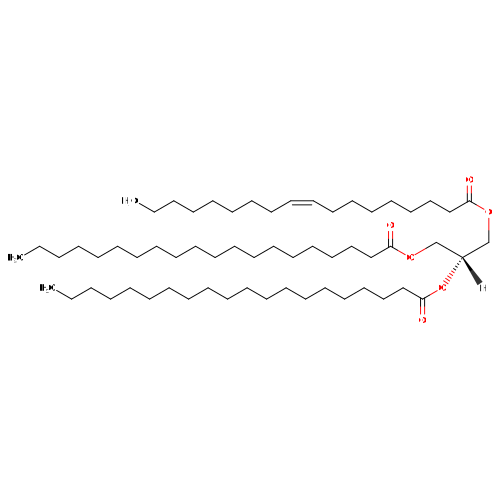
| Record Information |
|---|
| Version | 5.0 |
|---|
| Status | Expected but not Quantified |
|---|
| Creation Date | 2006-12-06 15:50:26 UTC |
|---|
| Update Date | 2022-11-30 19:02:47 UTC |
|---|
| HMDB ID | HMDB0005449 |
|---|
| Secondary Accession Numbers | |
|---|
| Metabolite Identification |
|---|
| Common Name | TG(18:1(9Z)/20:0/20:0) |
|---|
| Description | TG(18:1(9Z)/20:0/20:0)[iso3] is a diarachidic acid triglyceride. Triglycerides (TGs) are also known as triacylglycerols or triacylglycerides, meaning that they are glycerides in which the glycerol is esterified with three fatty acid groups (i.e. fatty acid tri-esters of glycerol). TGs may be divided into three general types with respect to their acyl substituents. They are simple or monoacid if they contain only one type of fatty acid, diacid if they contain two types of fatty acids and triacid if three different acyl groups. Chain lengths of the fatty acids in naturally occurring triglycerides can be of varying lengths and saturations but 16, 18 and 20 carbons are the most common. TG(18:1(9Z)/20:0/20:0)[iso3], in particular, consists of one chain of oleic acid at the C-1 position, one chain of arachidic acid at the C-2 position and one chain of arachidic acid at the C-3 position. TGs are the main constituent of vegetable oil and animal fats. TGs are major components of very low density lipoprotein (VLDL) and chylomicrons, play an important role in metabolism as energy sources and transporters of dietary fat. They contain more than twice the energy (9 kcal/g) of carbohydrates and proteins. In the intestine, triglycerides are split into glycerol and fatty acids (this process is called lipolysis) with the help of lipases and bile secretions, which can then move into blood vessels. The triglycerides are rebuilt in the blood from their fragments and become constituents of lipoproteins, which deliver the fatty acids to and from fat cells among other functions. Various tissues can release the free fatty acids and take them up as a source of energy. Fat cells can synthesize and store triglycerides. When the body requires fatty acids as an energy source, the hormone glucagon signals the breakdown of the triglycerides by hormone-sensitive lipase to release free fatty acids. As the brain cannot utilize fatty acids as an energy source, the glycerol component of triglycerides can be converted into glucose for brain fuel when it is broken down. (www.cyberlipid.org, www.wikipedia.org)TAGs can serve as fatty acid stores in all cells, but primarily in adipocytes of adipose tissue. The major building block for the synthesis of triacylglycerides, in non-adipose tissue, is glycerol. Adipocytes lack glycerol kinase and so must use another route to TAG synthesis. Specifically, dihydroxyacetone phosphate (DHAP), which is produced during glycolysis, is the precursor for TAG synthesis in adipose tissue. DHAP can also serve as a TAG precursor in non-adipose tissues, but does so to a much lesser extent than glycerol. The use of DHAP for the TAG backbone depends on whether the synthesis of the TAGs occurs in the mitochondria and ER or the ER and the peroxisomes. The ER/mitochondria pathway requires the action of glycerol-3-phosphate dehydrogenase to convert DHAP to glycerol-3-phosphate. Glycerol-3-phosphate acyltransferase then esterifies a fatty acid to glycerol-3-phosphate thereby generating lysophosphatidic acid. The ER/peroxisome reaction pathway uses the peroxisomal enzyme DHAP acyltransferase to acylate DHAP to acyl-DHAP which is then reduced by acyl-DHAP reductase. The fatty acids that are incorporated into TAGs are activated to acyl-CoAs through the action of acyl-CoA synthetases. Two molecules of acyl-CoA are esterified to glycerol-3-phosphate to yield 1,2-diacylglycerol phosphate (also known as phosphatidic acid). The phosphate is then removed by phosphatidic acid phosphatase (PAP1), to generate 1,2-diacylglycerol. This diacylglycerol serves as the substrate for addition of the third fatty acid to make TAG. Intestinal monoacylglycerols, derived from dietary fats, can also serve as substrates for the synthesis of 1,2-diacylglycerols. |
|---|
| Structure | [H][C@@](COC(=O)CCCCCCCCCCCCCCCCCCC)(COC(=O)CCCCCCC\C=C/CCCCCCCC)OC(=O)CCCCCCCCCCCCCCCCCCC InChI=1S/C61H116O6/c1-4-7-10-13-16-19-22-25-28-30-33-36-39-42-45-48-51-54-60(63)66-57-58(56-65-59(62)53-50-47-44-41-38-35-32-27-24-21-18-15-12-9-6-3)67-61(64)55-52-49-46-43-40-37-34-31-29-26-23-20-17-14-11-8-5-2/h27,32,58H,4-26,28-31,33-57H2,1-3H3/b32-27-/t58-/m0/s1 |
|---|
| Synonyms | | Value | Source |
|---|
| 1-Oleoyl-2-arachidonyl-3-arachidonyl-glycerol | HMDB | | TAG(18:1/20:0/20:0) | HMDB | | TAG(18:1n9/20:0/20:0) | HMDB | | TAG(18:1W9/20:0/20:0) | HMDB | | TAG(58:1) | HMDB | | TG(18:1/20:0/20:0) | HMDB | | TG(18:1n9/20:0/20:0) | HMDB | | TG(18:1W9/20:0/20:0) | HMDB | | TG(58:1) | HMDB | | Tracylglycerol(18:1/20:0/20:0) | HMDB | | Tracylglycerol(18:1n9/20:0/20:0) | HMDB | | Tracylglycerol(18:1W9/20:0/20:0) | HMDB | | Tracylglycerol(58:1) | HMDB | | Triacylglycerol | HMDB | | Triglyceride | HMDB | | 1-(9Z-Octadecenoyl)-2-eicosanoyl-3-eicosanoyl-glycerol | HMDB | | TG(18:1(9Z)/20:0/20:0) | Lipid Annotator |
|
|---|
| Chemical Formula | C61H116O6 |
|---|
| Average Molecular Weight | 945.593 |
|---|
| Monoisotopic Molecular Weight | 944.877191455 |
|---|
| IUPAC Name | (2R)-1-(icosanoyloxy)-3-[(9Z)-octadec-9-enoyloxy]propan-2-yl icosanoate |
|---|
| Traditional Name | (2R)-1-(icosanoyloxy)-3-[(9Z)-octadec-9-enoyloxy]propan-2-yl icosanoate |
|---|
| CAS Registry Number | Not Available |
|---|
| SMILES | [H][C@@](COC(=O)CCCCCCCCCCCCCCCCCCC)(COC(=O)CCCCCCC\C=C/CCCCCCCC)OC(=O)CCCCCCCCCCCCCCCCCCC |
|---|
| InChI Identifier | InChI=1S/C61H116O6/c1-4-7-10-13-16-19-22-25-28-30-33-36-39-42-45-48-51-54-60(63)66-57-58(56-65-59(62)53-50-47-44-41-38-35-32-27-24-21-18-15-12-9-6-3)67-61(64)55-52-49-46-43-40-37-34-31-29-26-23-20-17-14-11-8-5-2/h27,32,58H,4-26,28-31,33-57H2,1-3H3/b32-27-/t58-/m0/s1 |
|---|
| InChI Key | OWZMHFAFGQCCNI-KUHKQYGISA-N |
|---|
| Chemical Taxonomy |
|---|
| Description | Belongs to the class of organic compounds known as triacylglycerols. These are glycerides consisting of three fatty acid chains covalently bonded to a glycerol molecule through ester linkages. |
|---|
| Kingdom | Organic compounds |
|---|
| Super Class | Lipids and lipid-like molecules |
|---|
| Class | Glycerolipids |
|---|
| Sub Class | Triradylcglycerols |
|---|
| Direct Parent | Triacylglycerols |
|---|
| Alternative Parents | |
|---|
| Substituents | - Triacyl-sn-glycerol
- Tricarboxylic acid or derivatives
- Fatty acid ester
- Fatty acyl
- Carboxylic acid ester
- Carboxylic acid derivative
- Organic oxygen compound
- Organic oxide
- Hydrocarbon derivative
- Organooxygen compound
- Carbonyl group
- Aliphatic acyclic compound
|
|---|
| Molecular Framework | Aliphatic acyclic compounds |
|---|
| External Descriptors | Not Available |
|---|
| Ontology |
|---|
| Physiological effect | |
|---|
| Disposition | |
|---|
| Process | |
|---|
| Role | |
|---|
| Physical Properties |
|---|
| State | Solid |
|---|
| Experimental Molecular Properties | | Property | Value | Reference |
|---|
| Melting Point | Not Available | Not Available | | Boiling Point | Not Available | Not Available | | Water Solubility | Not Available | Not Available | | LogP | Not Available | Not Available |
|
|---|
| Experimental Chromatographic Properties | Not Available |
|---|
| Predicted Molecular Properties | |
|---|
| Predicted Chromatographic Properties | Predicted Collision Cross SectionsPredicted Kovats Retention IndicesNot Available |
|---|
| MS/MS Spectra| Spectrum Type | Description | Splash Key | Deposition Date | Source | View |
|---|
| Predicted LC-MS/MS | Predicted LC-MS/MS Spectrum - TG(18:1(9Z)/20:0/20:0) 10V, Positive-QTOF | splash10-03di-0000000009-a3e87985adeffd61b732 | 2017-10-04 | Wishart Lab | View Spectrum | | Predicted LC-MS/MS | Predicted LC-MS/MS Spectrum - TG(18:1(9Z)/20:0/20:0) 20V, Positive-QTOF | splash10-03di-0000000009-a3e87985adeffd61b732 | 2017-10-04 | Wishart Lab | View Spectrum | | Predicted LC-MS/MS | Predicted LC-MS/MS Spectrum - TG(18:1(9Z)/20:0/20:0) 40V, Positive-QTOF | splash10-03ea-0000009003-f503a11184547238180e | 2017-10-04 | Wishart Lab | View Spectrum | | Predicted LC-MS/MS | Predicted LC-MS/MS Spectrum - TG(18:1(9Z)/20:0/20:0) 10V, Negative-QTOF | splash10-03ec-0093002001-45d77b360648167ca9a4 | 2017-10-06 | Wishart Lab | View Spectrum | | Predicted LC-MS/MS | Predicted LC-MS/MS Spectrum - TG(18:1(9Z)/20:0/20:0) 20V, Negative-QTOF | splash10-03e9-0095001000-c1cc61b80a1dc2171809 | 2017-10-06 | Wishart Lab | View Spectrum | | Predicted LC-MS/MS | Predicted LC-MS/MS Spectrum - TG(18:1(9Z)/20:0/20:0) 40V, Negative-QTOF | splash10-03e9-2094000000-44b3e34a11112cbf66bd | 2017-10-06 | Wishart Lab | View Spectrum | | Predicted LC-MS/MS | Predicted LC-MS/MS Spectrum - TG(18:1(9Z)/20:0/20:0) 10V, Positive-QTOF | splash10-0udi-0000000009-6a2fcc5ce5cc77bc73f0 | 2021-09-21 | Wishart Lab | View Spectrum | | Predicted LC-MS/MS | Predicted LC-MS/MS Spectrum - TG(18:1(9Z)/20:0/20:0) 20V, Positive-QTOF | splash10-0udi-0000000009-6a2fcc5ce5cc77bc73f0 | 2021-09-21 | Wishart Lab | View Spectrum | | Predicted LC-MS/MS | Predicted LC-MS/MS Spectrum - TG(18:1(9Z)/20:0/20:0) 40V, Positive-QTOF | splash10-0f79-0090009009-f0523d50a90a3643e91b | 2021-09-21 | Wishart Lab | View Spectrum | | Predicted LC-MS/MS | Predicted LC-MS/MS Spectrum - TG(18:1(9Z)/20:0/20:0) 10V, Positive-QTOF | splash10-03di-0000000009-e1fa4fc1e83a81f2ea1f | 2021-09-23 | Wishart Lab | View Spectrum | | Predicted LC-MS/MS | Predicted LC-MS/MS Spectrum - TG(18:1(9Z)/20:0/20:0) 20V, Positive-QTOF | splash10-03di-0000000009-e1fa4fc1e83a81f2ea1f | 2021-09-23 | Wishart Lab | View Spectrum | | Predicted LC-MS/MS | Predicted LC-MS/MS Spectrum - TG(18:1(9Z)/20:0/20:0) 40V, Positive-QTOF | splash10-03ea-0010009003-2201e33a78f6b3aee3ae | 2021-09-23 | Wishart Lab | View Spectrum | | Predicted LC-MS/MS | Predicted LC-MS/MS Spectrum - TG(18:1(9Z)/20:0/20:0) 10V, Positive-QTOF | splash10-0002-4221006019-8486d27db822512bff37 | 2021-09-23 | Wishart Lab | View Spectrum | | Predicted LC-MS/MS | Predicted LC-MS/MS Spectrum - TG(18:1(9Z)/20:0/20:0) 20V, Positive-QTOF | splash10-059t-9342004132-7c6aef7481e78cd107a5 | 2021-09-23 | Wishart Lab | View Spectrum | | Predicted LC-MS/MS | Predicted LC-MS/MS Spectrum - TG(18:1(9Z)/20:0/20:0) 40V, Positive-QTOF | splash10-006t-4698003100-66a85daebc485b2e4544 | 2021-09-23 | Wishart Lab | View Spectrum | | Predicted LC-MS/MS | Predicted LC-MS/MS Spectrum - TG(18:1(9Z)/20:0/20:0) 10V, Negative-QTOF | splash10-000x-0036008009-b7898cb3a454199d8183 | 2021-09-24 | Wishart Lab | View Spectrum | | Predicted LC-MS/MS | Predicted LC-MS/MS Spectrum - TG(18:1(9Z)/20:0/20:0) 20V, Negative-QTOF | splash10-000i-0009001000-9392233df77568eac4c6 | 2021-09-24 | Wishart Lab | View Spectrum | | Predicted LC-MS/MS | Predicted LC-MS/MS Spectrum - TG(18:1(9Z)/20:0/20:0) 40V, Negative-QTOF | splash10-0bu9-1029001000-f5fb777add5b15c1aad4 | 2021-09-24 | Wishart Lab | View Spectrum | | Predicted LC-MS/MS | Predicted LC-MS/MS Spectrum - TG(18:1(9Z)/20:0/20:0) 10V, Positive-QTOF | splash10-014i-0000000009-a138ecb44ad6e64bce4b | 2021-09-25 | Wishart Lab | View Spectrum | | Predicted LC-MS/MS | Predicted LC-MS/MS Spectrum - TG(18:1(9Z)/20:0/20:0) 20V, Positive-QTOF | splash10-014i-0000000009-a138ecb44ad6e64bce4b | 2021-09-25 | Wishart Lab | View Spectrum | | Predicted LC-MS/MS | Predicted LC-MS/MS Spectrum - TG(18:1(9Z)/20:0/20:0) 40V, Positive-QTOF | splash10-014i-0000000009-a138ecb44ad6e64bce4b | 2021-09-25 | Wishart Lab | View Spectrum |
|
|---|